
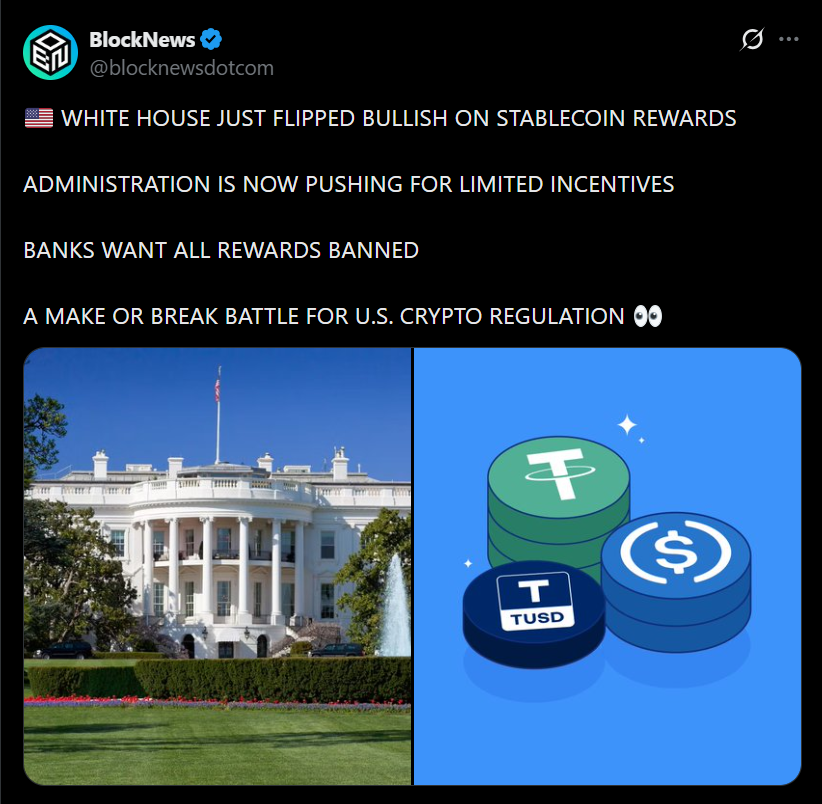
- Stablecoin yield on idle balances appears effectively off the table
- Debate now centers on activity-based rewards instead of passive yield
- A compromise could unlock broader crypto market structure legislation
The White House says it is closing in on resolving one of the biggest sticking points in U.S. crypto market structure legislation: whether crypto firms can offer rewards tied to stablecoins. Speaking at ETHDenver, White House Crypto Council Executive Director Patrick Witt said the gap between banks and crypto firms has “shrunk considerably” following a recent closed-door meeting.
The central tension has been clear for months. Banks argue that allowing yield on stablecoins could drain deposits from traditional institutions, creating financial stability risk. Crypto companies counter that restricting rewards too aggressively would crush innovation and hand incumbents an unfair advantage.
Idle Yield Is Likely Dead
One major shift emerged from the discussions: yield on idle stablecoin balances is now effectively off the table. That had long been a core objective for segments of the crypto industry. Instead, negotiations are focusing on whether firms can offer rewards tied to specific activities, such as transactions, network participation, or ecosystem engagement.
Draft legislative language reportedly includes narrowly scoped limits. A banking source indicated proposed anti-evasion provisions could empower the SEC, Treasury, and CFTC to enforce a ban on passive yield, with civil penalties of up to $500,000 per violation per day.
The White House Took a Direct Role
Unlike prior sessions, the administration brought draft language directly to the meeting. Participants, including representatives from Coinbase, Ripple, Andreessen Horowitz, the Blockchain Association, and major banking trade groups, reportedly reviewed the text line by line. Phones were collected at the door, underscoring the seriousness of the negotiations.
Witt indicated the administration aims to resolve the dispute by March 1. If an agreement is reached, the Senate Banking Committee could quickly reschedule its delayed markup session. According to Witt, resolving this issue could trigger a broader legislative domino effect.
Why This Matters for Crypto Markets
Stablecoin rules are foundational to crypto market structure. They influence exchange liquidity, DeFi participation, cross-border payments, and institutional adoption. Clarifying whether and how rewards can be offered removes a major uncertainty hanging over U.S.-based firms.
If idle yield is formally banned but activity-based incentives remain permissible, companies may adapt their models rather than abandon them. The outcome would likely reduce systemic risk concerns while preserving competitive innovation pathways.
The Bigger Picture
The stablecoin rewards debate has overshadowed other aspects of the market structure bill. Ethics concerns related to President Trump’s family crypto involvement remain in the background, but Witt suggested they are not currently the primary obstacle.
If compromise language is finalized, crypto regulation could accelerate significantly. Stablecoins are the plumbing of digital markets. Once their rules are settled, the broader framework may move quickly.