

- Twelve wallets reportedly made over $1 million before the exposé went public
- One trader turned low-cost shares into roughly $411,000 in profit
- The episode raises questions about information timing in crypto markets
Here’s the part that makes the crypto crowd pause for a second. On Polymarket, a decentralized prediction platform where users wager on real-world outcomes, a cluster of wallets placed bets tied to ZachXBT’s insider trading investigation before the findings became public. According to on-chain data, twelve wallets collectively turned roughly $400,000 into more than $1.4 million once the outcome resolved.
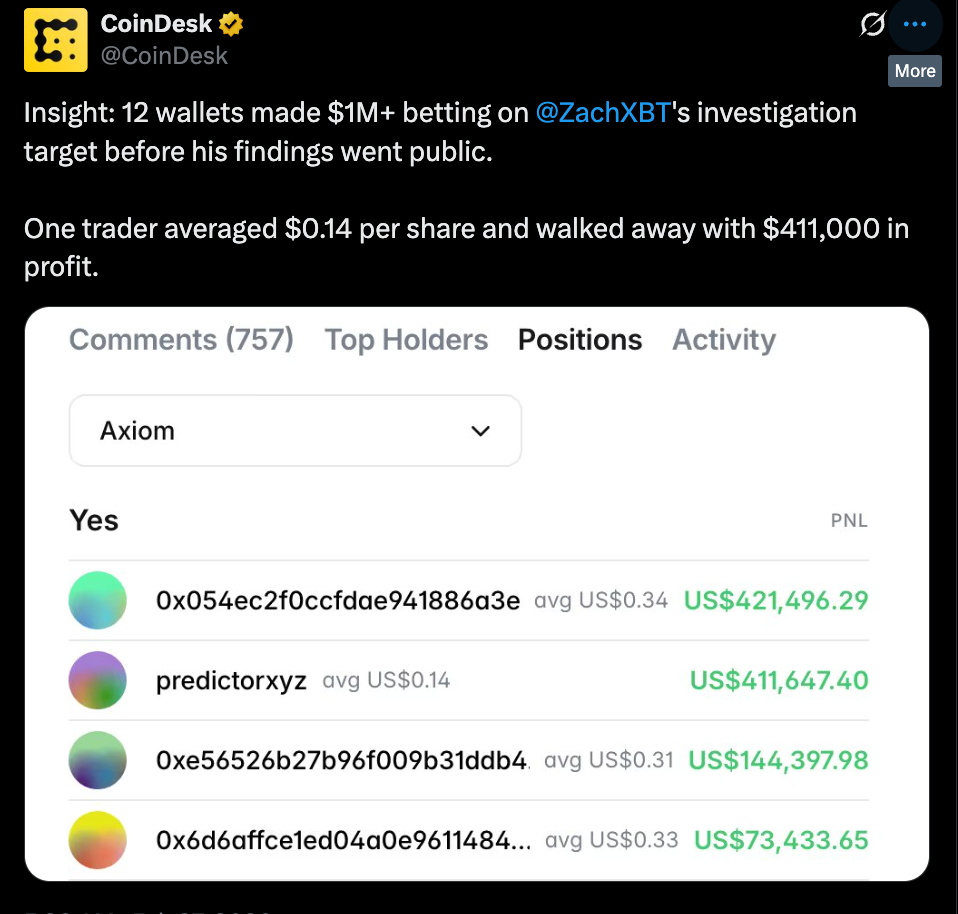
That’s not just a good trade, it’s surgical timing. The market allowed users to speculate on which company the on-chain investigator would name in his exposé. When the results hit, those early positions paid out handsomely, and almost instantly.
One Trader’s $411K Crypto Windfall
Among the addresses, one trader stood out. By accumulating shares at an average cost of around $0.14, this wallet positioned early and aggressively. When the prediction resolved, the trader reportedly walked away with approximately $411,000 in profit.
Returns like that don’t go unnoticed. Even in crypto, where volatility is normal and triple-digit gains aren’t rare, the precision of the entry sparked curiosity. Was it deep research, sharp probability modeling, or something else entirely? That’s the question floating around.
Information Timing in “Open” Crypto Systems
Prediction markets are designed to aggregate crowd expectations. In theory, they reflect distributed intelligence, not concentrated foresight. But when a small group of wallets captures outsized gains just before a major public disclosure, the optics shift.
Blockchain transparency shows the trades clearly, but it doesn’t reveal the reasoning behind them. Speculation has swirled around possible early awareness of investigative findings, though nothing has been proven and the addresses remain pseudonymous. Still, the timing has fueled debate about how symmetric information really is in public crypto systems.

A Crypto Case Study in Transparency and Trust
This episode highlights both the power and the peculiarities of decentralized markets. On one hand, everything is visible on-chain. Anyone can trace the trades, the entries, the payouts. There are no hidden ledgers.
On the other hand, transparency does not automatically guarantee fairness in timing. When knowledge, rumor, and capital intersect, profits can cluster in ways that feel uneven. Whether this becomes a cautionary tale about prediction markets or just another sharp crypto trade will depend on what, if anything, surfaces next.