- Trump says making the US the crypto capital is key to beating China.
- Crypto legislation delivered both political support and strategic leverage.
- Stablecoins were the first step, with market structure rules up next.
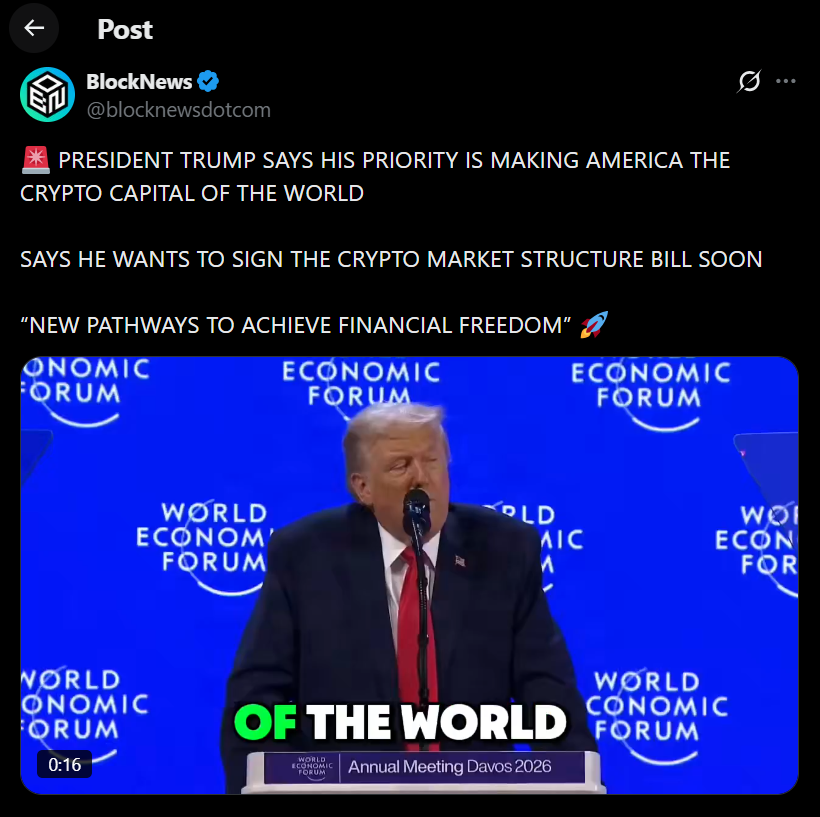
President Donald Trump used the World Economic Forum in Davos to double down on his crypto stance, telling global leaders that the United States should cement itself as the crypto capital of the world. In a wide-ranging speech, Trump framed digital asset legislation not just as an economic priority, but as a geopolitical one. In his view, the race isn’t abstract. It’s the US versus China, and crypto is part of the battleground.
Why Crypto Became a Political Priority
Trump was unusually candid about why crypto policy rose to the top of his agenda. He said supporting digital asset legislation delivered significant political backing, and that support mattered. Crypto-focused political action committees poured hundreds of millions of dollars into the 2024 election cycle and are already positioning for the 2026 midterms. For Trump, backing crypto wasn’t just policy, it was political alignment with a fast-growing voter and donor base.
Stablecoins Were the First Step
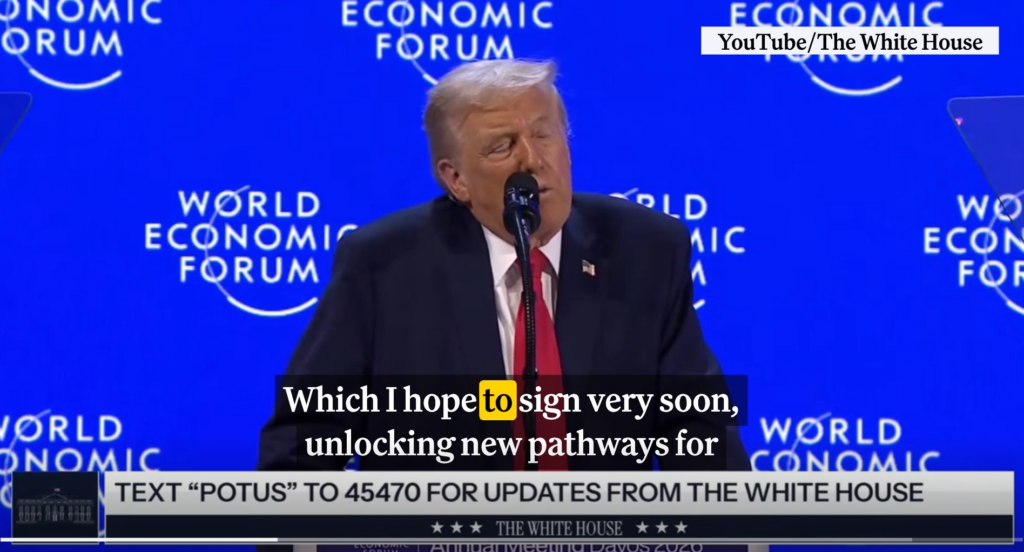
Trump pointed to the GENIUS Act, passed last year, as a foundational move aimed at regulating stablecoins and giving the industry clearer footing. He described it as a landmark step, one that set the stage for broader market structure legislation now working its way through Congress. Trump said he hopes to sign those rules very soon, signaling urgency rather than long-term deliberation.
China Is the Real Motivation
Beyond domestic politics, Trump repeatedly emphasized competition with China. He warned that Beijing wants control over crypto markets just as it has pushed aggressively into artificial intelligence and other strategic technologies. Allowing China to lead in digital assets, he argued, would be a strategic failure. Keeping crypto innovation anchored in the US is, in his framing, about national leverage as much as financial innovation.
What Happens Next
Congress is still divided on the path forward. Separate Senate committees are drafting and revising market structure legislation, with one expected to release updated language imminently while another continues internal negotiations. The process is messy, but the direction is clear. Crypto is no longer being debated as a fringe experiment. It’s being treated as infrastructure with geopolitical weight.