

- Tom Lee has moderated his Bitcoin outlook, boosting investor interest in altcoins with stronger fundamentals.
- Projects like DeepSnitch AI are gaining traction by offering utility and AI-driven tools rather than hype.
- Regulation, volatility, and shifting market behavior mean investors must diversify and adapt their strategies.
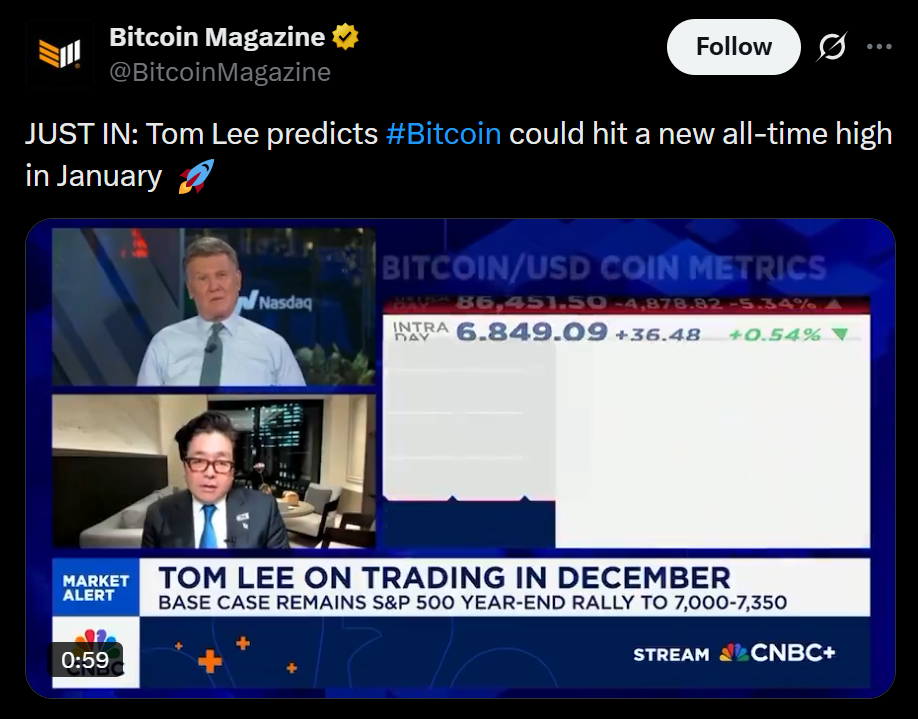
Bitcoin hovering around that slippery $100,000 mark has shifted the conversation in a big way. Tom Lee, long known for ultra-bullish BTC calls, is now walking back his earlier forecasts — and that subtle change in tone has investors scanning the market for alternatives with more bite. As Bitcoin loses some of its heat, attention is falling onto altcoins that offer actual utility rather than just noise, and the market mood is shifting into a more selective, fundamentals-driven hunt.

Tom Lee’s Softer Bitcoin Outlook Signals a Broader Market Shift
Lee once predicted Bitcoin would smash through $250,000 by year-end, but now he’s suggesting it “very likely” just stays above $100,000. That’s still bullish, but nowhere near the rocket-fuel optimism he’s known for. This cooling outlook usually trickles through the rest of the market — when Bitcoin slows down, altcoins often get caught in the downdraft. But this cycle feels slightly different. With uncertainty swirling around BTC’s next big move, investors are scouting for platforms and tokens anchored in real use cases rather than hype alone.
Altcoins Step Forward as Investors Look Beyond Bitcoin
A handful of projects are starting to stand out as the market rotates. DeepSnitch AI, Cronos, and Solana have risen as contenders, each offering something beyond speculation. DeepSnitch AI has especially picked up speed, raising more than $600,000 in its presale and climbing 64% in price. Built around AI tools that deliver trading signals, whale tracking, and contract-risk detection, DeepSnitch is designed to function even in choppy markets. It’s targeting a January 2026 launch and positioning itself as a utility-first altcoin with serious upside potential — maybe even the kind of early-stage momentum that turns into a 100x story if conditions align.
Regulatory Friction Creates Challenges, Especially in Europe
Still, the regulatory landscape casts a long shadow. Compliance is becoming a heavier lift, particularly in the EU under MiCA rules. Smaller firms are struggling with the cost of meeting strict operational and legal demands, which slows down innovation and squeezes the survival rate of new altcoin projects. It’s a double-edged sword — regulation brings structure, but it also blocks smaller players from getting a fair shot.
Strategies for Navigating a Volatile Market
Given Bitcoin’s unpredictable path, investors are leaning into more diversified approaches. Allocating around 20–30% of a portfolio to altcoins with strong fundamentals — while keeping Bitcoin as the backbone — is becoming a common strategy. Meanwhile, crypto payrolls and stablecoin-based salaries are gaining steam, reshaping how companies think about compensation in an increasingly digital economy. These shifts hint at a broader transition toward tools and tokens that serve real business needs, not just speculative waves.
A Future Leaning More Toward Utility
With Bitcoin’s momentum uncertain and Tom Lee’s tone noticeably softened, it’s clear that altcoins are entering a new phase of relevance. DeepSnitch AI and other utility-driven projects show how the market is adapting, seeking real-world function instead of empty promises. Investors who stay flexible — and open to regulatory, structural, and economic changes — may find that the next wave of opportunity is already forming in the altcoin space.