
- White House report says banning yields boosts lending just 0.02%
- Data weakens banks’ main argument against stablecoin rewards
- Could shift momentum around the stalled CLARITY Act
For months, banks have been arguing that stablecoin yields pose a real threat to the financial system. The logic was simple enough, if crypto firms offer returns on digital dollars, deposits leave banks, and lending suffers. It sounded convincing. Until someone actually ran the numbers.
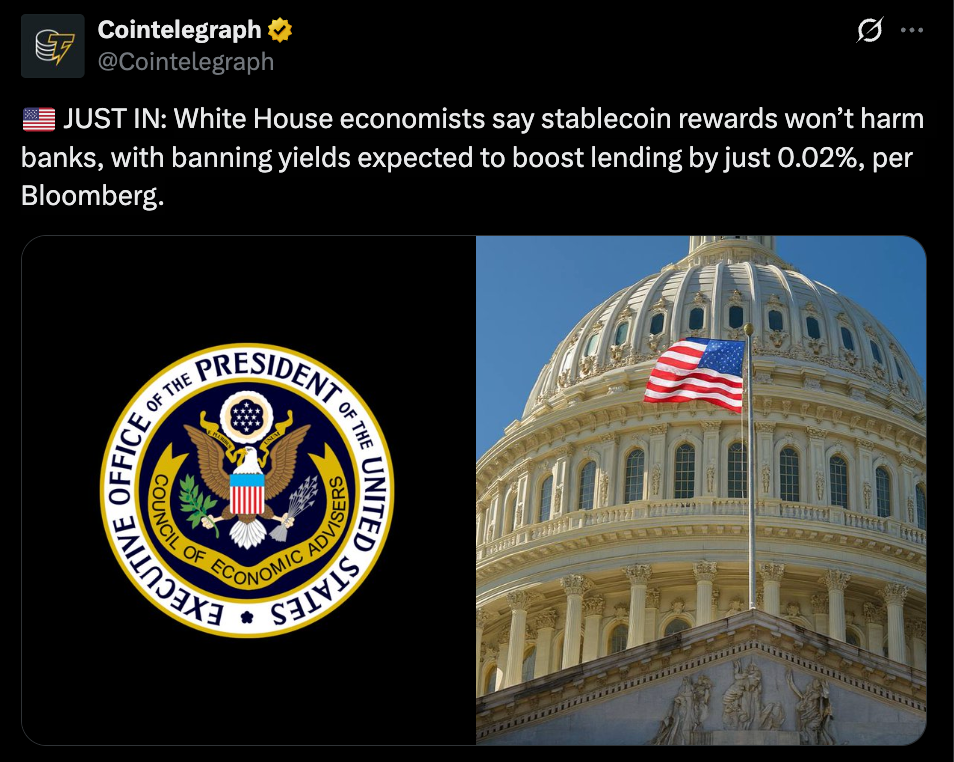
Now the White House’s own economists have stepped in, and the conclusion is… underwhelming for the banking side. According to the Council of Economic Advisers, banning stablecoin yields would increase bank lending by just 0.02%. That’s about $2.1 billion, which in banking terms, isn’t exactly system-shaking.
The Numbers Don’t Support the Narrative
The report goes further than just the headline figure. It estimates that eliminating yields would actually come with a net welfare loss of around $800 million. In other words, the cost of restricting stablecoins could outweigh the benefit to banks.
That’s a tough tradeoff to defend. Especially when the supposed upside barely moves the needle in the broader lending market.
Big Banks Benefit, Smaller Ones… Not Really
Another detail that stands out is who actually gains from this scenario. Roughly 76% of the additional lending would come from large banks. Community banks, often cited as the ones needing protection, would only see a marginal increase.
That weakens a key talking point. The argument that yield bans help smaller institutions doesn’t really hold up when the data shows minimal impact.
Even Worst-Case Models Fall Short
The report also explored more extreme scenarios, stacking assumptions to see how much lending could increase under pressure. Even then, the results were limited.
To get a meaningful jump, the model had to assume a much larger stablecoin market, restrictive reserve structures, and even changes to how the Federal Reserve operates. At that point, it starts to feel less like forecasting and more like… stretching the scenario a bit.
This Could Shift the CLARITY Act Debate
This matters because the yield debate has been one of the main reasons the CLARITY Act has stalled. Banks pushed for strict limits on stablecoin rewards, arguing it was necessary to protect lending and financial stability.
Now, with this report on the table, that argument looks weaker. Lawmakers suddenly have data suggesting the impact is minimal, while the cost to consumers could be real.
The Negotiation Just Changed
Banks will likely challenge the assumptions, that part is expected. But the broader dynamic has shifted. When the White House’s own economists question the core argument, it changes how the conversation unfolds.
This doesn’t guarantee anything passes quickly. But it does make it harder to justify broad restrictions without stronger evidence.
A Small Number With Big Implications
At face value, 0.02% doesn’t sound like much, and that’s kind of the point. The debate around stablecoin yields has been framed as a major systemic issue.
The data suggests otherwise. And when policy decisions hinge on numbers like that, even small percentages can carry a lot of weight.