

- SEC’s “Reg Crypto” framework awaits final White House approval
- Rules clarify token classifications, fundraising, and exemptions
- Marks a major shift from enforcement to structured regulation
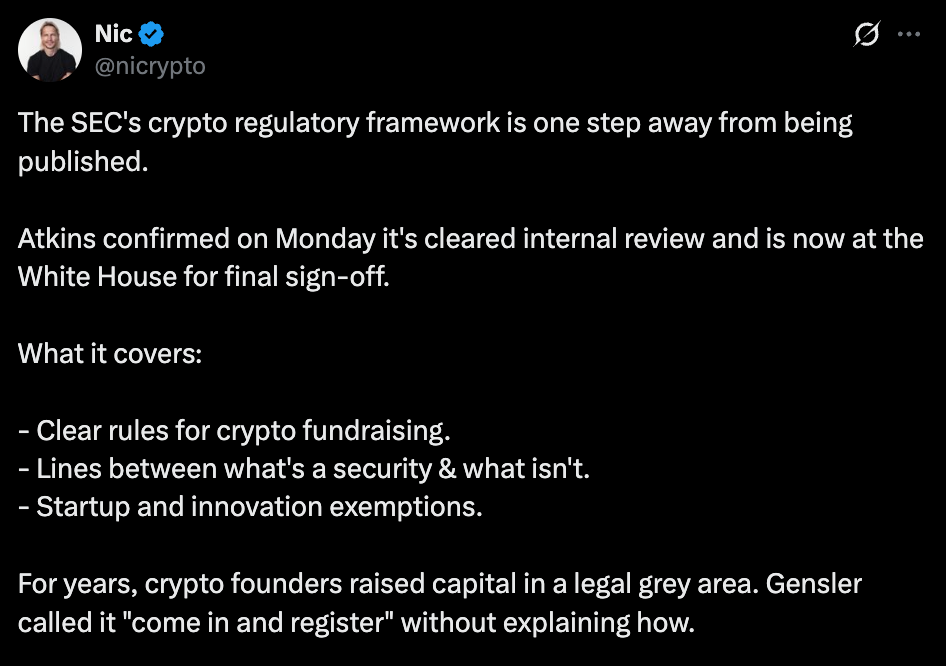
For years, crypto in the U.S. operated in a kind of legal fog. Founders built anyway, lawyers stayed busy, and the SEC mostly responded after the fact. Now, that might finally be changing. SEC Chair Atkins confirmed that the long-awaited “Reg Crypto” framework has cleared internal review and is sitting at the White House for final sign-off.
That alone is a big shift. Instead of enforcement-first ambiguity, the industry may finally get something closer to actual rules. Not perfect clarity, maybe, but at least something you can point to.
From Enforcement to Actual Rulemaking
Under the previous approach, regulation often felt reactive. Projects were told to “come in and register,” but without clear definitions, that guidance didn’t go very far. Many teams either stayed in limbo or moved operations offshore just to avoid the uncertainty.
This new framework aims to change that. It focuses on the Securities Act of 1933, outlining how crypto fundraising works, what qualifies as a security, and where exemptions might apply. In other words, it tries to define the playing field instead of enforcing it after the fact.
A Framework for Startups and Token Issuers
One of the more important pieces here is how early-stage projects are treated. The rules are expected to include clearer exemptions for startups, along with a possible “innovation exemption” that acts like a regulatory sandbox.
That could give builders room to experiment without immediately falling into compliance traps. It doesn’t remove regulation, but it makes the path forward a bit more navigable, which has been missing for a long time.

Not Everyone Is On Board
Of course, not all reactions are positive. Some traditional financial players, like Citadel Securities, are pushing for a more formal process, arguing that broad exemptions could weaken investor protections.
On the other side, crypto advocacy groups point out that the SEC has used exemptions before and has the authority to do so here as well. It’s the usual tension, innovation versus oversight, just playing out in a more structured way this time.
Clarity, But Not Permanence
Even if this framework is approved, it’s not necessarily permanent. Regulations can change with administrations, and Atkins himself acknowledged that legislation would carry more weight than agency rules.
Still, this would mark the first real attempt at defining crypto within a consistent regulatory structure in the U.S. And after years of uncertainty, that alone could reshape how companies operate.
Crypto Finally Gets a Rulebook, For Now
The rules are essentially written. What’s left is the final approval. If it goes through, the industry moves from guessing to operating within a clearer, if still evolving, system.
It won’t solve everything overnight. But it does signal something important, the conversation is shifting from “is this allowed?” to “how do we build within the rules?” And that’s a very different place to be.