

- Strive adds 317 BTC, bringing total holdings to over 13,600 Bitcoin
- Firm now ranks among top corporate Bitcoin holders ahead of Tesla
- Structured finance model aims to generate yield from BTC exposure
Strive is quickly positioning itself as one of the largest corporate players in Bitcoin, adding another 317 BTC to bring its total holdings to around 13,628 coins. That move pushes the company into the top 10 corporate Bitcoin holders globally, now sitting ahead of names like Tesla and CleanSpark. It’s not entirely new territory for Strive, but the speed at which it climbed the ranks is… kind of hard to ignore.

What stands out more is how fast this accumulation happened. In just about six months since going public, the Bitcoin-focused treasury firm has built a massive position, signaling a very deliberate strategy rather than opportunistic buying. This isn’t passive exposure, it’s aggressive positioning around Bitcoin as a core balance sheet asset.
How Strive Built Its Massive Bitcoin Position
The company’s Bitcoin accumulation came from multiple channels, not just open market purchases. Around 5,900 BTC came through initial private placement proceeds and a stock exchange transaction. Another 5,048 BTC were added through the acquisition of Semler Scientific, which already held a sizable Bitcoin reserve.
On top of that, roughly 2,694 BTC were secured through capital markets activity, including preferred stock-linked offerings. It’s a layered approach, combining traditional finance tools with crypto exposure, which, honestly, is becoming more common but still feels a bit experimental at this scale.
The SATA Instrument and Yield Strategy
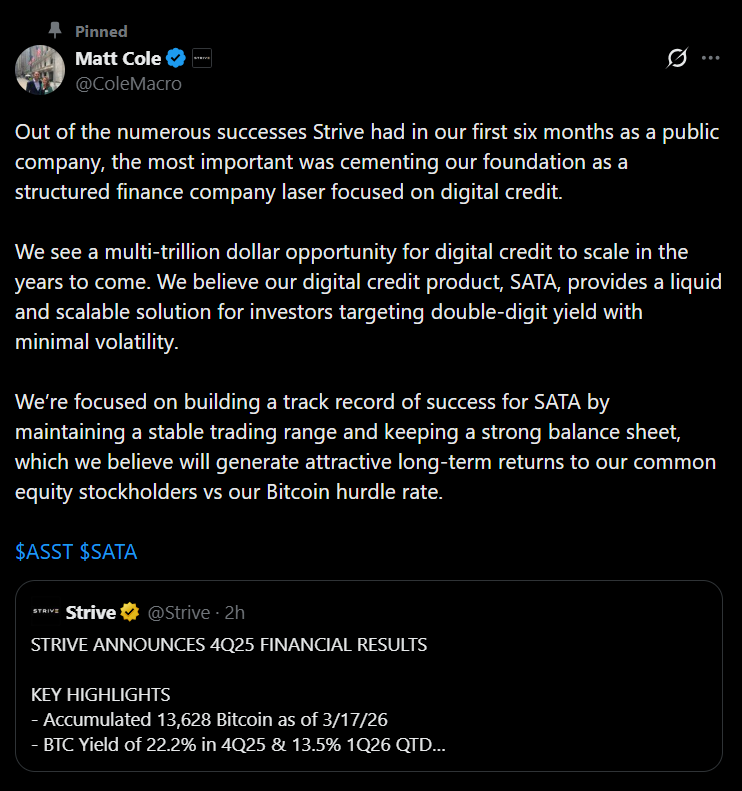
CEO Matt Cole pointed to Strive’s structured finance model as a key differentiator. At the center of that model is SATA, a variable-rate perpetual preferred stock product designed to generate double-digit yields with reduced volatility. It trades on Nasdaq under its own ticker, giving investors a more familiar entry point into what is still, fundamentally, a Bitcoin-driven strategy.
The company raised about $148 million from its initial SATA offering in late 2025, followed by another $109 million in early 2026. These capital raises helped fund Bitcoin accumulation while also creating a yield layer on top of what is typically considered a non-yielding asset. That shift, turning BTC into something closer to a structured financial product, is where things start to get interesting.
Losses Driven by Accounting, Not Strategy
On paper, Strive reported a net loss of $393.6 million following its public listing. But most of that figure comes from non-cash items rather than operational weakness. Around $194.5 million was tied to unrealized Bitcoin losses as prices dropped from roughly $126,000 to near $72,000.
Additional losses came from goodwill impairments linked to the Semler acquisition and transaction-related costs. When adjusted for these factors, the loss narrows significantly, though it still reflects the volatility tied to holding Bitcoin at scale. It’s a reminder that accounting optics and long-term strategy don’t always align cleanly, especially in crypto.
Bitcoin Yield Becomes the Core Metric
Rather than focusing purely on traditional earnings, Strive is pushing a different metric, Bitcoin Yield. This measures the change in Bitcoin per share over time, essentially tracking how effectively the company is increasing BTC exposure for shareholders. By that metric, Strive reported a 22.2% yield in Q4 and 13.8% so far in early 2026.
That translated into a “Bitcoin Gain” of over 1,300 BTC in Q4 alone, with another 1,050 coins added this year. It’s a different way of thinking about performance, less about fiat profits and more about accumulating Bitcoin itself. Whether markets fully buy into that framework is still an open question.
A Shift Toward Bitcoin as a Financial Strategy
Strive’s evolution from an anti-ESG investment firm into a Bitcoin accumulation vehicle reflects a broader trend. More companies are starting to treat Bitcoin not just as a speculative asset, but as a strategic reserve that can be enhanced through financial engineering.
The bet is clear. If Bitcoin continues attracting institutional capital, firms like Strive could benefit both from price appreciation and from the structured products built around it. It’s a high-conviction strategy, and maybe a risky one too, but it shows how quickly the role of Bitcoin in corporate finance is changing.