

- Strategy completed its 100th Bitcoin purchase with 592 BTC added
- Unrealized losses are secondary to its multi-decade accumulation thesis
- The company continues to treat Bitcoin as a strategic reserve asset
When Strategy added another 592 Bitcoin last week, marking its 100th purchase announcement, the usual criticism resurfaced. Commentators focused on average cost, short-term drawdowns, and unrealized losses. But that reaction misunderstands the strategy itself.
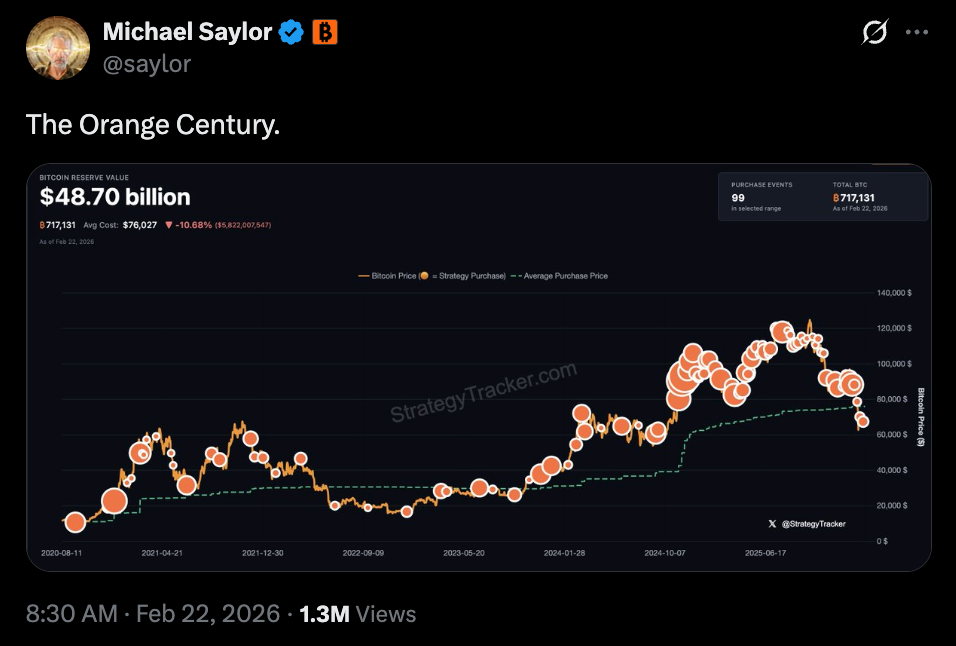
This is not a timing exercise. Strategy is not attempting to call local bottoms or outmaneuver quarterly volatility. The objective is consistency. A hundred purchase disclosures later, the thesis remains unchanged: accumulate Bitcoin steadily, regardless of short-term market conditions.
Paper Losses Don’t Define the Strategy
Yes, the company’s average acquisition cost currently sits above spot price. That translates into unrealized losses on paper. But unrealized losses only matter if the asset is viewed as a trading instrument rather than a long-term treasury reserve.
Strategy’s framework treats Bitcoin as a durable monetary asset. From that perspective, volatility is expected, not alarming. Accounting optics fluctuate. The balance sheet exposure remains intentional.
Michael Saylor’s Corporate Shift
Under Michael Saylor’s leadership, Strategy has evolved beyond its legacy identity as a software firm. It now functions effectively as a public Bitcoin accumulator, using equity markets as its capital engine. That shift makes traditional valuation models uncomfortable.

Equity analysts struggle to categorize a company whose primary growth engine is digital asset accumulation rather than operating income expansion. The market prefers clean classifications. Strategy intentionally operates outside of them.
This Is a Long-Duration Bet
A hundred purchases reflect institutional persistence. Strategy has continued buying through rallies, pullbacks, liquidity crunches, and macro turbulence. The pattern signals a multi-decade horizon rather than opportunistic speculation.
Critics often focus on entry price. Strategy focuses on position size and time. The company is betting that scarcity, adoption, and monetary dynamics will reward sustained exposure over extended periods.
The Bigger Question
The 100th purchase is less about bravado and more about structural clarity. Strategy has aligned its corporate identity with Bitcoin’s long-term thesis. It is not reacting to headlines. It is executing a fixed playbook.
Whether markets agree today is secondary. The more relevant question is how many public companies are willing to commit capital this consistently and this visibly over time.