

- Stellar completed the first fully on-chain UBI distribution, highlighting real-world blockchain utility beyond speculation
- Analysts believe XLM may be nearing the end of a multi-year correction that began in 2018
- Price is approaching a critical support zone that could determine Stellar’s next long-term trend
Stellar has quietly crossed a line that many blockchains talk about but rarely reach. For the first time, Universal Basic Income has been distributed fully on-chain, with funds sent directly through the Stellar network. No banks in the middle, no paperwork delays, just transparent transfers that land where they’re meant to. It’s a small headline on the surface, but a big shift in how crypto can actually show up in real life.
This move pushes Stellar beyond speculation and price charts, into something more concrete. By removing traditional financial bottlenecks, the network shows how blockchain can support communities, not just traders. For many observers, this UBI rollout feels like a blueprint, proof that crypto can solve social problems without overcomplicating the process.
Stellar’s real-world use case starts to matter
What stands out is how clean the execution was. Funds were distributed directly on-chain, making the process auditable, fast, and hard to manipulate. That level of transparency is exactly where blockchain is supposed to shine, yet it’s still surprisingly rare in practice.
Projects like this are why some analysts see Stellar as quietly underrated. It doesn’t chase hype cycles, but it keeps building infrastructure that works under real conditions. That approach is starting to matter more as markets mature and utility begins to outweigh speculation.
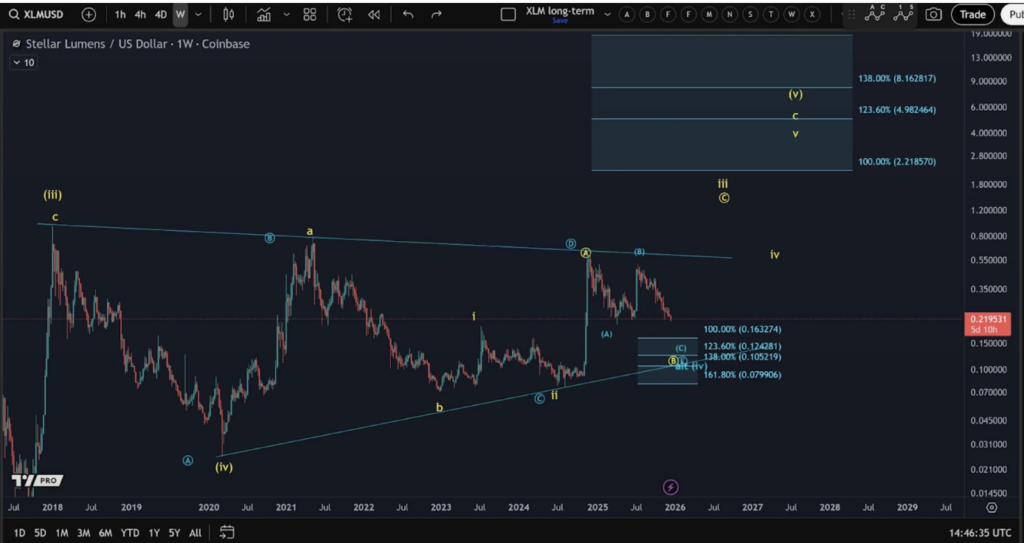
XLM may be nearing the end of a long correction
Alongside the adoption news, technical analysts are zooming out on Stellar’s price structure. Data from More Crypto Online suggests XLM could be approaching the end of a multi-year corrective phase that began back in 2018. That’s a long time for price to move sideways and frustrate holders, but those phases often matter most right before conditions change.
One scenario maps the entire post-2018 structure as a large corrective triangle, labeled A-B-C-D-E. In that view, the final E wave is still unfolding, with support zones sitting around $0.079 and $0.163. If that area holds, it could act as the base for a larger upside move into a new impulsive phase.
Two paths, one critical decision zone
There’s also an alternative count on the table. In that version, Wave 4 already completed back in 2020, and the recent pullbacks are part of a smaller A-B-C correction within a broader uptrend. The current C wave appears diagonal, forming while the market works through a deeper B-wave retracement.
Both interpretations point to the same thing: price is approaching a critical support region. The lower boundary of the triangular structure adds extra weight to that zone, making it a level where the market has to choose a direction. How XLM behaves here will likely decide which pattern takes control.
Between real-world adoption and a chart that’s compressing after years of correction, Stellar feels like it’s entering a quieter, more important phase. Not flashy, not loud, but potentially decisive.