
- Standard Chartered cut its XRP year-end target from $8 to $2.80
- ETF assets tied to XRP have fallen roughly 40% since early January
- The downgrade reflects broader crypto weakness, not XRP-specific collapse
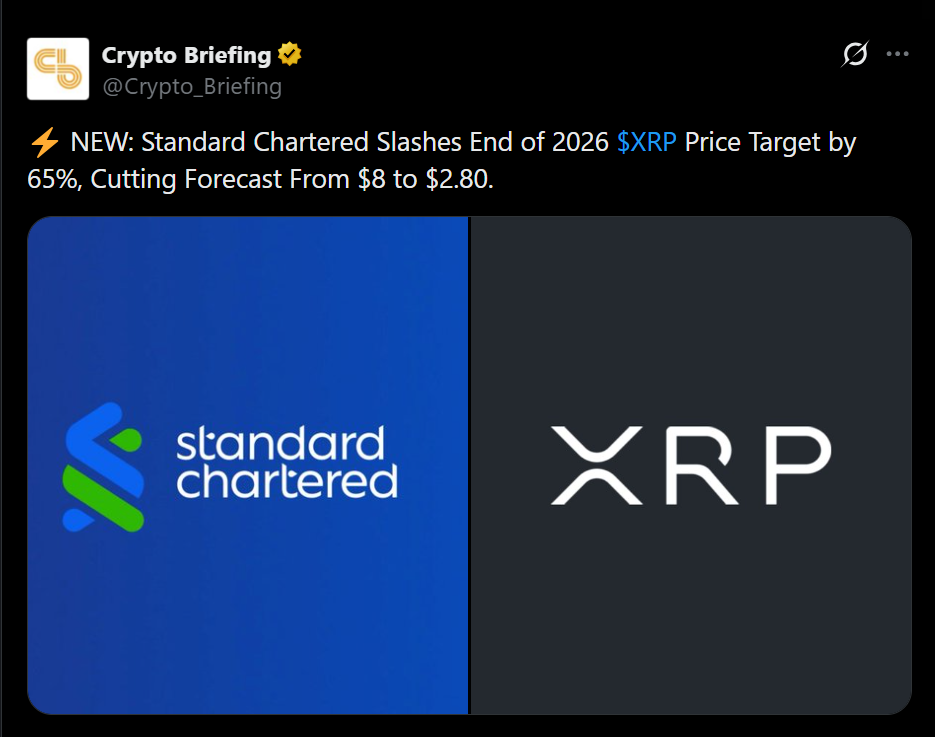
Standard Chartered trimming its XRP target by roughly 65% grabs attention fast. Dropping a forecast from $8 to $2.80 feels dramatic, especially in a market already nursing bruises. But the context matters. The bank didn’t single out XRP for structural failure. It revised projections across the board, cutting Bitcoin from $150,000 to $100,000, Ethereum from $7,000 to $4,000, and Solana from $250 to $135.

In other words, this is less about XRP breaking and more about risk appetite shrinking. Geoffrey Kendrick pointed to one of the harshest crypto drawdowns in nearly four years. When liquidity tightens and speculative flows fade, price targets tend to follow sentiment lower. Forecasts compress before fundamentals necessarily do.
ETF Flows Tell the Same Story
The ETF data reinforces that narrative. XRP-linked exchange-traded products saw assets fall from about $1.6 billion in early January to roughly $1 billion by mid-February. That 40% contraction isn’t subtle. It shows that institutional flows, which many expected to stabilize price action this cycle, are still highly reactive to volatility.
This doesn’t automatically mean institutions have lost faith. It means they are de-risking. ETFs make it easier to enter crypto, but they also make it easier to exit. When momentum turns, capital moves just as quickly in reverse.
Price Action Has Been Technically Fragile
XRP’s slide to $1.16 last month, its weakest level since late 2024, underlined how vulnerable the asset remains during broader market stress. The rebound that followed suggests buyers still exist, but the structure is not exactly screaming strength. In environments like this, analysts tend to widen downside scenarios before they upgrade conviction.
The key question isn’t whether $2.80 is conservative. It’s whether macro conditions improve fast enough to justify even that level by year-end. If liquidity remains tight and ETF inflows stay muted, the path higher becomes slower and more dependent on incremental adoption rather than explosive momentum.
What This Really Means for XRP
A lower target does not erase XRP’s longer-term thesis around settlement, tokenization, and regulated distribution channels. But it does reset expectations. The idea of rapid multi-fold upside in a cautious market cycle is harder to defend.
Forecast revisions like this often reflect the market mood more than a structural re-evaluation of technology. If sentiment stabilizes and capital rotates back into digital assets, price targets will likely move again. Analysts rarely lead markets. They adjust to them.
Conclusion
Standard Chartered’s downgrade is a reality check, not a death sentence. XRP’s revised $2.80 target mirrors a broader crypto slowdown rather than a collapse in its underlying story. The next move won’t hinge on a single forecast. It will hinge on whether liquidity, ETF flows, and risk appetite return in a meaningful way.