- Solana enters 2026 with stronger fundamentals, rising on-chain revenue, and renewed market confidence
- Major upgrades like Firedancer aim to fix past reliability issues while keeping fees low at scale
- User growth across NFTs, gaming, and consumer apps could define whether Solana becomes long-term infrastructure
The crypto market rolls into 2026 with a noticeably lighter mood, and Solana finds itself right in the middle of that renewed optimism. After a turbulent stretch defined by rapid growth, technical strain, and a few very public hiccups, the network now looks more stable, more mature, and frankly, more prepared. Fundamentals are improving, the tech stack is evolving, and real-world usage is no longer just a talking point.
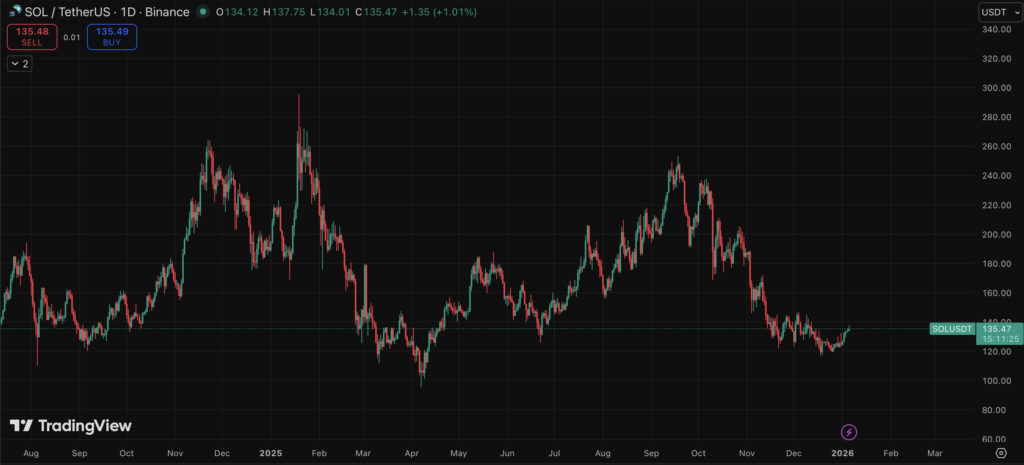
At press time, SOL is trading in the $125–$128 range, comfortably holding its place among the top ten cryptocurrencies by market cap. That alone reflects growing confidence from traders, developers, and long-term holders who appear willing to give Solana another serious look.
Network Upgrades Aim to Fix Old Weaknesses
Speed has always been Solana’s calling card, but congestion and outages in past cycles chipped away at trust. The 2026 roadmap is clearly designed to address that history head-on. Firedancer, a new validator client, is the headline upgrade. Built to dramatically increase throughput and resilience, it’s meant to reduce the chances of network-wide slowdowns that once haunted the chain.
Beyond Firedancer, developers are planning meaningful increases in block space and compute capacity. More room per block means smoother handling during traffic spikes, and ideally, consistently low fees even when demand heats up. If these upgrades roll out on time and validators adopt them broadly, Solana could look very different from the network many remember from earlier cycles.
On-Chain Revenue Starts Turning Heads
Solana wrapped up 2025 as one of the highest on-chain revenue generators in the entire crypto space. That revenue didn’t come from hype alone, it was driven by transaction fees, decentralized exchange volume, NFT activity, and other application-level usage. In other words, people were actually using the network.
That matters, especially to institutions. In 2026, payment processors, trading firms, and fintech platforms are hunting for fast, low-cost settlement layers that can scale. Solana fits that profile better than many alternatives. Rising on-chain revenue also strengthens the long-term value case for SOL, since demand for block space ties directly into the token’s utility.
NFTs, Gaming, and Social Apps Expand the User Base
Solana is no longer defined solely by DeFi. The ecosystem has widened considerably, leaning into consumer-facing applications that attract a different type of user. NFTs continue to perform well thanks to cheap minting and fast confirmations. Gaming studios favor Solana because it can handle frequent in-game transactions without pricing players out.
Prediction markets and social platforms are also gaining traction. These apps pull in users who might never touch traditional DeFi tools, which helps diversify activity. As more mobile-first experiences go live, daily active wallets could rise steadily through 2026, creating a more balanced and resilient ecosystem.

Price Outlook Depends on Execution, Not Hype
Forecasts for SOL in 2026 are all over the map. Some analysts expect steady, moderate gains, while others float scenarios that push into the several-hundred-dollar range. The difference isn’t optimism versus pessimism, it’s execution versus narrative.
SOL already trading near $125–$130 suggests confidence in the recovery story. Network upgrades, rising revenue, and expanding usage all support a constructive medium-term outlook. Still, crypto remains volatile by nature. Liquidity conditions, Bitcoin’s direction, and broader risk sentiment will continue to influence price, with sharp rallies and pullbacks likely along the way.
Regulation and Payments Could Shape the Long Game
Technology alone won’t decide Solana’s future. Regulatory clarity will matter, especially around stablecoins, custody, and tokenized assets. Clearer rules would give institutions more confidence to build and deploy Solana-based systems.
Payment partnerships are another potential catalyst. Solana’s pitch around near-instant settlement for digital assets becomes far more powerful if major payment providers adopt its rails. If that happens, transaction volumes could scale beyond crypto-native use cases and into everyday financial activity, a big step forward.

Risks Haven’t Disappeared
Even with progress, risks remain. Complex upgrades always carry execution risk, and a misstep could shake confidence quickly. Competition is also fierce. Other layer-1 and layer-2 networks are improving fast, pushing scalability and user experience forward at the same time.
Solana will need to deliver consistent performance while making development and onboarding easier, not harder. That balance will be critical.
A Defining Year Ahead
Solana enters 2026 with strong fundamentals, rising revenue, and a clear plan to address its past weaknesses. Firedancer and capacity upgrades target the network’s biggest pain points, while a broader mix of applications brings in new users.
If development milestones land and regulatory pressure eases, 2026 could mark a turning point. Solana may finally move from a high-speed experiment to a dependable backbone for payments, markets, and consumer apps. Whether that promise turns into lasting leadership is the real test waiting ahead.