
- Solana is the worst-performing large-cap asset this quarter, down about 37%
- On-chain data shows growing capitulation among both short and long-term holders
- Rising validator costs and exits are putting pressure on Solana’s network resilience
Market fear hasn’t been kind to Layer 1s, and Solana is feeling it more than most. SOL has quietly become the worst-performing large-cap asset this quarter, sliding roughly 37%. That makes this its steepest quarterly drop since Q2 2022, and it’s been enough to keep FOMO completely out of the picture.
On-chain data suggests the pain is starting to sink in. Net realized losses are climbing fast, while short-term holder NUPL has dropped deep into negative territory. With SOL down about 50% from its $250 peak, capitulation behavior is starting to look textbook, not theoretical.
Long-Term Holders Are Losing Patience Too
What’s more concerning is that even long-term holders are starting to feel the strain. Solana’s LTH NUPL has slipped back to levels last seen in April, right before a sharp 30% sell-off. In a calmer market, this might look like a routine shakeout, flushing out weak hands and resetting sentiment.
But this isn’t a calm market. Risk appetite is thin, and the broader structure remains bearish. That changes the context. If pressure continues, the weakness could bleed into Solana’s fundamentals, testing not just price support, but confidence in the ecosystem itself.
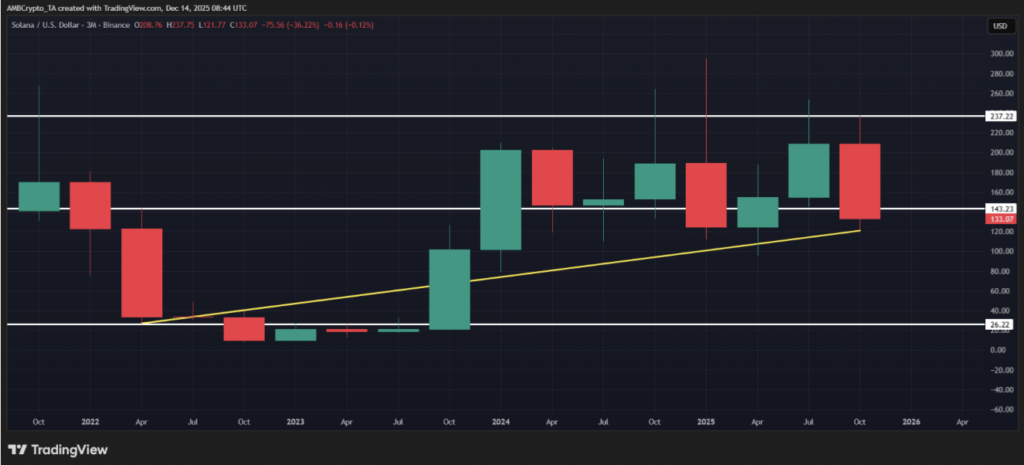
The Cost of Just Breaking Even Is Climbing Fast
Despite the price damage, Solana has been pushing hard to stay relevant. An ETF launch, the Firedancer upgrade, growing institutional interest, tokenized assets, and multi-chain ambitions have all kept the long-term narrative alive. Even JPMorgan has sounded optimistic.
The market, however, is less convinced. Validator numbers have dropped roughly 68% over the past two years, leaving the network with only about 800 active nodes. That’s not just a statistic, it’s a stress signal.
Validator Pressure Raises Real Network Risks
At the core of the issue is staking economics. Weak price performance has created a feedback loop, failed support levels kill enthusiasm, which then makes staking harder to justify. To simply break even, validators now need to stake roughly $17 million worth of SOL per block, nearly triple previous levels.
Under those conditions, unstaking starts to look rational. This pullback isn’t just a healthy reset anymore. Validator exits are challenging Solana’s adoption story and raising real questions about how resilient the network is if prices continue to slide.