

- Solana is hosting real, regulated fund infrastructure without traditional banking rails
- Institutional players are increasingly relying on on-chain execution for speed and cost efficiency
- Despite adoption, short-term price structure suggests liquidity-driven volatility may continue
Solana is quickly carving out a role as a core hub for tokenized finance, and this time it’s not driven by hype cycles or short-term narratives. WisdomTree’s decision to deploy real fund infrastructure on the network points to something more structural taking shape. Traditional asset managers are showing growing confidence that Solana can support large-scale, regulated financial products with the speed and cost efficiency modern markets actually need.
This isn’t about experimentation anymore. It’s about moving real money, at scale, without leaning on the slow plumbing of legacy systems.
Regulated Funds Move On-Chain Without Banking Rails
WisdomTree’s deployment of roughly $159 billion in fund infrastructure on Solana marks a quiet but meaningful shift. According to disclosures shared by Genfinity, regulated money market funds are now settling directly on-chain, which removes the need for traditional banking rails altogether. Institutional cash-like assets are no longer waiting on correspondent banks or multi-day settlement cycles.
A clear example is the Government money market digital fund, which already holds about $730 million in on-chain assets. These are not synthetic representations. Funds are minted directly, backed by real Treasuries, and settled on Solana itself. That setup allows retail participants to access institutional-grade products with blockchain-native speed and lower costs, something that simply wasn’t possible a few years ago.
What’s striking is how little ceremony surrounds this shift. Performance, not storytelling, appears to be the deciding factor.
On-Chain Infrastructure Replaces Legacy Settlement
Solana is now processing the same regulated funds that previously relied on correspondent banking networks and standard T+2 or T+3 settlement windows. That gap between traditional finance products and on-chain infrastructure has effectively collapsed. Funds move faster, settle instantly, and do so at a fraction of the cost.
This trend extends beyond asset managers. The Kobeissi Letter recently noted that Coinbase is integrating Jupiter Exchange directly into its on-chain trading stack. As a result, millions of Solana-based tokens will become accessible to Coinbase users for the first time, using Jupiter’s on-chain liquidity rather than a centralized order book.
Instead of manually listing assets and managing fragmented liquidity, Coinbase is leaning into on-chain infrastructure. Users will be able to deploy existing balances and payment methods to trade Solana-native tokens from self-custodial wallets. Even centralized exchanges, slowly but clearly, are moving closer to on-chain execution.
Liquidity Sweeps and Market Structure Still Matter
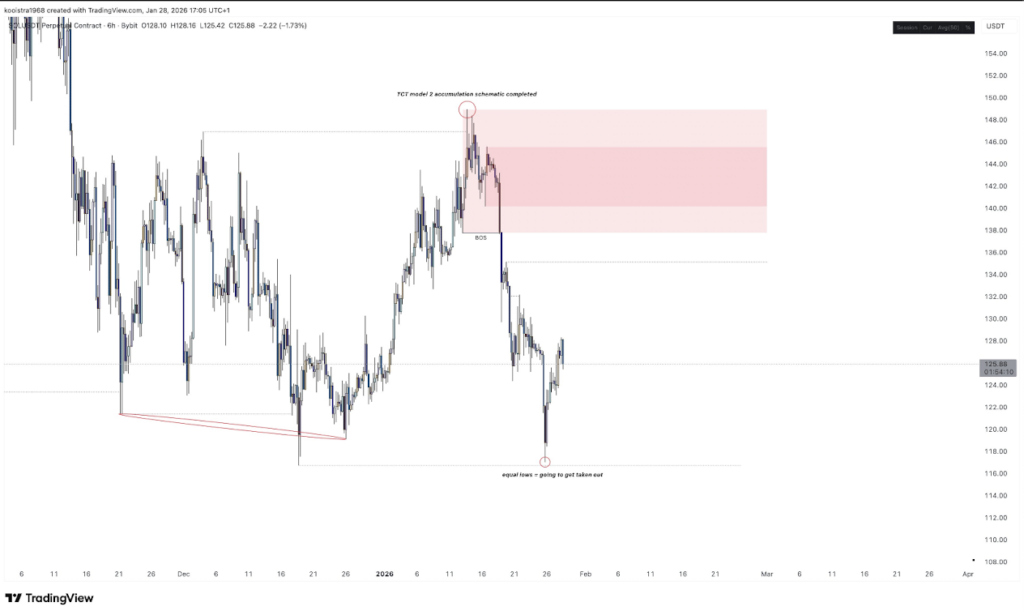
While infrastructure adoption accelerates, short-term price structure on Solana remains more nuanced. Analyst Larskooistra suggests the local context is setting up a broader structural move rather than an immediate breakout. Price has already completed a Model 2 accumulation schematic, sweeping buy-side liquidity by taking the range high, then breaking market structure back to bearish, which created fresh supply.
From a higher-timeframe view, this behavior often appears when accumulation models complete and then reverse. The expectation, according to Larskooistra, is that equal lows may still be targeted as liquidity before any durable trend shift can occur. He’s watching for distribution schematics on the current move higher, rather than assuming momentum has already flipped.
In short, the rails are being built at institutional scale, but price still needs to resolve its own structure. Infrastructure moves faster than charts, and that disconnect tends to confuse people.