

- Banks are now running Visa-linked payments on Solana at an estimated $3.5B pace, signaling real institutional usage
- Charles Schwab has launched Solana futures, giving mainstream investors regulated exposure without holding SOL directly
- SOL price has pulled back into a major demand zone, making the next close critical for short-term direction
Banks are no longer just testing blockchain rails in sandboxes. They’re actually using them.
Recent data shows that banks have begun processing real payments through Visa on the Solana network, and that activity is already running at an estimated $3.5 billion pace. That’s not a pilot, and it’s not a proof-of-concept. It’s live usage, at scale, which says a lot about where institutional comfort with blockchain infrastructure is heading.
By tapping into Solana’s fast and low-cost transaction layer, Visa and participating banks are streamlining settlement flows while cutting down on intermediaries. Fewer middlemen, faster settlement, lower friction. For global payments, that combination matters. And for Solana, it places the network squarely in the spotlight as a serious backend option for real-world finance, not just crypto-native use cases.
Solana Quietly Moves Into the Institutional Payments Stack
What stands out here isn’t just the volume. It’s the intent. This isn’t experimentation anymore. It signals that major financial institutions are comfortable enough with blockchain infrastructure to rely on it for day-to-day settlement operations.
That shift reflects a broader change in how blockchains are being viewed. Less as speculative tech, more as plumbing. Solana’s role in this setup highlights why it keeps coming up in conversations around scalable, enterprise-ready chains.
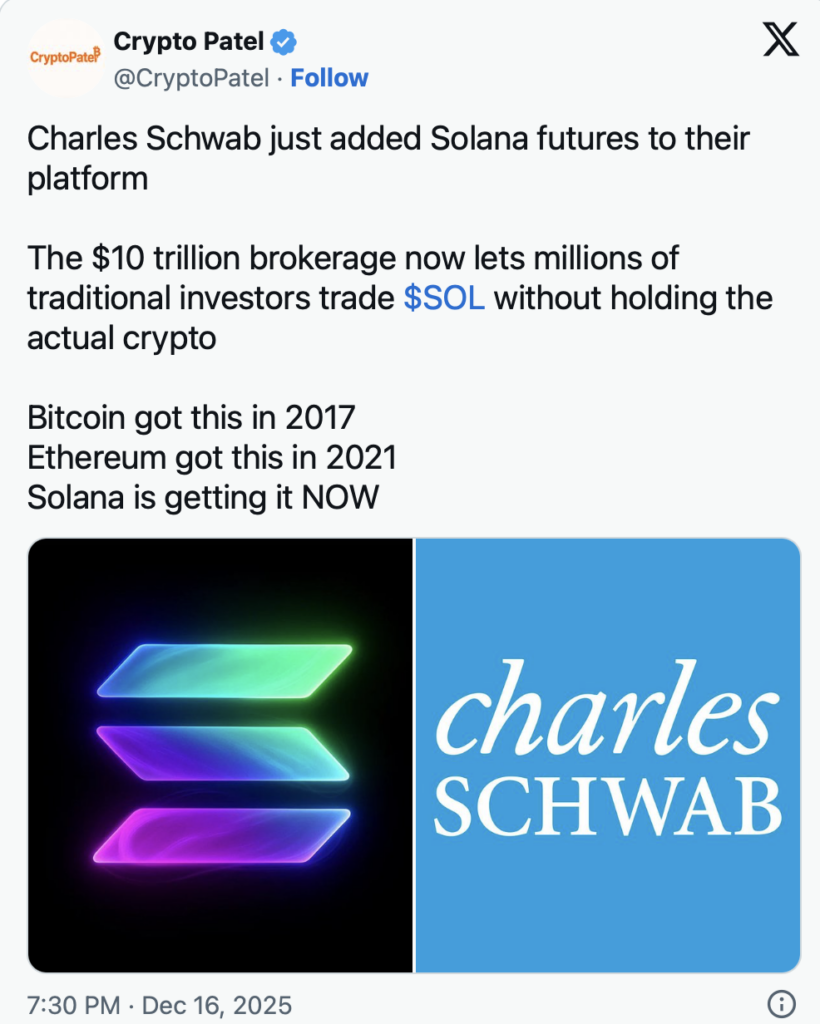
Charles Schwab Adds Solana Futures to Its Lineup
On the investment side, adoption is showing up in another form. Crypto analyst Crypto Patel recently pointed out that Charles Schwab has expanded its crypto-related offerings by launching Solana futures on its platform. For SOL, that’s a meaningful step.
Schwab oversees more than $10 trillion in client assets, and this move gives traditional investors exposure to Solana’s price action without holding the token directly. Futures products tend to appeal to institutions and professional traders who want regulated access, risk management tools, and liquidity, not wallets and private keys.
This also puts Solana in familiar company. Bitcoin futures launched in 2017. Ethereum followed in 2021. In both cases, futures markets played a role in improving liquidity and price discovery over time. Solana joining that group reflects its growing acceptance as more than just an emerging Layer 1.
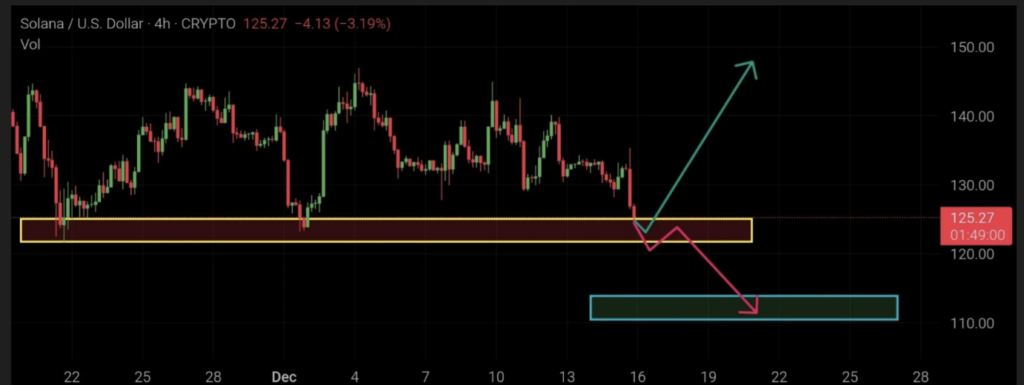
SOL Price Sits at a Key Decision Zone
While fundamentals are stacking up, price action is doing what it often does, testing patience. Analyst Elite Crypto noted that SOL has pulled back into a strong demand zone, an area that has repeatedly acted as support in the past.
This zone has absorbed selling pressure multiple times before, either triggering a clean bounce or pushing price lower briefly to clear liquidity before the real move started. That makes it a critical level to watch. What happens here tends to shape the short-term trend.
If buyers step in with conviction and price closes strong, it could mark the early stages of a reversal. If not, the market may need to flush a bit more before direction becomes clear. Either way, this area is unlikely to be ignored.
Taken together, the picture is interesting. On one side, real payment volume, institutional futures, and growing infrastructure relevance. On the other, a token sitting at a technical crossroads. Solana isn’t shouting. It’s building, and the market is deciding when to listen.