

- Ripple Treasury connects XRP to a $12.5 trillion corporate payment network
- The platform integrates blockchain quietly without changing user workflows
- Even small adoption could significantly impact XRP demand and market dynamics
Ripple’s acquisition of GTreasury, now rebranded as Ripple Treasury, feels like more than just another expansion move, it’s almost a strategic pivot. The platform already connects around 13,000 banks and supports over 1,000 corporate clients, including names like Volvo, Subway, and Stihl. Together, these entities process roughly $12.5 trillion in payments every year, which is… honestly a staggering figure.
What stands out though is that none of that volume currently touches crypto. Zero. Ripple CEO Brad Garlinghouse has openly pointed to this gap as the real opportunity, not just adding more users, but tapping into existing financial flows that are already massive.
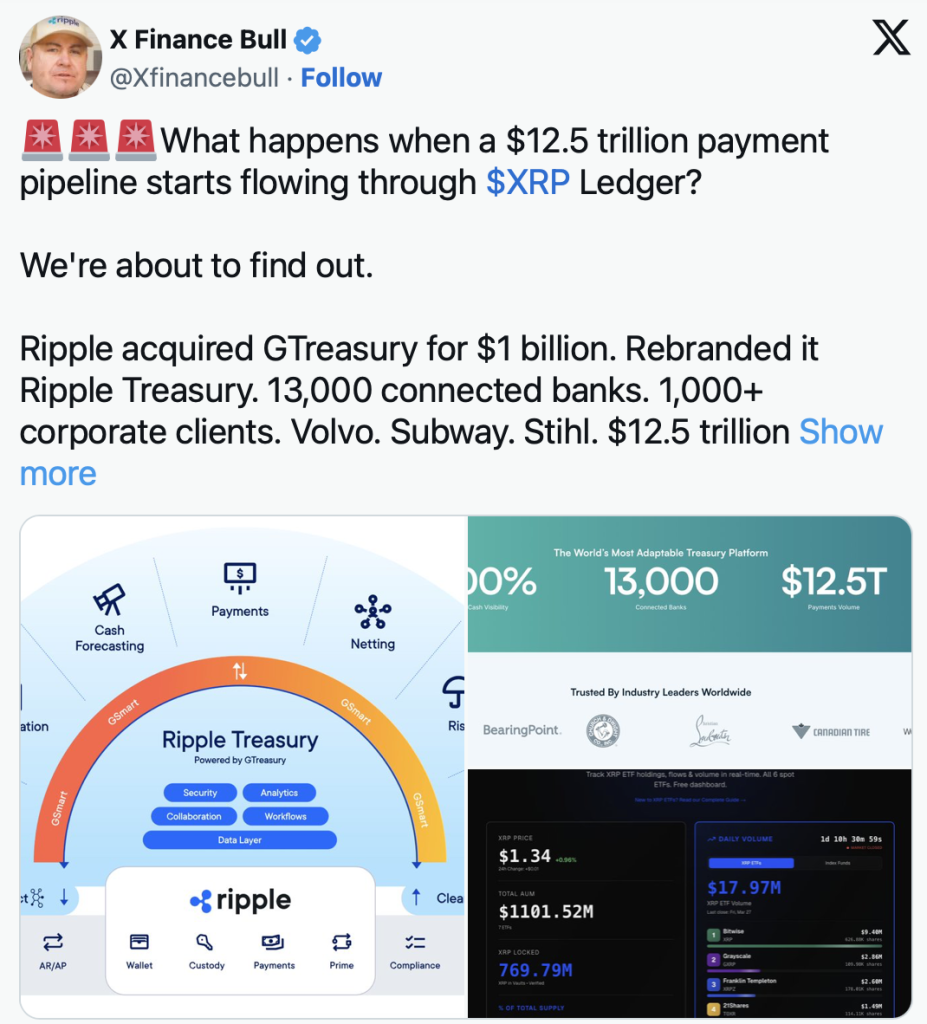
A Quiet Shift Toward Blockchain Integration
Ripple Treasury isn’t just a payment tool, it’s a full-stack corporate treasury system. It handles everything from payments and forecasting to reconciliation, liquidity, and even compliance, basically the entire financial backend companies rely on daily. And the interesting part is, companies don’t need to understand blockchain at all to use it.
On the surface, everything looks and feels like traditional software. Behind the scenes though, ClearConnect links banks and ERP systems on one end, while Ripple’s blockchain infrastructure handles wallets, custody, and settlement on the other. The shift from traditional correspondent banking to the XRP Ledger happens quietly, almost invisibly, but the impact on speed and cost could be significant.
Trillions in Volume, Yet Zero Crypto Penetration
There’s a pretty noticeable disconnect right now between infrastructure and actual usage. As pointed out by X Finance Bull, the gap between XRP’s current price and the scale of what’s being built has never really been wider. That $12.5 trillion annual payment flow still sits entirely outside crypto, at least for now.
But the pathway for migration is already there. The system doesn’t force companies to change how they operate, no new interfaces, no retraining, nothing disruptive. Instead, the underlying settlement layer gradually transitions to XRPL, which lowers friction significantly, especially for large enterprises that tend to resist change.

Supply Constraints Meet Growing Utility
On the investment side, supply dynamics are starting to shift too. Around 769 million XRP is currently locked in exchange-traded funds, with seven funds holding about $1.1 billion in assets. That effectively reduces the circulating supply available in the open market, which could matter more over time.
Now, consider this, even if just 1% of that $12.5 trillion payment pipeline moves onto XRPL, that’s $125 billion in annual volume. That kind of activity would be massive for the network, potentially reshaping liquidity, demand, and overall market behavior. It’s not guaranteed, of course, but the scale alone makes it worth watching.
XRP’s Market Outlook Faces a New Test
Right now, XRP trades around $1.31, which doesn’t exactly reflect the size of the infrastructure Ripple is building behind it. That contrast is starting to catch attention, especially among analysts who are looking beyond short-term price action. There’s this sense that the market hasn’t fully priced in what’s developing.
If even a fraction of institutional volume starts flowing through XRPL, it could shift how XRP is valued entirely. For now, it’s still a theory playing out in real time, but the setup is there. And unlike many crypto narratives, this one is tied directly to existing financial systems, not just speculation.