- OpenAI and Paradigm built EVMbench to evaluate AI performance in smart contract security
- The benchmark tests bug detection, controlled exploitation, and safe patching
- With $100B+ in crypto contracts at stake, AI-driven audits are becoming unavoidable
OpenAI is stepping deeper into crypto security with the launch of EVMbench, a new testing framework designed to measure how well AI can understand, audit, and potentially secure smart contracts on Ethereum and similar blockchains. This isn’t a casual research release. It’s a direct response to how much value is now locked inside onchain code, and how expensive mistakes can be once contracts are deployed.
Smart contracts are the backbone of DeFi. They run decentralized exchanges, lending protocols, stablecoin systems, and a growing list of onchain financial products. And because most contracts are effectively immutable once deployed, a vulnerability isn’t just a bug, it can become a permanent attack surface.
EVMbench Was Built With Paradigm Using Real Smart Contract Exploits
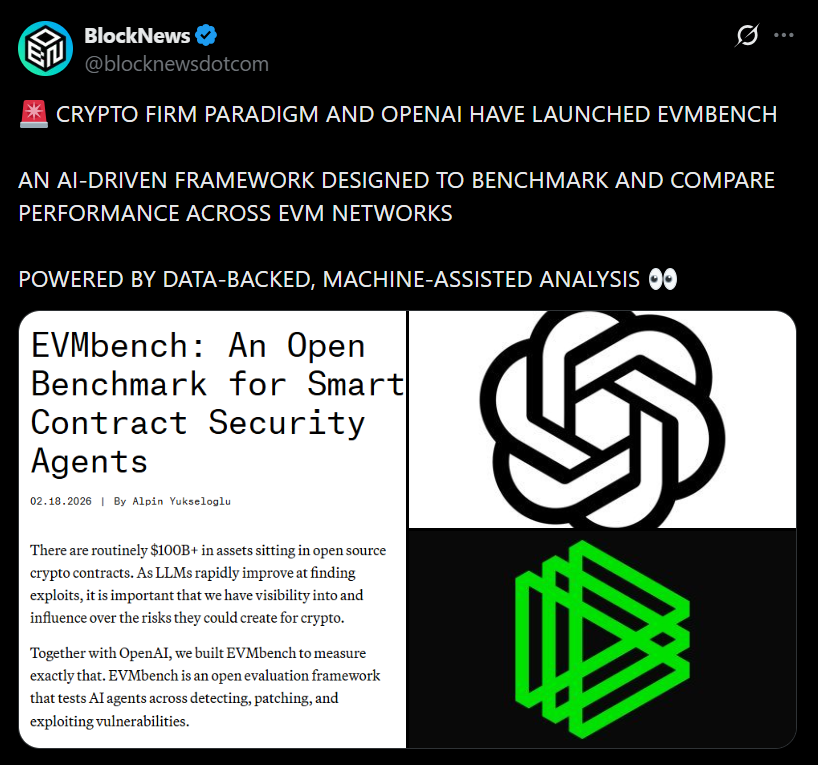
EVMbench was built in collaboration with Paradigm, one of the most influential firms in crypto. The benchmark draws from real-world vulnerabilities discovered through audits and security competitions, not toy examples designed to make models look good. That choice matters, because the industry doesn’t need AI that performs well on classroom problems. It needs systems that can handle the messy, high-stakes reality of production contracts.
The framework is designed to evaluate whether modern AI agents can operate in environments that resemble real auditing work. It’s essentially a stress test for how capable these systems are becoming, and how quickly that capability is improving.
The Benchmark Tests Detection, Exploitation, and Patching
EVMbench measures AI performance across three core abilities. First, can the model identify security bugs in a contract. Second, can it exploit those bugs in a controlled environment, proving it actually understands the attack path. Third, can it fix the vulnerable code without breaking the contract’s logic or introducing new issues.
That third part is quietly the hardest. Finding bugs is one thing. Patching safely is another, because smart contract systems often fail due to unintended side effects. A “fix” that breaks functionality is still a failure, just a different kind.
OpenAI Wants a Standard for Measuring Blockchain Security AI
OpenAI says the goal is to establish a clear evaluation standard for AI systems in blockchain security, especially as DeFi continues to secure billions of dollars in user funds. This is a major shift in tone compared to the past, where AI and crypto security mostly lived in separate conversations.

OpenAI’s framing is blunt. Smart contracts routinely secure more than $100 billion in open-source crypto assets, and as AI agents improve at reading, writing, and executing code, it becomes increasingly important to measure those capabilities in economically meaningful environments. The point isn’t just to understand the risk. It’s to push the ecosystem toward defensive use before attackers scale faster than auditors.
AI Audits Are Becoming Part of Crypto’s Base Layer
The deeper implication is that crypto auditing is heading toward an agent-assisted future whether the industry is ready or not. EVMbench is not just a benchmark. It’s a signal that AI is becoming a core part of how smart contracts will be evaluated, hardened, and monitored going forward.
In other words, the security game is changing. The only question now is whether the industry adapts fast enough to use AI defensively, before the same tools get used offensively at scale.