- Japan approved a bill to treat crypto like stocks and bonds
- New rules include insider trading bans and stricter disclosures
- Move could unlock institutional capital and reshape the market
Japan just took one of the clearest steps yet toward fully integrating crypto into traditional finance. On April 10, 2026, the cabinet approved an amendment to the Financial Instruments and Exchange Act, officially reclassifying crypto assets as financial instruments. That shift sounds technical, but it changes the entire framework, crypto is no longer just a payment tool, it’s now being treated like an investment product.
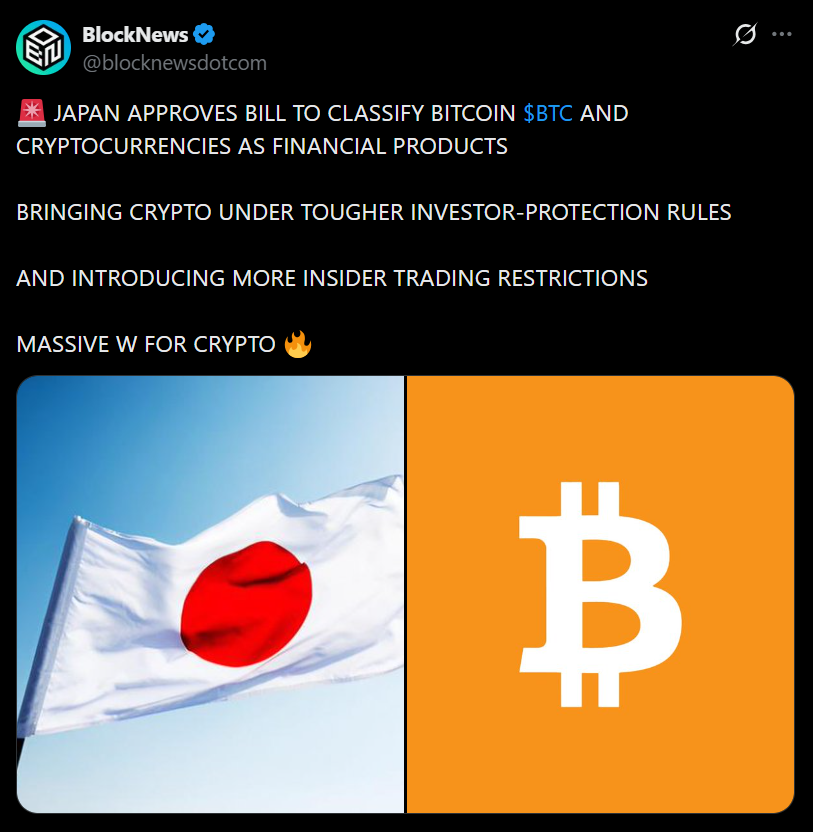
This didn’t come out of nowhere either. Regulators had been moving in this direction for months, with internal groups already signaling that most crypto activity today looks more like investing than spending. The cabinet approval just made it official, and now the bill heads to Japan’s National Diet, where it’s expected to pass with relatively little resistance.
Crypto Now Faces Full Financial Regulation
The biggest change here is how crypto will be regulated going forward. Under the new framework, digital assets will fall under the same rules that govern stocks and bonds, which means stricter oversight across the board. That includes bans on insider trading, mandatory disclosures from issuers, and tighter rules around how businesses operate.
Even the terminology is changing. Exchanges will now be classified as “crypto-asset dealers,” which might sound minor, but reflects a shift in how the industry is viewed. At the same time, penalties for operating without a license are increasing sharply, with potential prison sentences and significant fines, so compliance is no longer optional.
A Major Break From the Old System
Previously, crypto in Japan was regulated under the Payment Services Act, which treated it more like a method of payment than an investment asset. That framework worked for early adoption, especially after the Mt. Gox collapse, helping Japan become one of the largest Bitcoin markets globally.
But it also left gaps. While exchanges had to follow AML rules and protect user funds, there wasn’t the same level of market oversight you’d see in traditional finance. As more institutional and retail investors entered the space, that gap became harder to justify, and eventually, something had to change.
Institutional Capital Could Be Next
One of the biggest implications of this shift is what it could unlock. By treating crypto as a regulated financial instrument, Japan is making it easier for institutional players to participate. Pension funds, asset managers, and even ETF structures become more viable in a framework that looks familiar to them.
At the same time, stronger rules could improve trust among everyday investors. More transparency, clearer protections, and better enforcement might make the market feel less risky, even if volatility doesn’t go anywhere. The trade-off, of course, is higher compliance costs, which could push smaller players out.
A Decade of Crypto Evolution in Japan
This move is really the culmination of years of gradual change. Since 2017, Japan has been building its crypto framework step by step, starting with exchange regulation, then adding derivatives oversight, custody rules, and stablecoin legislation. Each phase tightened controls while still allowing the market to grow.
Now, with crypto officially recognized as a financial asset, the process feels complete, or at least closer to it. The focus shifts from experimentation to integration, which is a very different mindset than what existed just a few years ago.
Crypto in Japan Just Entered a New Phase
Assuming the bill passes the Diet, these changes could take effect as early as 2027. That gives the industry time to adjust, but the direction is already set. Crypto in Japan is no longer operating on the edges, it’s being pulled directly into the core financial system.
For investors and institutions alike, the message is clear. Crypto isn’t being pushed out, it’s being formalized. And once that happens, the opportunities grow, but so do the expectations.