- Hong Kong will allow licensed platforms to offer perpetual contracts to professional investors
- Brokers can now extend margin financing using bitcoin and ether as collateral
- Officials frame it as liquidity, but it’s clearly a strategic embrace of derivatives
Hong Kong’s Securities and Futures Commission has expanded its crypto framework in a way that sounds technical but is actually massive. Licensed platforms will now be allowed to offer perpetual contracts to professional investors, and brokers can extend margin financing using bitcoin and ether as collateral. On paper, it’s positioned as controlled modernization. In reality, it’s Hong Kong acknowledging what every serious market already knows.
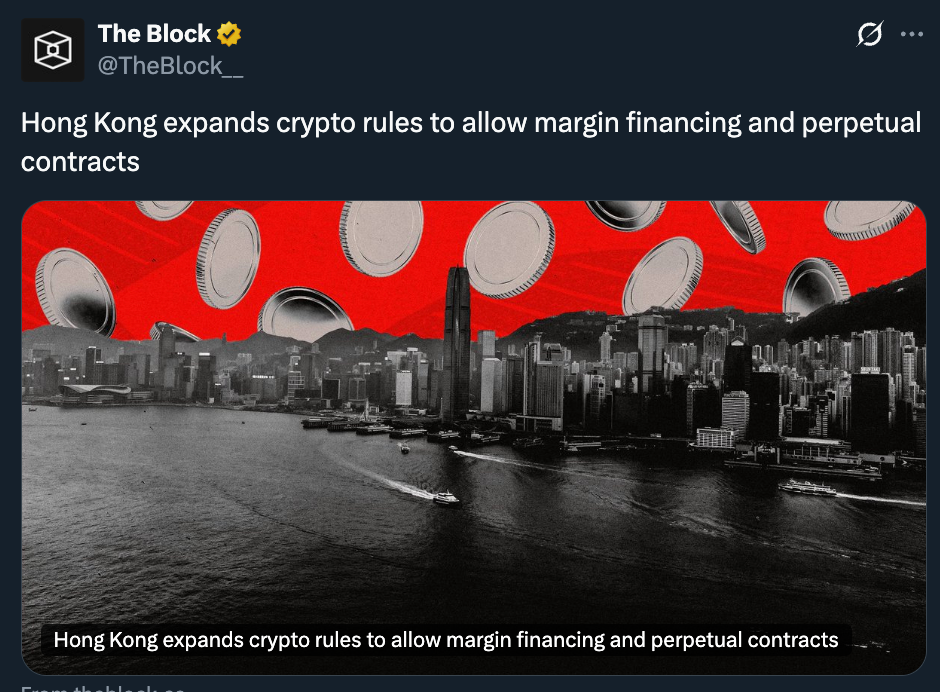
Derivatives are not optional if you want to be a global hub. You can’t market yourself as the regulated alternative while ignoring the fact that leverage is where real liquidity lives. Allowing perps is Hong Kong stepping into that truth, even if the language stays cautious.
Liquidity Is the Official Narrative, but It’s Not the Whole One
Regulators are emphasizing market depth, better price discovery, and tighter supervision. The framework includes leverage caps, margin requirements, liquidation mechanisms, and strict oversight, which is meant to reassure the public that this isn’t a free-for-all. They’re also permitting broader collateral, explicitly including BTC and ETH, and allowing affiliated market makers under governance safeguards.
That’s the careful version of the story. But once you open the door to perpetuals, you are inviting sophisticated capital and, inevitably, more volatility. The market gets deeper, yes. It also gets sharper. Derivatives don’t just increase liquidity. They increase speed, reflexes, and liquidation cascades when conditions turn.
This Is Competitive Positioning, Not Just Policy
Let’s be honest. This move isn’t only about “improving liquidity.” It’s about competition. Singapore, Dubai, and offshore venues already serve professional traders who want access to perpetuals and margin. If Hong Kong didn’t expand, it would lose relevance for the very audience it’s trying to attract.
Professional traders aren’t sentimental about jurisdictions. They go where the tools are, where execution is clean, and where capital can move efficiently. Hong Kong is betting it can capture that flow while keeping it inside a regulated perimeter. That’s a calculated gamble, not a neutral tweak.
The Real Test Comes During the Next Volatility Spike
Hong Kong isn’t loosening the reins recklessly. It’s building a structured derivatives market rather than letting it thrive offshore with zero oversight. By limiting access to professional investors and layering strict risk controls, the SFC is trying to balance credibility with competitiveness.
The real question is whether that balance holds when markets get ugly. Perpetuals behave well when volatility is calm. They behave violently when liquidity thins. Hong Kong is stepping into the arena anyway, because global hubs don’t get to opt out of leverage. They only get to decide whether they regulate it or pretend it’s not happening.