

- The Ethereum Foundation released a technical L1 roadmap called “Strawmap”
- The plan outlines upgrades through 2029 with forks roughly every six months
- Five major “north-star” goals focus on speed, scale, privacy, and quantum safety
The Ethereum Foundation has published a new long-term roadmap framework titled “Strawmap,” combining a strawman proposal with a structured upgrade plan. Announced by EF Protocol researcher Justin Drake, the document is designed as a coordination tool for researchers, developers, and governance stakeholders.
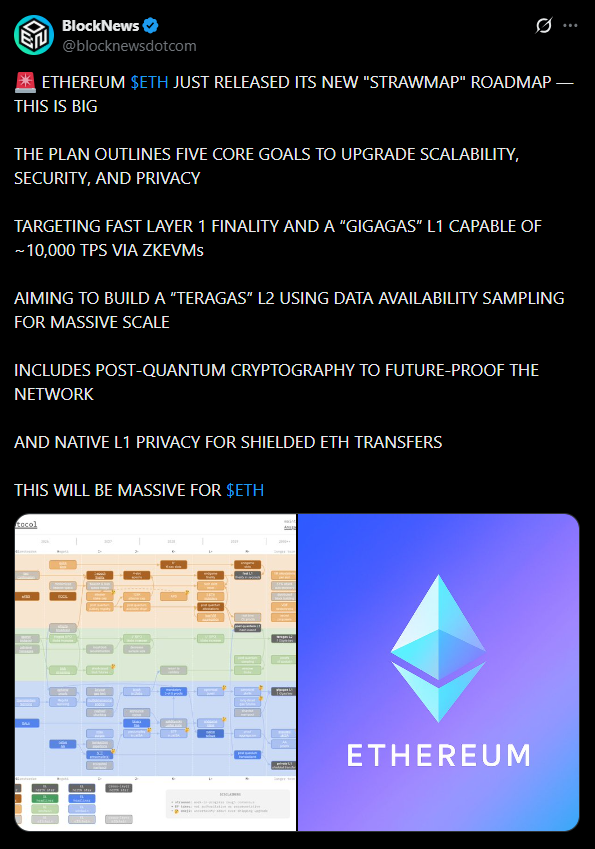
Rather than predicting a single future outcome, Strawmap organizes Ethereum’s Layer 1 evolution into a coherent trajectory. Drake described it as a way to narrow millions of theoretical upgrade paths into a consistent and reasonable direction for the mainnet.
A Multi-Year Upgrade Timeline
Strawmap outlines seven major upgrade phases extending through 2029. The framework assumes a hard fork roughly every six months, though the document cautions that timelines could shift.
The roadmap also acknowledges that development speed may accelerate. If AI-assisted coding tools, formal verification systems, and automation improve protocol engineering efficiency, Ethereum’s upgrade cadence could move faster than currently projected.
Five Core “North-Star” Goals
At the center of Strawmap are five ambitious objectives guiding Ethereum’s mainnet evolution.
The first is “fast L1,” which aims to deliver near-instant finality and shorter slot times, significantly improving transaction confirmation speed. The second goal, “gigagas L1,” targets roughly 1 gigagas per second in throughput, enabled by technologies like zkEVMs and real-time proof generation.
The third vision, “teragas L2,” focuses on scaling second-layer solutions to massive throughput levels—potentially up to 10 million transactions per second—through data availability sampling while maintaining mainnet security. The fourth objective introduces post-quantum cryptography at the base layer to defend against future quantum threats. The fifth, “hidden L1,” seeks built-in privacy features such as shielded ETH transfers directly at the protocol level.

Structured Upgrades Across Core Layers
Strawmap organizes upgrades across three primary components: the consensus layer (CL), data layer (DL), and execution layer (EL). Each planned fork typically features one major consensus headliner and one execution headliner to limit complexity per release cycle.
The visual timeline uses color-coded segments to illustrate how upgrades interact across layers, reinforcing the idea that Ethereum’s scaling and security goals must advance in coordination rather than isolation.
A Coordination Framework, Not a Guarantee
Importantly, the Ethereum Foundation emphasizes that Strawmap is not a fixed promise but a directional framework. It is intended to align contributors around shared long-term objectives rather than dictate rigid deadlines.
By consolidating its Layer 1 ambitions into a unified vision, Ethereum signals that its scaling strategy is evolving beyond short-term forks toward a multi-year structural roadmap.