

- The Ethereum Foundation will stake roughly 70,000 ETH from its treasury
- Staking rewards will fund research, grants, and ecosystem development
- The move reduces reliance on direct ETH sales for operating expenses
The Ethereum Foundation (EF) has begun staking a portion of its treasury holdings, marking a significant shift in how the organization funds its operations. An initial deposit of 2,016 ETH was made Tuesday, with plans to stake approximately 70,000 ETH in total over time.
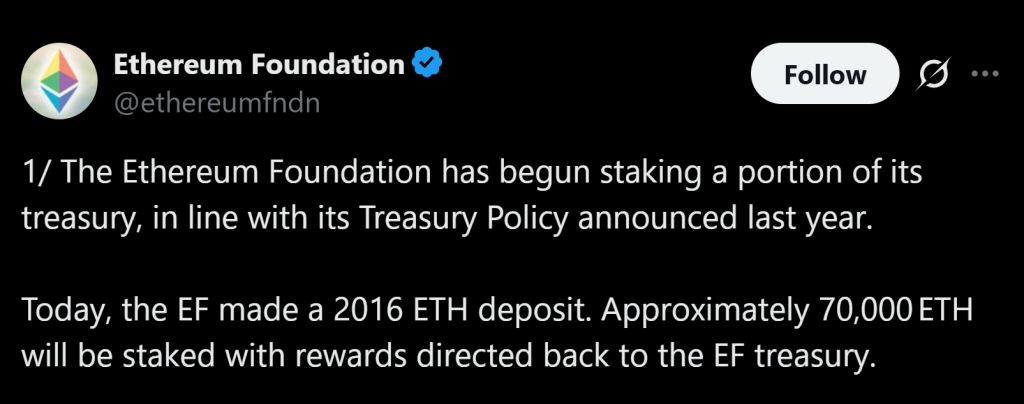
Rather than relying heavily on selling ETH to cover expenses, the foundation will now generate staking rewards that flow back into its treasury. Those rewards are intended to support protocol research, ecosystem growth initiatives, and community grants.
A Structural Treasury Shift
This move follows the Treasury Policy introduced in June 2025, which established a more formal asset-liability model. The framework targets a 15% annual spending rate relative to total treasury value and maintains a 2.5-year operating runway.
Historically, the foundation funded its activities primarily through direct ETH sales. That approach often drew scrutiny during market downturns, as large sales could add short-term pressure. By staking instead, the EF transforms idle holdings into yield-generating infrastructure.
Infrastructure Designed for Resilience
The foundation is using open-source tools Dirk and Vouch, developed by Attestant, for its staking operations. Dirk operates as a distributed signing system run across multiple jurisdictions, reducing single-point-of-failure risks.
Vouch enables diversified client pairings and incorporates minority clients to mitigate client concentration risk. The setup includes both hosted and self-managed hardware spread across different regions, reinforcing decentralization principles.
Strengthening Network Security
Beyond treasury management, the staking initiative also bolsters Ethereum’s security. By committing a substantial portion of its holdings to validation duties, the foundation deepens its alignment with network health.

Staking locks capital into consensus participation rather than circulating it through markets. That reduces potential supply overhang while increasing the amount of ETH securing the chain.
What This Means for Ethereum
The foundation currently holds more than 172,000 ETH, valued at roughly $315 million, alongside over 10,000 Wrapped Ethereum. Committing 70,000 ETH to staking signals a long-term sustainability strategy rather than short-term liquidity management.
For Ethereum holders, the shift represents a structural evolution. The foundation is moving from being a periodic seller to a yield participant. That change subtly adjusts supply dynamics while reinforcing operational independence.