

- Ethereum derivatives show strong buying pressure with Net Taker Volume turning positive
- Spot ETF outflows indicate weak institutional demand despite improving sentiment
- Mixed signals suggest ETH may be forming a base, but confirmation is still needed
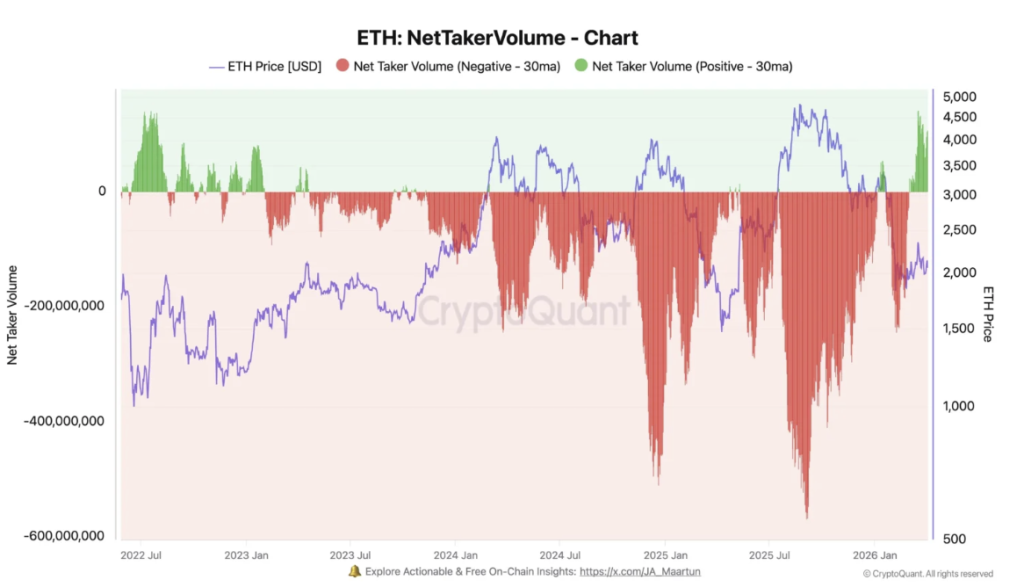
Something has changed in Ethereum’s derivatives market — and it’s not subtle. Net Taker Volume has flipped positive, meaning buyers are finally showing more aggression than sellers. That hasn’t really happened in a sustained way since the last bear market, so… it matters.
According to CryptoQuant data shared by Darkfost, over $104 million in net buying pressure has entered the market. That’s not small. It suggests traders might be moving away from distribution and slowly stepping into accumulation mode.
At the same time, ETH is trading around $2,050. Price isn’t exploding upward, but it’s holding steady, which, in this kind of environment, says quite a bit.
A Structural Change Beneath the Surface
Net Taker Volume basically tells us who’s in control — buyers or sellers — based on aggressive market orders. When it turns positive, it means buyers are pushing harder, taking liquidity instead of waiting.
For most of 2023 and into 2024, Ethereum’s derivatives market leaned heavily bearish. Selling pressure stayed persistent, even during recovery attempts. But around mid-April 2026, that trend started to flip.
That shift could signal something deeper than just a short-term bounce. Reduced selling pressure across major exchanges, like Binance, often sets the stage for broader reversals. Still, it’s not a guarantee… not yet anyway.
Because for a full confirmation, spot demand needs to follow. And right now, that part looks a bit shaky.
Long-Term Range Hints at Bigger Setup
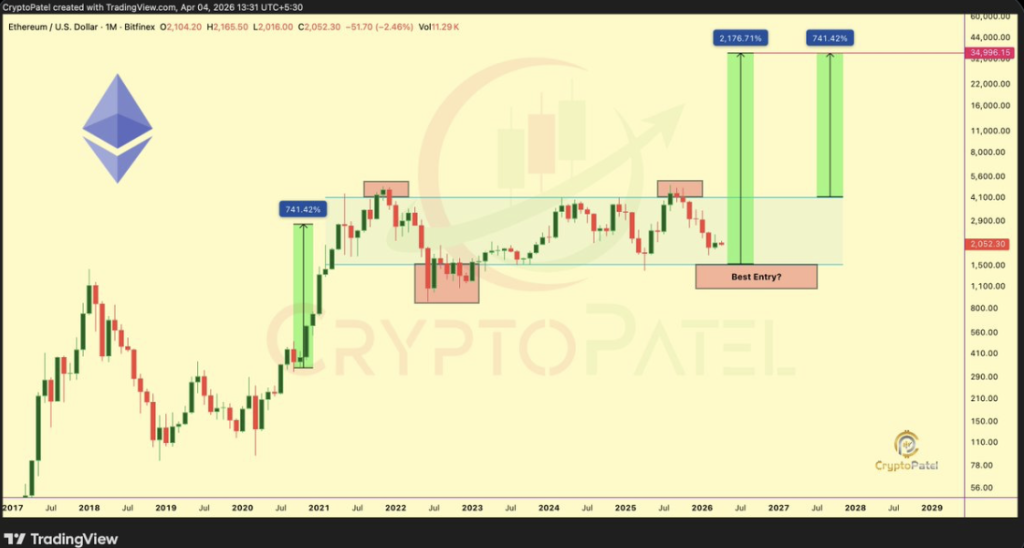
Zooming out, Ethereum has been trading within a wide range — roughly between $1,500 and $4,100 — for years now. That kind of structure doesn’t happen randomly. It usually reflects long-term accumulation or distribution cycles.
A similar pattern played out between 2018 and 2020. Back then, the market spent years consolidating before eventually breaking out in a big way. So naturally, some analysts are starting to wonder if we’re seeing something similar again.
But timing matters. Liquidity, macro conditions, broader sentiment — all of these factors play a role in whether a breakout actually happens. The derivatives shift adds weight to the idea, but it doesn’t confirm it.
Spot Market Tells a Different Story
Here’s where things get complicated. While derivatives are showing strength, spot demand isn’t exactly backing it up.
Ethereum ETFs saw over $71 million in net outflows on April 2. That suggests institutional investors, at least in the short term, are still pulling back rather than stepping in.
That creates a bit of a disconnect. On one side, traders in derivatives markets are positioning for upside. On the other, institutions in spot markets seem hesitant, maybe even cautious.
Total ETF assets still sit around $11.7 billion, so capital hasn’t disappeared. But the direction of flows — that’s what matters right now.
A Market Caught Between Signals
So what does all this mean?
On one hand, the derivatives market flipping bullish could be an early signal of a bottom forming. It’s the kind of shift that often happens before price starts moving in a more meaningful way.
On the other hand, weak spot demand — especially from ETFs — suggests that not everyone is convinced yet. And without that broader participation, rallies can struggle to sustain.
For now, Ethereum sits in this in-between phase. Not bearish, not clearly bullish either… just building, slowly.
And sometimes, that’s exactly where the next big move begins — though it doesn’t always look like it at first.