

- 6,969 NFTs enter a survival game with rising daily taxes
- Players can audit competitors and eliminate delinquent wallets
- Only 69 surviving Citizens split the entire on-chain treasury
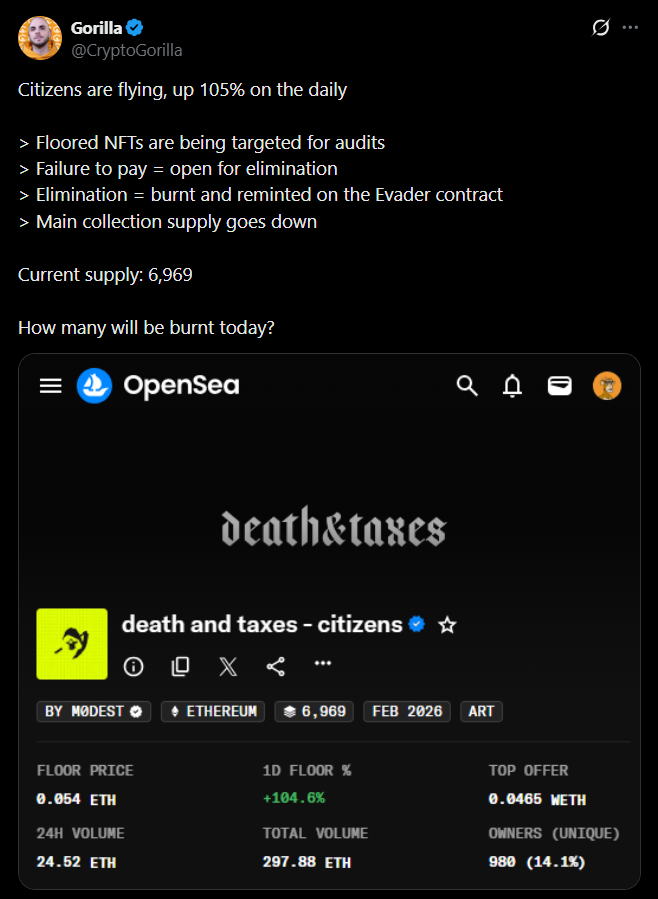
The NFT project Death and Taxes turns an old saying into a ruthless on-chain game where survival literally depends on paying up. At launch, 6,969 NFTs known as Citizens entered the system with a mint price of 0.0169 ETH each. But simply holding the NFT is only the beginning of the challenge, because every Citizen must continue paying a daily tax to stay alive in the system.
The tax begins at 0.00069 ETH and increases by the same amount every single day. Players can prepay taxes for up to seven days in advance, which offers a small buffer against mistakes. But once that window closes, the pressure starts to build. Miss a payment and the NFT becomes vulnerable, and other players are constantly watching for those slips.
Player-Driven Enforcement Makes the Game Ruthless
Unlike most NFT games that rely entirely on automated rules, Death and Taxes places enforcement directly in the hands of players. Participants can audit other Citizens to check whether their taxes are overdue. Bureaucrat class holders have a stronger advantage here, as they can perform up to three audits each day, while other players are limited to one.
If an audit reveals that taxes have not been paid, the owner has just 24 hours to fix the problem. Fail to do so, and anyone in the system can execute the elimination transaction. These eliminations are permanent and fully recorded on-chain, which adds both transparency and a very public sense of defeat.
Recently, eliminations have already begun appearing in the ecosystem. Around 119 Citizens were burned and reminted into a separate Evaders contract, marking their removal from the main survival pool. One collector known as WhyCaptainY has reportedly carried out dozens of eliminations already, showing how aggressive the system can become.
Eliminated NFTs Still Live On
In Death and Taxes, elimination does not mean total disappearance. When a Citizen is removed from the game, the NFT is burned from the main collection and reminted in the Evaders contract. The result is essentially a permanent on-chain record of failure, something like a historical artifact from the survival game.
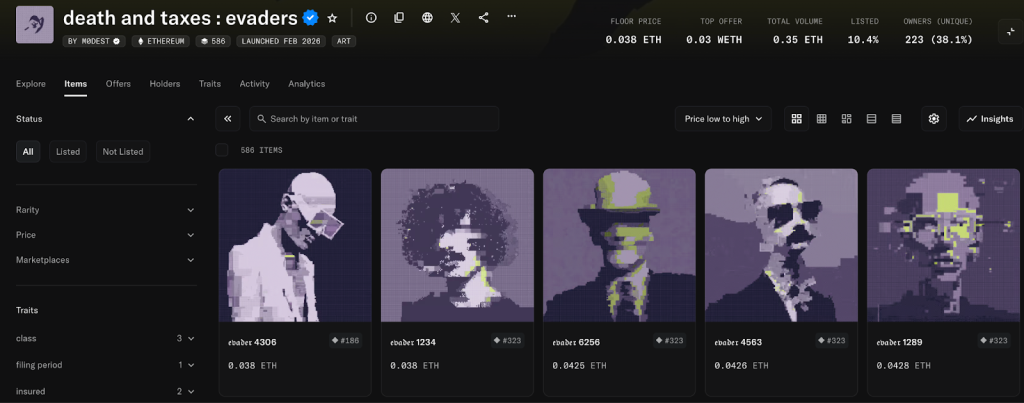
Another mechanic adds an extra strategic layer to this outcome. Holders can purchase insurance for their Citizens for 0.00969 ETH. If the NFT owner had insurance before elimination, the reminted version keeps its original colored artwork. Without insurance, the piece returns in grayscale, visually marking its fall from the active game.
Over time, this could create a fascinating visual archive. Some collectors may begin valuing eliminated Citizens as pieces of game history, especially if notable players or rare NFTs are involved.
The Treasury Prize Driving the Competition
The financial engine behind Death and Taxes is simple but surprisingly powerful. About 93.1 percent of all taxes, trading fees, and audit fees flow directly into a shared treasury. The remaining 6.9 percent goes to the project team.
As players continue paying taxes and trading NFTs on secondary markets, the treasury steadily grows. The game only ends when the number of surviving Citizens drops to 69 or fewer. At that point the tax system shuts down and the treasury becomes claimable.
Each surviving Citizen receives an equal share of the final pool, which means the entire game revolves around endurance. Thousands enter, but only a tiny fraction ultimately reach the end.
A Brutal Social Experiment on the Blockchain
Death and Taxes is less like a traditional NFT collection and more like a live economic experiment. Players must constantly decide whether to continue paying higher taxes, eliminate competitors, speculate on fallen NFTs, or exit before the risks grow too high.
Every elimination shrinks the field and raises the stakes for those remaining. The math behind the game is intentionally unforgiving. Out of nearly seven thousand Citizens that began the journey, only 69 wallets will eventually survive and split the treasury.