
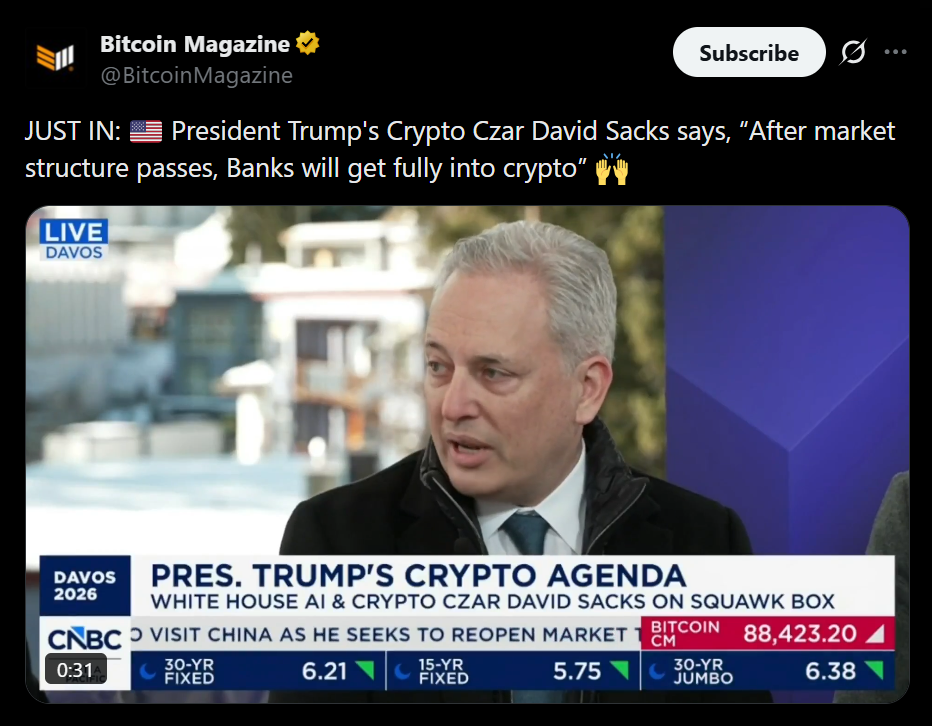
- David Sacks says banks will fully enter crypto once market structure legislation passes.
- Stablecoin yield is the main issue slowing progress.
- Long term, banks may want yield once they’re active in stablecoins.
The divide between traditional banking and crypto may not last much longer. According to David Sacks, once US crypto market structure legislation is approved, banks are likely to move fully into the digital asset space. In his view, the end result isn’t coexistence, it’s convergence. The banking industry and crypto industry don’t remain separate lanes, they collapse into a single digital assets sector.

Why Market Structure Is the Gate
Sacks made it clear that legislation is the unlock. Until market structure rules are in place, banks remain cautious and politically defensive. Once those rules pass, the incentive flips. Banks won’t sit on the sidelines anymore. They’ll issue, custody, settle, and compete directly in crypto markets. At that point, the distinction between a bank product and a crypto product becomes mostly semantic.
Stablecoin Yield Is the Sticking Point
The biggest obstacle standing in the way is stablecoin yield. Banks oppose it. Crypto firms want it. Sacks framed the dispute as commercial rather than ideological. Under current law, rewards remain a live issue, and if market structure legislation fails, crypto platforms will likely continue offering them anyway. That reality weakens the banks’ negotiating position more than many want to admit.
Why Compromise Favors Everyone
Sacks urged both sides to meet in the middle. Banks, he argued, should recognize that blocking progress entirely could leave them worse off. Crypto firms, meanwhile, need to decide whether defending yield at all costs is worth delaying an entire regulatory framework. In his words, a real compromise usually leaves everyone slightly unhappy, and that’s often how durable policy gets passed.
The Endgame Banks Are Quietly Eyeing
Sacks also hinted at something banks rarely say out loud. Over time, they may actually want stablecoin yield. Once banks are issuing and managing stablecoins themselves, paying yield stops being a threat and starts being a feature. At that point, the debate flips from restriction to competition.
A Familiar Legislative Path
Comparing the current stalemate to the GENIUS Act’s rocky journey, Sacks suggested this bill may stumble multiple times before crossing the finish line. That doesn’t mean failure. It means friction. If history is any guide, market structure legislation will pass when both industries accept that harmonization, not dominance, is the real prize.