- Charles Hoskinson believes Cardano has largely peaked as a standalone layer-1 and must now scale its DeFi ecosystem to grow further.
- He says key metrics like TVL, stablecoin supply, and monthly active users need to grow 10x–100x to compete with Ethereum and Solana.
- Hoskinson views the Midnight sidechain as a major adoption driver, especially for privacy-focused apps, institutional use cases, and cross-chain users.
Cardano founder Charles Hoskinson has once again weighed in on what he believes could unlock the next phase of growth for the ADA ecosystem. Speaking in a recent interview with Altcoin Daily co-founder Aaron Arnold, Hoskinson pointed less toward hype cycles and more toward fundamentals, specifically the expansion of Cardano’s decentralized finance layer.
According to him, the next real catalyst won’t come from shiny narratives alone. It will come from numbers, usage, and DeFi activity that actually shows up on-chain.
DeFi, Not Just Layer 1, Is the Next Test
When asked whether he feels more bullish on Cardano itself or on its privacy-focused sidechain, Midnight, Hoskinson made it clear that he sees them as tightly linked rather than competing ideas. He said he remains committed to both, but believes their combined impact could be what finally pushes Cardano into its next growth phase.
Hoskinson was fairly blunt in his assessment. In his view, Cardano has largely reached its ceiling as a standalone layer-1 network. To move forward, it needs to lean harder into DeFi and start posting results that rival other major chains.
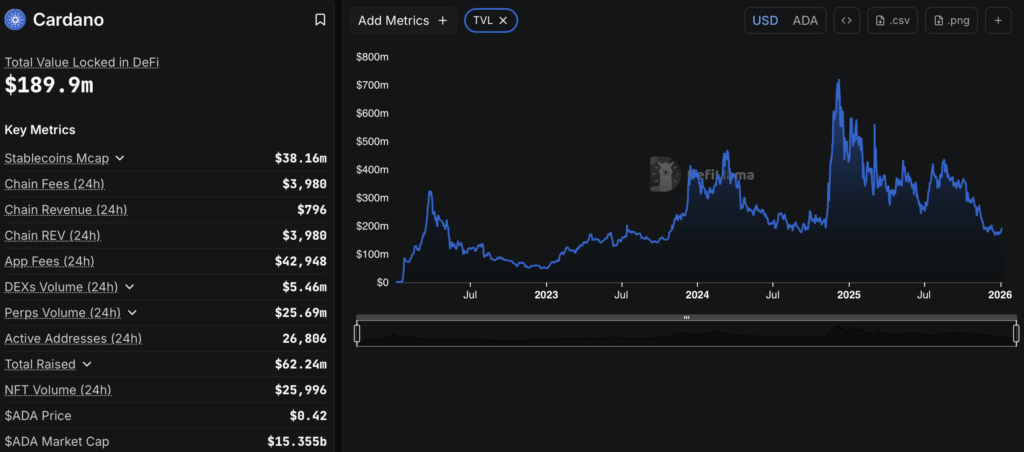
“We’ve got to start putting up the numbers,” he said, pointing directly to metrics like monthly active users, total value locked, and stablecoin supply. In his opinion, those figures need to grow anywhere from 10x to 100x from current levels if Cardano wants to compete seriously with ecosystems like Ethereum or Solana.
Stablecoins and Liquidity Are a Priority
That focus on DeFi metrics isn’t just talk. The Cardano ecosystem has already taken steps to close the gap. Recently, the Cardano Foundation committed an eight-figure amount of ADA to strengthen stablecoin liquidity across DeFi protocols. Hoskinson also confirmed that efforts are underway to bring major stablecoins like USDC and USDT onto Cardano this year.
The goal is simple, even if execution isn’t. More stablecoins mean easier onboarding, deeper liquidity, and better user retention. Without that, DeFi growth tends to stall, no matter how strong the underlying tech might be.
Why Midnight Could Be the Missing Piece
Hoskinson also spent time highlighting Midnight, describing it as part of what he calls the “fourth generation” of cryptocurrencies. In his view, Midnight introduces a new angle by focusing on privacy while remaining compatible with multiple chains.
He argued that if Midnight can move quickly and establish itself in this emerging privacy niche, it could attract a sizable share of the broader crypto market. More importantly, he believes Cardano-based applications that integrate with Midnight could tap into entirely new user bases.
By upgrading to hybrid platforms that combine Cardano’s infrastructure with Midnight’s privacy features, Hoskinson said decentralized apps could realistically onboard the next million users. That inflow, he suggested, wouldn’t just come from Cardano natives, but from Bitcoin, XRP, and other ecosystems looking for privacy-aware solutions.
A Bigger Vision Than DeFi Alone
Beyond retail users, Hoskinson also pointed to institutional interest. He noted that Midnight’s privacy and multi-chain design could appeal to legacy finance players exploring real-world asset tokenization and global remittances. Those use cases, if they materialize, would feed directly back into Cardano’s DeFi metrics.
In the end, Hoskinson framed the Cardano–Midnight collaboration as an attempt to create a better overall experience than what users currently find on Ethereum or Solana. If that vision plays out, he believes the result could be a defining year for Cardano.
“It would be a bull year,” he said, with the caveat that the ecosystem still has to execute.