- The CFTC will allow the first-ever regulated spot crypto trading on U.S. futures exchanges.
- Acting Chair Caroline Pham calls it a “historic milestone” tied to the Trump Administration’s innovation agenda.
- The move follows broad work from the President’s Working Group and the CFTC’s Crypto Sprint, including tokenized collateral reforms.
The U.S. Commodity Futures Trading Commission has taken a historic leap, confirming that listed spot cryptocurrency products will begin trading for the first time ever on federally regulated U.S. futures exchanges. The announcement, delivered by Acting Chairman Caroline D. Pham, pushes forward the Trump Administration’s pledge to spark a “Golden Age of Innovation” and position America as the crypto capital of the world — a phrase that suddenly feels a bit less like a catchphrase and more like a policy roadmap.

A Landmark Shift Led by the CFTC
Pham stressed that the agency’s long-running approach — balancing innovation with core protections — is now being activated in full for digital assets. And, somewhat bluntly, she credited the Administration’s leadership for forcing clarity where regulators had dragged their feet for years.
She explained that, despite Congress giving the CFTC authority 15 years ago to ensure leveraged retail commodity trading takes place only on regulated futures exchanges, the agency never implemented the framework needed to safely list retail spot products. Instead, she argued, the CFTC allowed “regulation by enforcement” to take hold, hitting crypto firms with massive fines but offering no safe legal pathway for Americans to trade.
That era, she said, is now over.
Why This Moment Matters
The new framework doesn’t just check a regulatory box — it reshapes what “legal crypto trading” means in the U.S. For the first time, spot Bitcoin and other digital assets can be traded on systems that have served as financial backbones for nearly a century.
And the timing is intentional:
• Recent failures and scandals on offshore exchanges highlighted the danger of pushing U.S. crypto traders abroad.
• Market demand for federally overseen spot crypto products has been building for years.
• The Administration’s digital assets strategy placed heavy emphasis on giving retail traders safe, American trading venues — not ones operating “in the shadows” overseas.
Pham described the transition as essential, saying Americans deserve markets with “the customer protections and market integrity that have defined U.S. futures trading for almost a hundred years.”
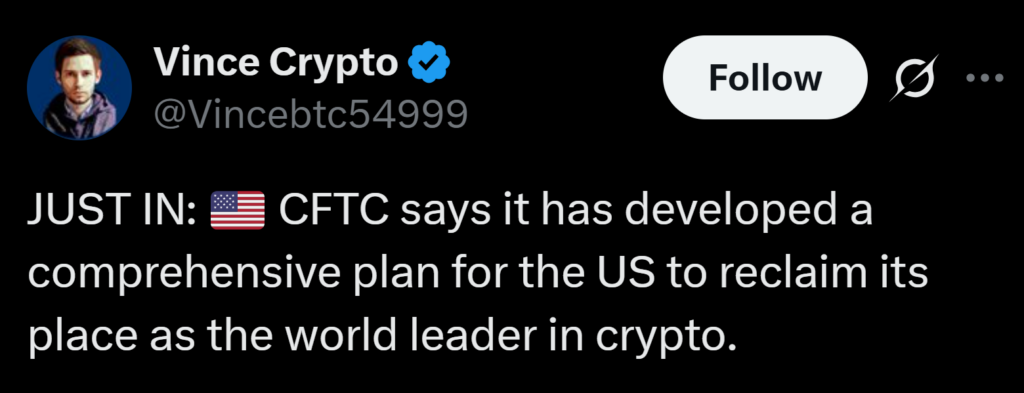
Backed by the President’s Working Group and the CFTC’s Crypto Sprint
The move follows months of consultation under the President’s Working Group on Digital Asset Markets, along with public engagement through the CFTC’s Crypto Sprint — a multi-part initiative designed to rapidly modernize the agency’s rulebook for digital assets.
Other related efforts include:
• A new framework enabling tokenized collateral, including stablecoins, inside derivatives markets.
• A sweeping rulemaking that updates margin, clearing, settlement, reporting, and recordkeeping rules to support blockchain-based market infrastructure.
• Cooperative regulatory work with the U.S. Securities and Exchange Commission, a shift from the turf battles that previously defined crypto oversight.
According to Pham, the goal is simple: modern rules, safer markets, and a clear regulatory path that encourages innovation instead of punishing it.
A Turning Point for U.S. Crypto Markets
For a market long forced into offshore venues, the impact of this decision could be massive. Traders gain access to regulated markets. Institutions get clarity. And the U.S., after spending years sidelined by indecision and enforcement skirmishes, is recalibrating its stance toward leadership.
If this rollout succeeds, it may be remembered as the moment America finally decided to stop watching crypto innovation happen everywhere else — and started bringing it home.