

- Cardano ranked higher than Bitcoin and Ethereum in a new decentralization scorecard focused on governance, validators, and protocol design.
- The launch of native USDCx on Cardano strengthened arguments around on-chain control and reduced reliance on third-party bridges.
- Ongoing debate shows decentralization is no longer just about mining, but about governance access and how value moves across crypto networks.
In the latest Cardano news, the network’s decentralization ranking has stirred up a surprisingly heated debate. A new assessment placed Cardano ahead of both Bitcoin and Ethereum, which immediately challenged some long-held assumptions in the crypto space. Rather than focusing on market cap or brand recognition, the analysis leaned into governance design, validator distribution, and native protocol systems.
Cardano News: The Decentralization Ranking
The Cardano decentralization ranking gained traction after analyst Justin Bons released a detailed scorecard aimed at measuring how power and control are actually spread across major blockchains. Under this framework, Cardano scored 46 out of 60, landing ahead of Ethereum at 42, Solana at 40, and Bitcoin at 20. The metrics focused on governance and infrastructure, not price action or adoption headlines.
Bons highlighted Cardano’s large validator set, broad client diversity, built-in delegation model, and its on-chain governance structure. These elements, taken together, helped Cardano perform strongly across most of the categories. It wasn’t about one feature standing out, but how the pieces fit together, more or less.
According to the Cardano news breakdown, the main weakness came from what Bons described as limited internal pushback against IOHK and founder Charles Hoskinson. That dynamic slightly dragged down the final score, even though the underlying systems remained intact.
The discussion widened after crypto commentator dori compared the rankings directly against other top chains.
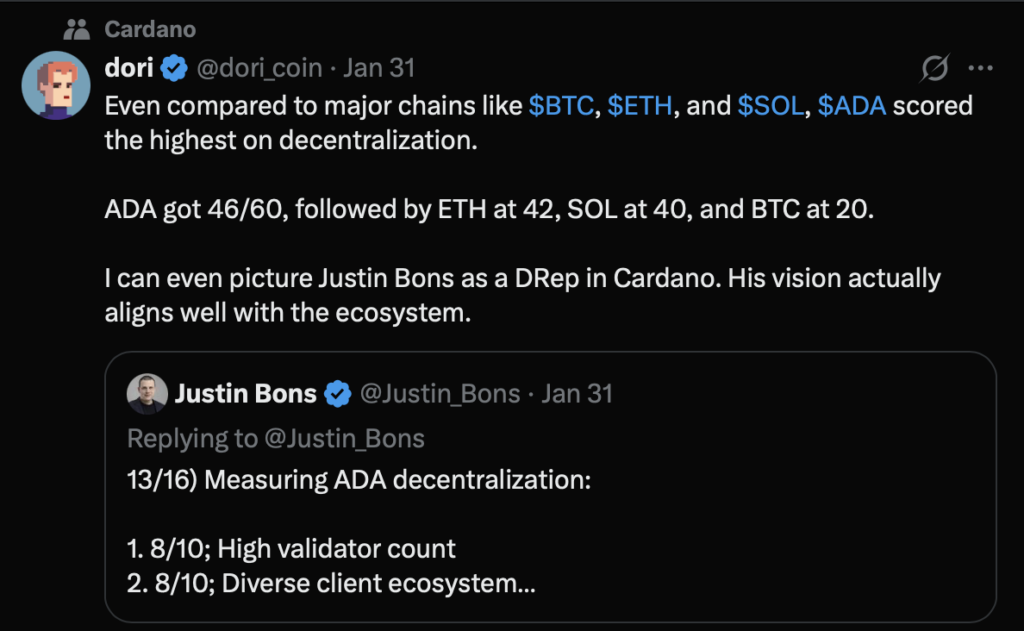
As noted in dori’s Cardano news commentary, ADA still emerged as the most decentralized network under this specific framework. That conclusion reframed the usual narrative, especially since Bitcoin is often treated as the default standard for decentralization due to its age and lack of formal leadership.
Supporters of the ranking argue that decentralization today is about more than mining or validator count alone. Governance access, participation in upgrades, and how decisions are executed now matter just as much. From that angle, Cardano’s design allows users to engage directly without relying on off-chain coordination or informal power centers.
Critics, though, point out that any ranking depends heavily on definitions. Bitcoin’s low score reflects its intentionally minimal governance model, not necessarily centralized control. In that sense, the debate says as much about evolving expectations as it does about the networks themselves.
Cardano News: Expanding Functionalities
Separate Cardano news developments have also added context to the decentralization conversation. One of the more talked-about updates is the launch of native USDC on Cardano via Circle’s Cross-Chain Transfer Protocol.
The asset, known as USDCx, is neither wrapped nor issued through a custodial bridge. Instead, USDC is burned on the source chain and minted natively on Cardano, remaining fully backed one-to-one by Circle’s reserves. It’s a cleaner mechanism, even if it sounds technical at first glance.
By design, this approach removes reliance on third-party bridges, which have become frequent targets for exploits across the broader crypto market. Charles Hoskinson confirmed the agreement with Circle, describing it as a direct pipeline to global dollar liquidity rather than a synthetic workaround.

With native USDC in place, users can supply liquidity on decentralized exchanges like Minswap, interact with lending protocols such as Liqwid, and settle payments without leaving the Cardano ecosystem. Supporters argue this keeps risk lower while preserving on-chain control instead of outsourcing trust.
Treasury incentives for USDCx and ADA pairs are expected to attract liquidity providers over time. If that plays out, Cardano’s DeFi markets could deepen while keeping assets native, which matters more than it might sound. For advocates, this is another example of decentralization extending beyond consensus and into how value actually moves.
Tim Draper and the Early Bitcoin Adoption Perspective
Outside of the Cardano news cycle, the debate often circles back to Bitcoin’s early days. Venture capitalist Tim Draper recently revisited his purchase of 30,000 Bitcoin at a U.S. Marshals auction, when BTC was trading near $618 and still far from mainstream acceptance.
Draper said the logic was straightforward. If Bitcoin succeeded, its upside against fiat had no clear ceiling. If it failed, the difference in bid price wouldn’t really matter in the end.

He won all nine auction lots and briefly offered portions to former partners, who passed. The process itself, though, exposed Bitcoin’s early limitations. Draper recalled waiting through multiple confirmations as the network moved slowly at the time.
That experience captures something important. Bitcoin adoption, especially early on, was driven more by conviction than efficiency. And that history still shapes how decentralization is understood today, even as newer networks try to redefine it.