
- Cardano is preparing an intra-era hard fork to Protocol Version 11, delivering upgrades to security, Plutus smart-contract capabilities, and on-chain governance while staying in the Conway era to reduce disruption.
- The proposal, now in public review and supported by Intersect and the Hard Fork Working Group, includes Plutus compatibility across V1–V3, new array and multi-asset support, faster list operations, and performance gains via improved UPLC case expressions.
- Ledger-level changes like unique VRF key enforcement, corrected Plutus rules, and moving governance voting logic into the ledger aim to harden the protocol, with community feedback guiding final adjustments before mainnet rollout.
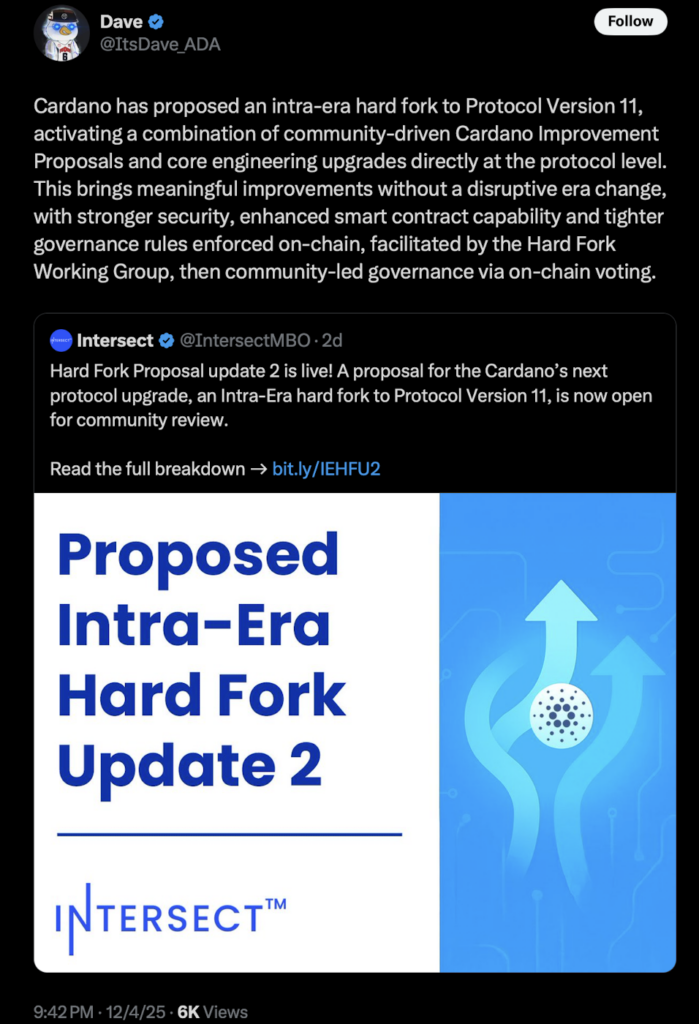
Cardano is gearing up for another pretty major technical step, as community contributor Dave highlighted the proposal for an intra-era hard fork to Protocol Version 11. It’s not a full era shift—so no brand-new ledger era to migrate into—but more of a heavy upgrade layered into the current one. The goal? Tighten security, boost smart-contract flexibility, clean up on-chain governance quirks, and do it all without changing the transaction format users are used to.
The proposal has now officially entered public review, with backing from Intersect and the Hard Fork Working Group. Both groups are coordinating feedback, stress-testing assumptions, and basically making sure the rollout isn’t rushed or sloppy.
Hard Fork Proposal Update 2 Goes Live
Intersect confirmed that Hard Fork Proposal Update 2 is now open, kicking off the structured community review phase. This package focuses on three big pillars:
• stronger Plutus scripting capabilities,
• cleaner and more predictable ledger behavior, and
• tighter node-level protections.
These improvements come from ongoing treasury-funded development and have finally reached the point where the wider ecosystem—wallets, devs, node operators—can dig in.
Cardano plans a mainnet hard fork that keeps everything inside the Conway era, which makes life easier for tooling and infrastructure teams. No major rework for wallets, no panic updates. The Hard Fork Working Group, which helped navigate the Chang and Plomin updates, will continue meeting twice a month and is open for anyone in the ecosystem to join and contribute feedback.
Plutus and Ledger Upgrades Take Center Stage
One of the biggest parts of the proposal touches the Plutus environment. Every built-in function will remain compatible across Plutus V1, V2, and V3. That means developers won’t need to reinvent or rewrite entire scripts just to adopt the new capabilities.
There’s also a performance boost coming. UPLC is getting support for case expressions on Bool, Integer, and Data types, which should clear up a bottleneck that’s been slowing more complex scripts for a long while.
Some standout features proposed include:
• array-type support,
• better multi-asset behaviors,
• faster list operations,
• modular exponentiation improvements,
• multi-scalar multiplication support.
All of these push Cardano deeper into on-chain functionality the ecosystem has been asking for.
Ledger improvements are on the table as well—things like enforcing unique VRF keys for better security, correcting certain Plutus rule inconsistencies, and moving governance voting logic directly into the ledger layer, making it harder to manipulate and easier to verify.
Cardano’s Upgrade Path Moves Forward
As the proposal develops, the working groups will continue refining the details and adjusting based on feedback from the community. Nothing is final until the ecosystem is comfortable, and Cardano tends to move cautiously when upgrades touch critical infrastructure.
For now, all eyes are on how Protocol Version 11 evolves during review. Users, developers, and node operators can follow the progress as the technical teams turn the proposal into a fully-ready mainnet upgrade.