

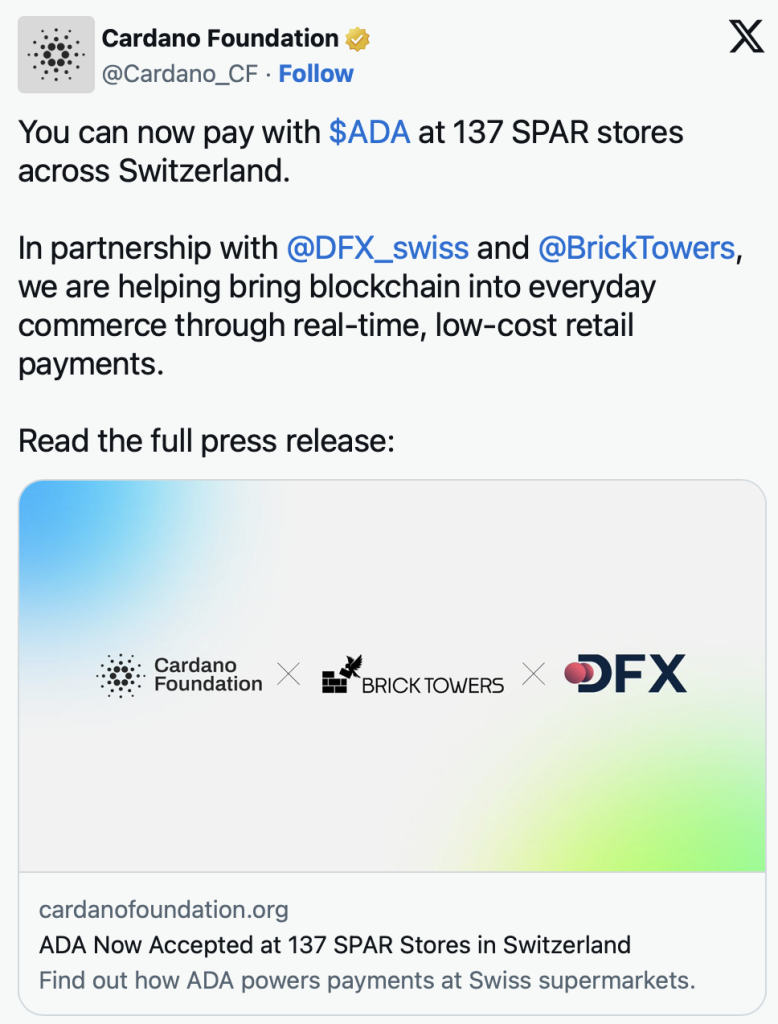
- Cardano’s ADA can now be used for grocery purchases at 137 Spar supermarkets in Switzerland.
- The new Open Crypto Pay system allows direct wallet payments with lower merchant fees.
- ADA price remains range-bound near $0.27 despite growing real-world adoption.
Cardano’s ADA token has taken a notable step into everyday commerce. Shoppers can now use ADA to pay for groceries at 137 Spar supermarkets across Switzerland, marking one of the more practical retail integrations the blockchain has seen so far. While crypto payments in stores aren’t entirely new, seeing them scale across a large retail chain like this feels… a bit different.
The rollout was announced on March 5 by Open Crypto Pay, a payment platform built by the Swiss crypto company DFX.swiss. According to the announcement, customers can now pay directly from their ADA wallets at participating Spar locations. The Cardano Foundation later confirmed the update, describing it as part of a broader push to bring blockchain payments into everyday retail settings.
Direct Wallet Payments Without Central Exchanges
One interesting part of the system is how transactions are processed. Payments are confirmed in real time on the blockchain, which means there’s no need to route transactions through centralized crypto exchanges. The result is a simpler payment flow — at least in theory — where users send ADA directly from their wallets and merchants receive confirmation almost immediately.
There’s also a cost benefit involved. Traditional payment methods like credit cards or bank transfers often carry merchant fees that eat into profits. By contrast, ADA payments can significantly reduce those costs. Estimates suggest merchants could save roughly 66% compared to the fees typically charged by traditional payment networks.
For retailers operating on thin margins, that kind of difference can matter quite a bit.
Cardano Foundation Sees Shift Toward Blockchain Payments
Frederik Gregaard, CEO of the Cardano Foundation, framed the development as part of a much larger trend. In his view, blockchain payments are gradually moving from experimental infrastructure into something that actually works in day-to-day economic activity.
“This is the beginning of a fundamental shift in how value moves through society,” Gregaard said while discussing the rollout. It’s a bold statement, sure. But the broader point is clear: blockchain systems are slowly transitioning from theoretical tools into practical financial rails that businesses and consumers can use.
That transition won’t happen overnight, of course. Still, developments like this suggest the gap between crypto and traditional commerce might be shrinking, little by little.
Switzerland Continues Building a Crypto-Friendly Environment
Spar’s decision also reflects Switzerland’s broader push to position itself as a global hub for digital asset innovation. The country has been steadily embracing blockchain infrastructure for years now, encouraging experimentation across finance, payments, and decentralized technologies.
Spar had already started integrating crypto payments before this ADA rollout. Earlier initiatives allowed customers to pay using stablecoins at more than 100 Swiss stores through partnerships with DFX.swiss and Binance Pay. The company has even indicated that it plans to expand crypto payments to as many as 300 stores across Switzerland in the future.
Meanwhile, cities like Lugano are taking things even further. Residents there can already pay certain municipal fees using Bitcoin and USDT, part of the city’s broader “Plan B” initiative aimed at turning Lugano into a leading digital asset hub. The effort also receives backing from Tether, which has committed funding to support the program.
ADA Price Remains Range-Bound
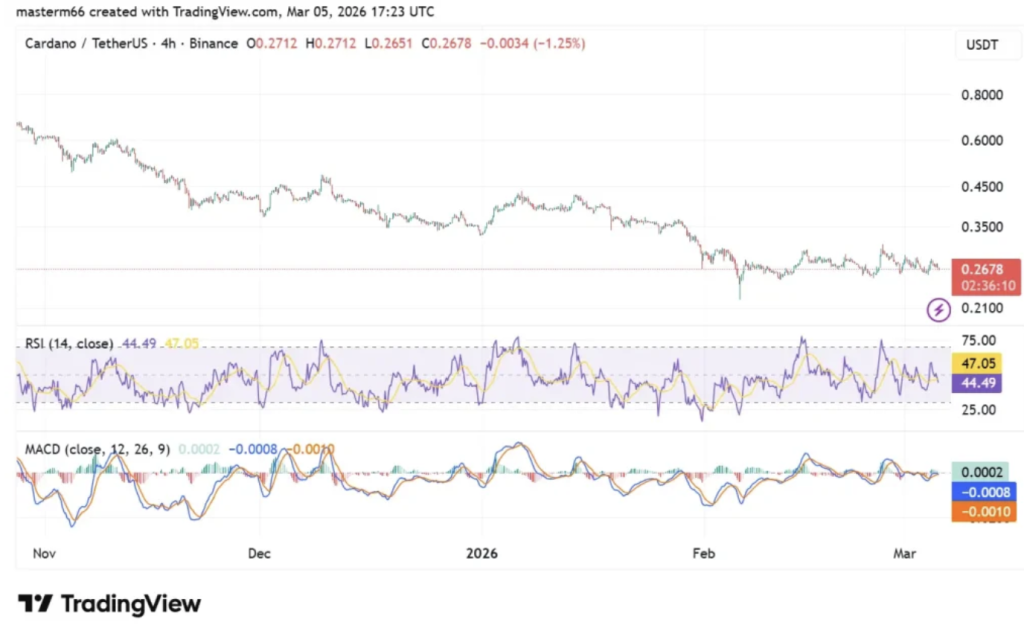
Despite the positive retail adoption news, Cardano’s market price hasn’t reacted dramatically. At the time of writing, ADA is trading near $0.27 according to TradingView data, still stuck within a trading range that has persisted for several months.
Technically speaking, the asset remains in a broader downtrend on the 4-hour chart. The price continues trading below major moving averages, including the 50-period exponential moving average around $0.274. Above that sits an even stronger resistance zone near the 200-period EMA around $0.288.
Momentum indicators also show a fairly neutral market. The Relative Strength Index currently sits around 44, suggesting neither strong buying nor heavy selling pressure. Meanwhile, the MACD remains slightly negative, indicating that bearish momentum hasn’t fully reversed just yet.
If ADA manages to break through the $0.274–$0.288 resistance range, analysts believe the token could attempt a recovery toward the $0.30 level. On the other hand, if it loses support around $0.26, the market could see another slide toward roughly $0.24.
For now, the price is waiting — but adoption, at least, is moving forward.