

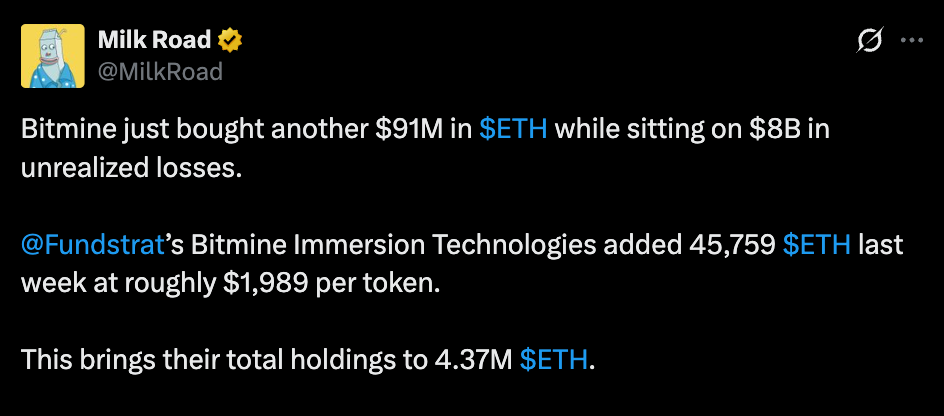
- BitMine holds 4.37M ETH and stakes over 3.04M of it for yield
- Annualized staking revenue is ~$176M, with a path toward ~$252M via MAVAN
- The strategy is less about ETH price and more about crypto infrastructure cash flow
Holding 4.37 million ETH is already aggressive by any corporate standard. But staking more than 3 million of that stack pushes BitMine Immersion Technologies into a completely different category. This isn’t a company sitting on tokens and praying for a rebound. It’s a firm actively treating Ethereum like a balance sheet engine, the kind that quietly produces revenue while everyone else argues about charts.
At current rates, BitMine is already generating roughly $176 million annually in staking revenue. And according to its own projections, that figure could climb toward $252 million per year once MAVAN is fully deployed. That’s not theoretical yield farming. That’s institutional-scale staking revenue, even with ETH still down hard on the year.
Ethereum Looks Less Like a Trade and More Like Productive Crypto Infrastructure
Most of the market still talks about ETH as if it’s a tech stock proxy, a high-beta trade that rises and falls with sentiment. BitMine is treating it like infrastructure. Validators earn. Networks secure themselves. And cash flow shows up in the background, almost boringly, while the headlines stay obsessed with price levels.
Even with Ethereum down more than 30% on the year, the staking math keeps working. That disconnect matters because it forces a different conversation. If ETH can generate meaningful revenue while price is weak, then ETH stops being just a speculative asset. It starts looking like a productive one, and that changes how treasuries behave.
Volatility Isn’t a Bug, It’s Part of the Strategy
Chairman Tom Lee is right about one thing: balance sheet swings are not a flaw here, they’re built into the model. BitMine is effectively running long-duration exposure to Ethereum’s relevance, while staking revenue cushions the ride. That is a very different posture than simply buying ETH and hoping for upside.

Volatility becomes something the company absorbs rather than something it fears. Unrealized losses may look ugly in a drawdown, sure, but staking revenue keeps compounding in the background. And when markets eventually shift, the treasury doesn’t just rebound on price. It rebounds with a larger, yield-producing base.
Corporate Crypto Is Starting to Look Like a Real Asset Class
BitMine is no longer operating like a miner in the traditional sense. Between ETH holdings, staking infrastructure, cash positioning, and strategic equity exposure, it’s running closer to a digital asset holding company. This is what corporate crypto looks like when it stops apologizing and starts acting like an allocator.
The market is still adjusting to this concept. Bitcoin treasuries were the first wave. Ethereum treasuries might be the next, and staking is what makes them structurally different. A BTC treasury is a scarcity bet. An ETH treasury is scarcity plus yield, and that combo hits differently.
BitMine Is Building Yield While Markets Fixate on Drawdowns
While traders focus on ETH’s drawdowns and macro uncertainty, BitMine is building something more durable. Four million ETH generating real revenue is not a narrative. It’s a statement. Ethereum is no longer just something you trade when sentiment is hot.
For some balance sheets, it already works, even in the cold.