
- New mining cycle is pushing companies beyond pure Bitcoin hashpower
- AI high-performance computing offers higher revenue than mining
- Public markets are rewarding miners shifting into AI infrastructure
Bitcoin mining has traditionally followed a predictable rhythm. After each halving, block rewards drop, inefficient operators disappear, and the surviving miners eventually benefit when Bitcoin prices climb again. That cycle has played out multiple times over the past decade.

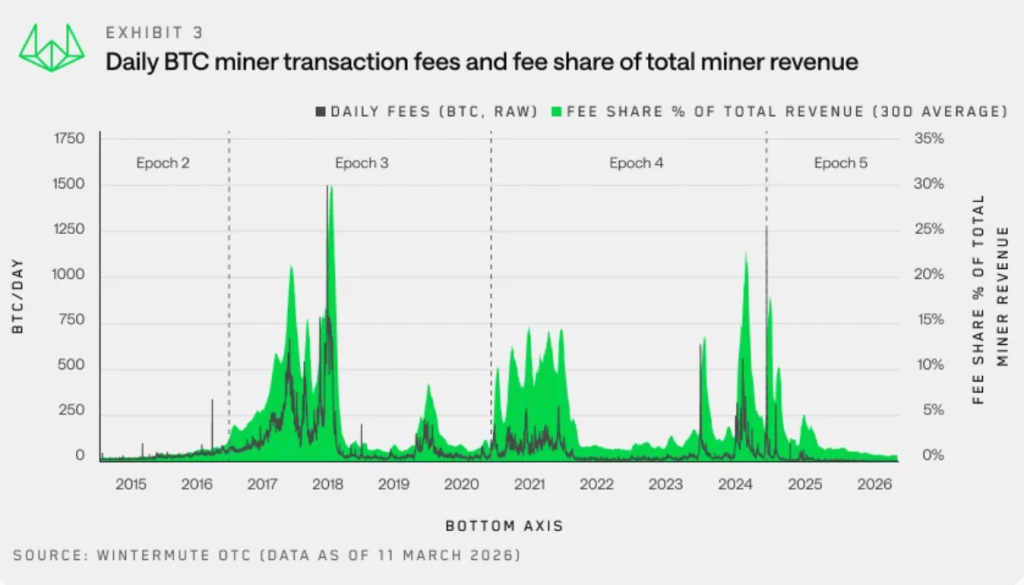
But the current cycle appears to be evolving into something very different. According to new research from Wintermute, the latest phase of Bitcoin’s mining economy, often referred to as “Epoch 5,” is structurally changing the industry. Instead of simply waiting for higher BTC prices to restore profitability, many miners are transforming their entire business strategy.
Mining Margins Are Under Pressure
The core challenge miners face today is tightening profitability. After the most recent halving reduced block rewards, mining revenue fell while competition continued to increase. At the same time, the global Bitcoin hashrate has kept climbing, meaning more computational power is competing for fewer rewards.
Wintermute’s analysis suggests that margins in this cycle are diverging from patterns seen in previous post-halving recoveries. Historically, miners could rely on a gradual rebound in Bitcoin prices to offset declining rewards. In the current environment, however, that strategy alone may not be enough.
As a result, many companies are rethinking what it means to operate a mining business.
Miners Are Becoming Energy and Compute Companies
Rather than functioning solely as Bitcoin miners, several firms are beginning to reposition themselves as broader infrastructure providers. The massive facilities built for mining already contain high-power electrical connections, advanced cooling systems, and data center capacity capable of running thousands of machines.
Those same capabilities can also support high-performance computing workloads, particularly the infrastructure required to train and operate artificial intelligence models.
This shift effectively turns mining companies into hybrid operators sitting between energy providers, data centers, and technology infrastructure.
AI Data Centers Are Becoming the New Revenue Engine
The most significant development is the growing shift toward high-performance computing for artificial intelligence. According to Wintermute’s report, HPC workloads tied to AI can generate significantly higher revenue per gigawatt hour than traditional Bitcoin mining.
For miners already operating large-scale facilities, this creates a compelling opportunity. Instead of dedicating all available energy capacity to hashing, companies can allocate portions of their infrastructure toward AI computing services.
Investors have already begun reacting to this transition. Publicly traded mining companies that announce partnerships related to AI compute or HPC infrastructure have often seen their market valuations rise.
The Industry Is Evolving Into Something New
This transformation suggests that Bitcoin mining is entering a new phase. Hashrate and electricity costs still matter, but they are no longer the only drivers of a mining company’s value.
Instead, the sector is gradually evolving into a hybrid industry where energy infrastructure, computing capacity, and artificial intelligence all intersect.
If this trend continues, the largest mining companies of the future may resemble technology infrastructure firms more than traditional crypto miners. They could operate massive AI-ready data centers that also secure the Bitcoin network in the background.
In that sense, Bitcoin mining may be quietly becoming one of the foundational infrastructure layers of the emerging AI economy.