- NFTs emerge as identity layer for autonomous AI agents
- Agent economies require persistent, verifiable onchain identity
- Shift moves NFTs from speculation to core infrastructure
NFTs have spent the last couple of years trying to justify their existence. Floor prices dropped, narratives faded, and most of the conversation circled back to the same question, what are these actually for? Now, quietly, a different answer is starting to take shape. Not collectibles, not status symbols, but identity.
Because as AI agents become more capable, something strange happens. They can act, transact, even earn, but they don’t really have a way to exist consistently across systems. That gap, oddly enough, is where NFTs start to make sense again.
AI Agents Need Identity More Than Anything
Sreeram Kannan’s thesis is pretty straightforward, AI makes agents intelligent, crypto makes them economic. Combine the two, and you don’t just get better software, you get something closer to autonomous entities.
But there’s a problem. Agents can’t legally own assets or sign contracts. They don’t have identity in the way humans do. Blockchain solves part of that by letting code control assets, but something still needs to anchor that control.
That anchor, in many cases, is an NFT. A fixed, onchain identity that doesn’t change, even as the agent evolves.
The Missing Layer Isn’t Intelligence, It’s Accountability
What’s interesting is that the bottleneck here isn’t capability. AI is already getting good enough. The real issue is trust and accountability.
If an agent interacts with another agent, how do you know who, or what, you’re dealing with? Without identity, everything becomes anonymous and difficult to verify. That’s not ideal in a system where value is moving around.
An NFT tied to the agent solves that in a simple way. It becomes a persistent credential, something that proves continuity across interactions.
Developers Are Already Building Around This
This isn’t just theory floating around on social media. Developers like @aaronjmars are mapping out how these agent systems actually function, from execution environments to payments and collaboration layers.
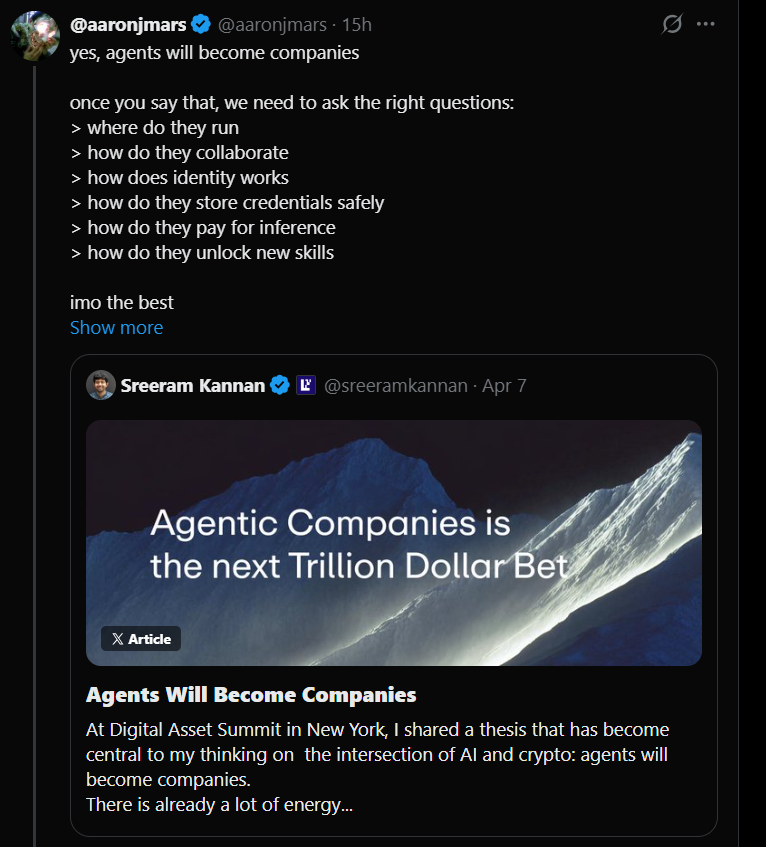
GitHub becomes the coordination layer. Micropayments like x402 fund operations. And underneath all of it sits identity, which ties everything together. Without that layer, the rest starts to feel disconnected.
Teneo Shows It’s Already Live
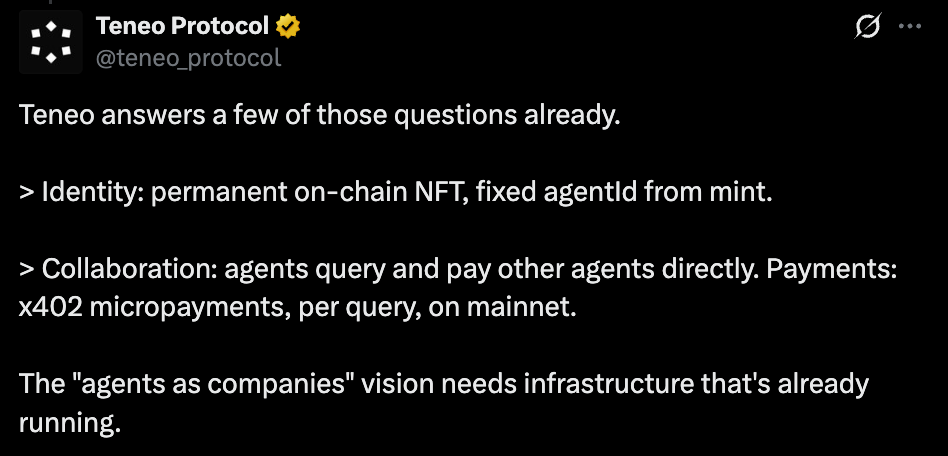
Teneo Protocol takes it a step further by actually shipping the model. Their system assigns each agent a permanent NFT identity at mint, one that doesn’t change over time.
That identity allows agents to transact, communicate, and operate across networks with a consistent reference point. It’s not flashy, and it’s definitely not designed for speculation, but it works.
And that’s the part that stands out. NFTs here aren’t the product, they’re the infrastructure.
NFTs Might Finally Have a Real Use Case
For years, the space talked about utility without really landing on something concrete. This might be it. An identity layer for autonomous systems that need to operate without human oversight.
If the agent economy grows the way some expect, NFTs won’t be remembered for profile pictures or hype cycles. They’ll be remembered for quietly solving a problem that nothing else handled well.
And that’s a very different narrative than the one people got used to.