
- Whales accumulated heavily during the governance-driven selloff, increasing supply concentration
- Selling pressure on exchanges has declined as uncertainty cooled slightly
- AAVE must reclaim $174 to unlock upside, while $160 remains critical support
The recent governance turmoil around Aave quietly handed smart money a rare opportunity. As headlines grew louder and sentiment cracked, AAVE sold off hard, sliding nearly 20% to lows around $143 and erasing more than $500 million from its market cap in the process. For many retail traders, that drop was enough to step aside, or panic out entirely.
But beneath the surface, something very different was happening.
Whales Used the Chaos to Accumulate
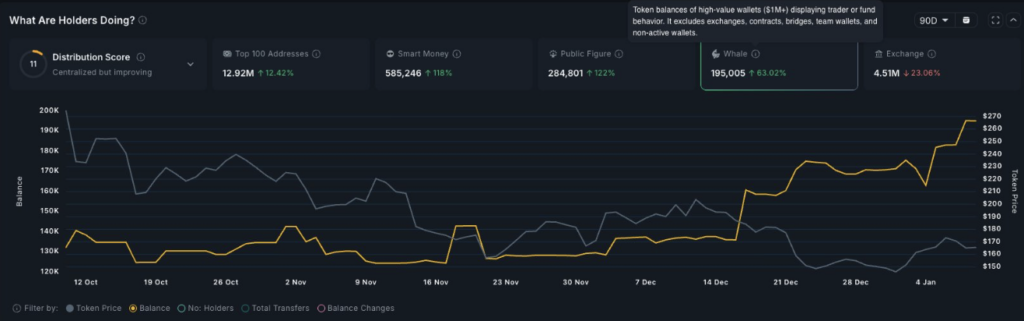
During the height of the selloff, the Top 100 AAVE addresses steadily increased their holdings to roughly 12.92 million tokens, adding close to 8% of the total supply while prices were under pressure. As a result, those top wallets now control nearly 80% of all AAVE in circulation, a concentration that rarely goes unnoticed for long.
Large holders weren’t just active, they were aggressive. Whale wallets holding over $1 million worth of AAVE jumped by roughly 66% between early and late December, climbing from around 120,000 to nearly 200,000. That surge in whale participation made it clear that bigger players were buying while smaller investors were backing away during the governance dispute.
Selling Pressure Began to Cool Off
Perhaps more important than accumulation was what happened next on exchanges. Santiment data showed that during the peak of the Aave Labs and DAO governance drama, AAVE balances on exchanges spiked from about 1.22 million to 1.43 million tokens. That increase lined up closely with the sharp drop from $182 to $143, reflecting heightened selling pressure.
Since then, that pressure has eased. Supply on exchanges has fallen back to roughly 1.31 million AAVE, suggesting that sellers are running out of momentum, at least for now. Notably, this cooling-off period followed public commitments from Aave Labs and founder Stani Kulechov to explore sharing non-protocol revenue with tokenholders, a move that helped calm some nerves.
That said, the situation isn’t fully resolved. Until negotiations between the involved parties are finalized in a binding agreement, lingering uncertainty remains part of the equation.
Derivatives Stay Quiet as Spot Tells the Story
While spot market behavior shifted, derivatives activity stayed relatively muted. Open Interest hovered between $130 million and $150 million, roughly the same range seen during the quiet conditions of Q4 2025. This lack of leverage suggests the recent price action has been driven more by spot positioning than speculative excess, which can be a healthier setup, depending on what comes next.
AAVE Price Levels That Matter Now
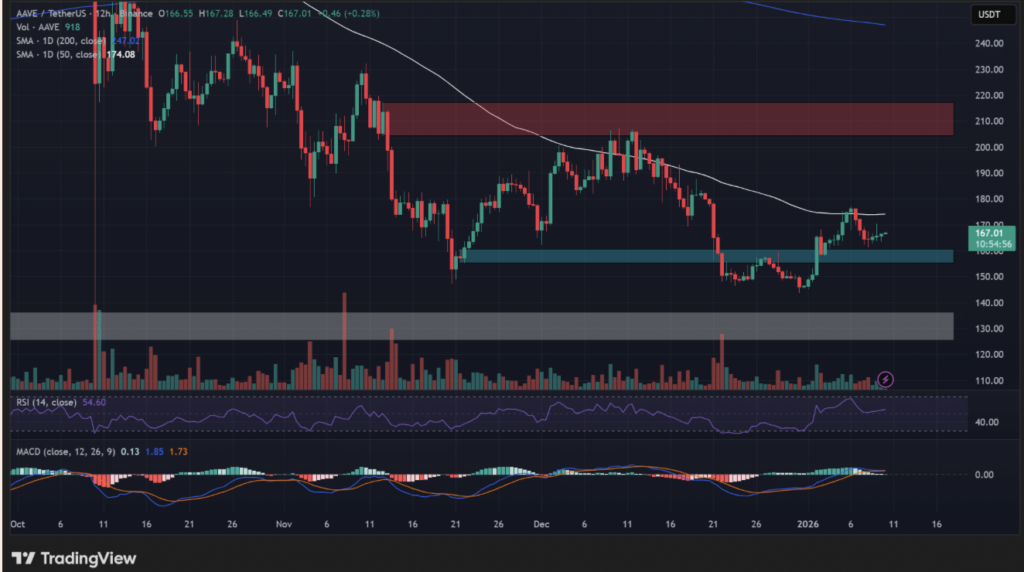
On the charts, AAVE bulls have tried, and failed, twice since December to reclaim the 50-day moving average around $174. A successful break and hold above that level would signal a meaningful shift in market structure and could open the door to a more sustainable recovery.
In the near term, consolidation between $160 and $174 may be necessary for bulls to regroup and build momentum. If price manages to clear that zone convincingly, a move toward the $210 to $220 range, roughly a 30% upside, becomes a realistic target.
On the flip side, losing the $160 support would weaken the bullish case significantly and could send AAVE back toward the $140 region once again. For now, the battle lines are clearly drawn.