
- Strategy holds ~$7.1B in unrealized Bitcoin losses
- Losses reflect market drawdown, not forced selling
- The real risk depends on how long Bitcoin stays weak
A ~$7.1 billion unrealized loss sounds dramatic, maybe even alarming at first glance. But the key detail is often skipped over, it’s not realized. No Bitcoin has been sold, no losses have been locked in, and the position itself hasn’t fundamentally changed, at least not yet.
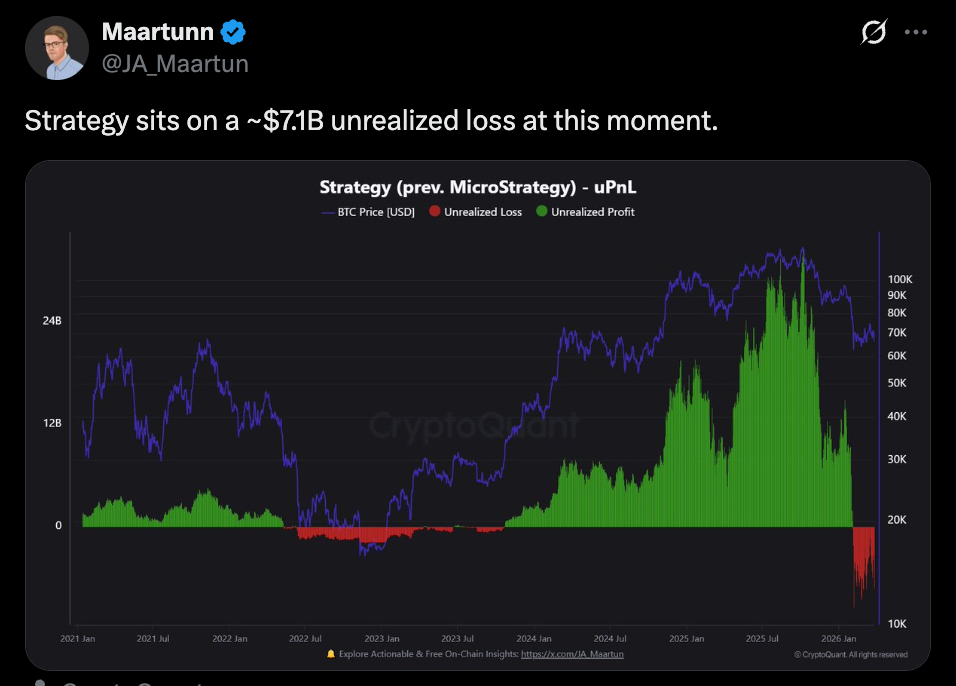
What we’re really seeing is a mark-to-market reflection of Bitcoin pulling back, not a collapse in Strategy’s core thesis. Still, the size of the number matters more than people admit. At this scale, even “paper losses” start to shape perception, influence sentiment, and quietly shift how investors frame the story.
This Is Bitcoin Volatility Playing Out in Real Time
Strategy didn’t just allocate to Bitcoin, it built its identity around it. That kind of positioning amplifies everything. When Bitcoin rallies, the company looks like a high-beta proxy that outperforms expectations, almost effortlessly.
But when Bitcoin drops 30–40%, the downside hits just as hard, if not harder. This current drawdown aligns closely with Bitcoin’s broader decline over recent months. Structurally, nothing has broken, but the magnitude makes it feel heavier than usual, and maybe that’s the point.
Time Is the Real Pressure Point
The bigger question isn’t whether Bitcoin can recover, it’s how long it takes. Strategy operates under a different set of constraints than a typical long-term holder. There’s debt involved, there are expectations baked into the stock, and there’s constant scrutiny from public markets.

Short-term dips are manageable, even expected in crypto. But extended periods of weak price action introduce a different kind of pressure, slower, more persistent, and harder to ignore. That’s where things can get complicated, even if the long-term thesis still holds together.
This Isn’t a Breaking Point, Yet
A $7 billion unrealized loss isn’t a failure, it’s the cost of conviction in a volatile asset like Bitcoin. Strategy hasn’t changed its approach, and that consistency is part of the story. The market understands what the company is doing, even if it doesn’t always agree with it.
What matters now isn’t just the size of the drawdown, but its duration. If Bitcoin rebounds, this becomes a footnote, something people reference in hindsight. If it drags on, though, the narrative starts to shift, and that’s when things could get a bit more interesting.