- Cardano founder Charles Hoskinson announced he is “taking a break” after warning of potential ecosystem failures.
- ADA has fallen below $0.20 for the first time in more than five years and remains down nearly 70% over the last year.
- Governance disputes, project closures, and declining market sentiment have intensified pressure on the Cardano ecosystem.
Cardano is facing one of its most challenging periods in recent memory, and now its founder is stepping away from the spotlight, at least temporarily.
Charles Hoskinson surprised many community members this week after posting a short message that read, “I’m taking a break. TTYL.” While brief, the announcement landed at a difficult moment for the network. ADA recently slipped below $0.20, a price level not seen since early 2021, while several ecosystem projects continue to struggle with funding, adoption, and long-term sustainability.
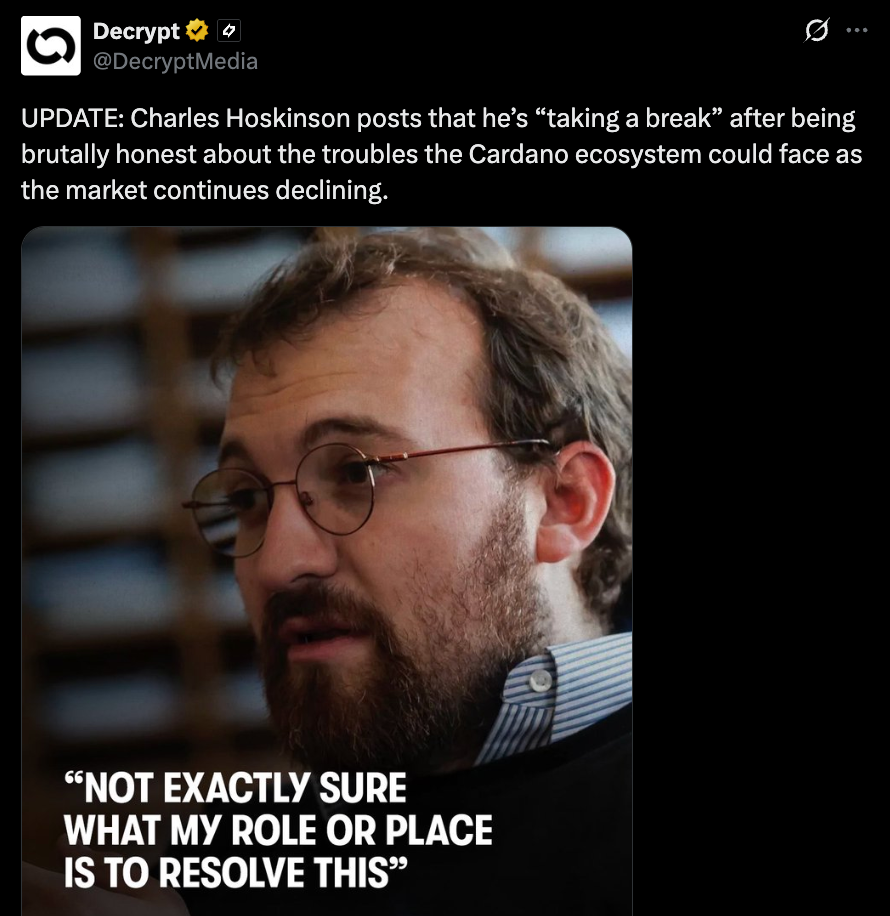
For investors who have endured years of market volatility, the timing could hardly feel more uncomfortable.
Ecosystem Pressures Continue to Build
Hoskinson’s decision comes shortly after he publicly warned that Cardano may experience a significant wave of failures throughout 2026. According to the founder, prolonged market weakness has placed enormous strain on smaller projects operating within the ecosystem, particularly those relying on limited treasury funding or shrinking user activity.
Some projects have already announced closures, while others are reportedly exploring mergers, acquisitions, or restructuring efforts to remain operational. The difficult environment has forced many teams to make hard decisions about staffing, development priorities, and future roadmaps.
While painful, this type of consolidation is not entirely uncommon during extended market downturns.
Governance Challenges Add to Uncertainty
Market conditions are only part of the story.
Cardano’s governance model recently found itself in the spotlight after a treasury proposal for the 2026 Cardano Summit failed to secure the required level of support. Despite backing from prominent ecosystem figures, the proposal fell short of the supermajority threshold needed for approval, ultimately leading to the cancellation of the event.
Supporters viewed the outcome as proof that Cardano’s governance system works as intended. Critics, however, argued that the vote exposed growing divisions within the community and highlighted challenges associated with decentralized decision-making.
Either way, the result demonstrated that large spending proposals are no longer guaranteed approval.
Why Some Investors Remain Optimistic
Despite the current negativity, some investors see historical parallels with other major blockchain ecosystems.
Bitcoin endured multiple bear markets where sentiment collapsed and predictions of failure became commonplace. Ethereum survived the ICO crash and several brutal downturns before emerging stronger in later cycles. In both cases, periods of maximum pessimism often coincided with long-term opportunities for patient participants.

That doesn’t guarantee Cardano will follow the same path, but it does provide some perspective.
Crypto history is filled with examples of projects being written off long before they ultimately recovered.
The Road Ahead for Cardano
The coming months could prove critical for the ecosystem.
Project closures, governance debates, and declining token prices have placed Cardano under significant pressure. At the same time, supporters argue that difficult periods can force ecosystems to become more efficient, focused, and resilient.
Much will depend on whether developers continue building, communities remain engaged, and new use cases emerge despite challenging market conditions. If those pieces remain intact, the current downturn may eventually be viewed as a necessary period of restructuring rather than a permanent decline.
For now, however, uncertainty remains high.
A Defining Moment for the Ecosystem
Hoskinson’s temporary break may not alter Cardano’s long-term roadmap, but it does reflect the reality of the current environment. Founders, developers, investors, and community members alike are navigating one of the toughest stretches the ecosystem has faced since its launch.
The silver lining is that crypto markets have repeatedly shown an ability to recover from periods that felt overwhelmingly negative at the time. Whether Cardano ultimately follows that pattern remains an open question.
What is clear is that the network has reached a pivotal moment. The decisions made over the next year could help determine whether this chapter becomes a temporary setback or a more significant turning point in Cardano’s history.