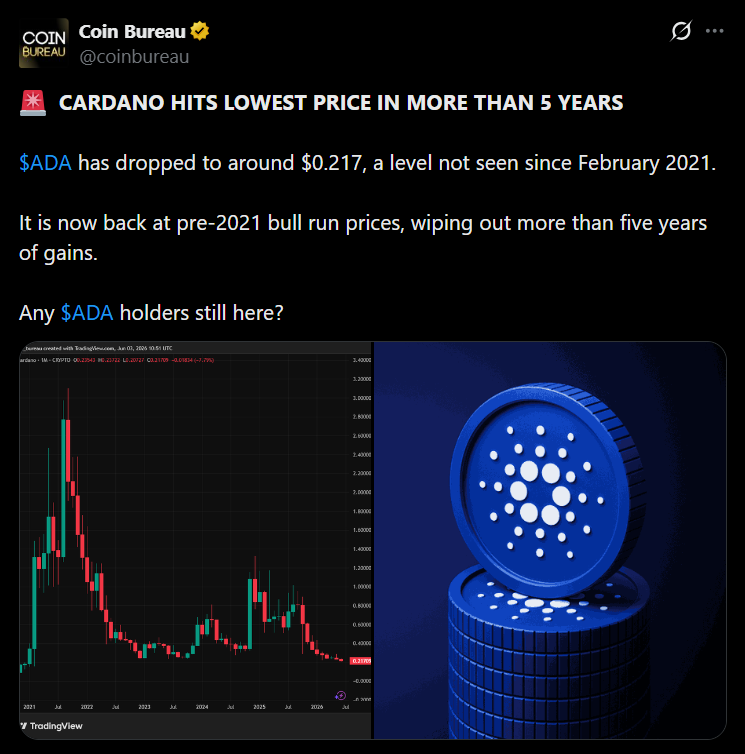
- Cardano’s ADA has dropped to roughly $0.217, its lowest price since February 2021.
- Analytics platform TapTools is shutting down, with rising costs and leadership departures cited as key factors.
- Charles Hoskinson has warned that additional project closures and ecosystem consolidation may be ahead.
For Cardano holders, the past few years have been a difficult reminder that crypto cycles do not always move in a straight line. ADA has fallen to approximately $0.217, returning to price levels last seen before the 2021 bull market transformed the industry.
That means Cardano has effectively round-tripped through one of crypto’s most eventful periods. NFTs exploded, DeFi boomed, AI tokens emerged, memecoins dominated headlines, and countless new narratives came and went. Yet ADA now trades near levels seen before most of those trends even existed.
The price decline alone would be enough to spark concern. What is happening inside the ecosystem may be drawing even more attention.
TapTools Shuts Down Operations
One of the biggest recent developments came from TapTools, a well-known analytics and infrastructure provider within the Cardano ecosystem.
The company announced plans to wind down operations over the coming weeks, citing a combination of leadership departures and increasing infrastructure, development, and support costs. While the team indicated it remains open to acquisition opportunities, its future remains uncertain.
TapTools played an important role within the ecosystem by providing analytics, APIs, market tracking tools, and project data used by developers and community members. Its closure removes a piece of infrastructure that many Cardano users relied upon daily.
While one company shutting down does not define an ecosystem, it often serves as a reflection of broader market conditions.
Charles Hoskinson Expects More Challenges
Cardano founder Charles Hoskinson responded to the announcement with a warning that many community members found concerning.
According to Hoskinson, TapTools may not be an isolated situation. He suggested that difficult market conditions are putting significant financial pressure on projects throughout the Cardano ecosystem and that additional closures could occur during the second half of the year.
Hoskinson specifically referenced the possibility of DeFi projects shutting down, struggling teams consolidating resources, and older projects becoming increasingly difficult to sustain. He also noted that there are limited resources available to rescue every team facing financial challenges.
It was a notably candid assessment from the network’s founder and one that reflects the reality many blockchain ecosystems face during prolonged downturns.
Price Action Tells Only Part Of The Story
The return to 2021 price levels has understandably become the headline, but the bigger question may involve ecosystem health rather than token performance.
Markets move in cycles. Assets rise, fall, and often recover over time. What tends to matter more over the long run is whether developers continue building, businesses continue operating, and users continue finding reasons to participate.
Strong ecosystems can survive bear markets because activity continues even when prices struggle. Weaker ecosystems often see talent, capital, and development activity gradually disappear.
That is why the closure of infrastructure providers tends to attract so much attention. It raises questions about sustainability beyond token prices alone.
Cardano Still Has A Loyal Community
Despite the recent challenges, Cardano continues to maintain one of the most dedicated communities in crypto.
The network remains active across staking, governance, and development initiatives. Cardano’s governance model has become increasingly decentralized, and the ecosystem continues pursuing long-term upgrades aimed at expanding utility and adoption.
Supporters argue that market downturns naturally eliminate weaker projects while allowing stronger builders to emerge. In that view, the current environment may ultimately strengthen the ecosystem by forcing teams to focus on sustainable growth rather than speculation.
Whether that proves true will become clearer over the coming months.
A Defining Period For The Ecosystem
Cardano now finds itself navigating two separate challenges simultaneously. The first is the obvious price weakness that has pushed ADA back to levels not seen in years. The second is the growing pressure facing projects operating within the ecosystem itself.
Markets eventually recover. History has shown that repeatedly. The more important question is whether the surrounding ecosystem remains healthy enough to fully participate when that recovery arrives.
The coming months could become one of the most important periods in Cardano’s recent history. If developers, businesses, and users continue building despite difficult conditions, today’s challenges may eventually be viewed as a temporary setback. If ecosystem activity continues shrinking, however, the concerns raised by recent closures may prove more significant than the price chart alone suggests.