
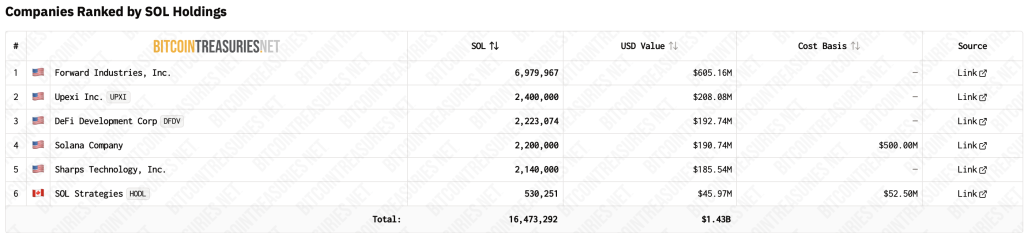
- Forward Industries holds nearly $606 million worth of SOL, far ahead of competitors
- Companies ranked second through fifth remain tightly clustered in holdings size
- Corporate Solana treasury exposure now exceeds $1.39 billion among top disclosed holders
The corporate race to accumulate Solana has become increasingly competitive lately, but one company is operating in an entirely different league compared to the rest of the field.
Forward Industries currently holds 6,979,967 SOL valued at roughly $606.52 million, giving it an enormous lead over every other publicly tracked corporate treasury. In fact, its holdings are nearly 2.9 times larger than the second-largest corporate SOL holder.
What really stands out though is the size of the gap itself. The difference between Forward Industries and second-place Upexi now sits near $397.97 million. To put that into perspective, that spread is roughly 17 times larger than the relatively tiny gap separating companies ranked second through fifth.
That creates a fascinating structure inside the Solana treasury landscape right now — one dominant leader sitting alone at the top, while the next four companies remain tightly packed together in what essentially feels like a battle for second place.
The Fight Between Ranks Two Through Five Remains Extremely Tight
Right behind Forward Industries, the rankings become far more competitive.
Upexi currently holds around 2.4 million SOL valued near $208.55 million, placing it narrowly ahead of DeFi Development Corp, which controls approximately 2,223,074 SOL worth roughly $193.17 million.
Not far behind sits Solana Company with 2.2 million SOL valued near $191.17 million, followed closely by Sharps Technology holding approximately 2.14 million SOL worth around $185.96 million.
The separation between those companies is surprisingly small considering the scale of the assets involved. Realistically, a single quarter of meaningful accumulation by any one of those firms could completely reshuffle the rankings between second and fifth place.
That’s why many traders and analysts now see the corporate Solana treasury race as divided into two separate segments — one clear leader, followed by an intensely competitive cluster of challengers all sitting relatively close together.
Some Companies Are Structurally Built Around Solana
Another important detail emerging from the rankings is the type of companies appearing near the top of the list.
Entities like Solana Company and DeFi Development Corp are not simply traditional corporations holding crypto as a reserve asset. Their entire corporate identity and business model are deeply connected to Solana itself.
That creates a very different dynamic compared to companies that hold crypto passively on balance sheets. In these cases, treasury strategy and operational business incentives become tightly aligned around the growth and success of the Solana ecosystem.
It’s a structure that resembles something closer to ecosystem-aligned financial infrastructure rather than simple treasury diversification.
Corporate Solana Holdings Continue Expanding
Combined, the top five companies now collectively control approximately 15,943,041 SOL valued near $1.39 billion based on current market prices.
Importantly though, those figures only reflect publicly disclosed corporate treasury holdings tracked through BitcoinTreasuries.net. They do not include ETFs, private funds, undisclosed institutional wallets, or other non-public entities accumulating Solana exposure behind the scenes.
In reality, total institutional and corporate SOL exposure is likely significantly larger than the visible numbers suggest.
For now, the broader market seems focused on whether another major player eventually enters the space aggressively enough to break the current structure. If a new company accumulates more than 3 million SOL within the next few quarters, it could finally create a second heavyweight tier alongside Forward Industries.
On the other hand, if the current clustering between ranks two through five continues without a breakout leader emerging, it may signal that corporate Solana accumulation is entering a more balanced equilibrium phase instead of developing a clear hierarchy beneath the top spot.
Either way, the scale of corporate interest around Solana continues growing — and the treasury competition is getting harder to ignore.