- Researcher SMQKE shared documents linking Ripple to post-2008 financial reform discussions
- The materials discussed blockchain transparency and reducing systemic financial risk
- XRP supporters believe Ripple’s technology could eventually play a larger role in global finance
Crypto researcher SMQKE recently shared a collection of documents on X that quickly reignited discussion around Ripple’s long-term role in global finance. According to the posts, several academic and institutional references appear to mention Ripple as a potential solution for improving transparency and reducing systemic financial risk after the 2008 global financial crisis.
The documents immediately gained attention across the XRP community because they seemed to connect Ripple’s payment infrastructure to broader conversations surrounding trade finance, cross-border settlement systems, and financial stability reforms that emerged after the collapse of major banking institutions back in 2008.
For XRP supporters, the timing of these discussions feels especially important as governments and financial institutions continue searching for faster, more transparent settlement infrastructure in 2026.
Blockchain Transparency Was Linked to Risk Reduction
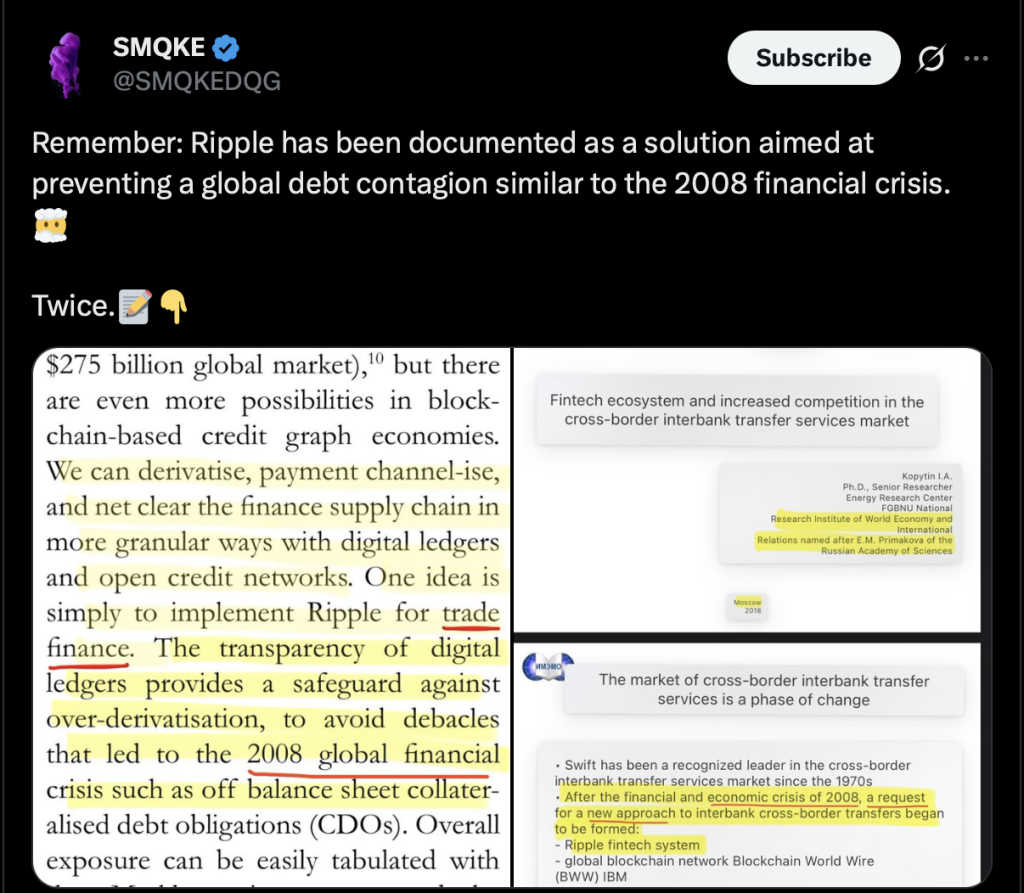
One of the highlighted passages focused heavily on transparency within financial markets. The document argued that blockchain-based systems — including Ripple-related infrastructure — could potentially help reduce systemic financial risks by creating transaction records that are easier to track, verify, and audit.
The text specifically referenced the 2008 financial crisis and the role collateralized debt obligations played during that collapse. According to the document, transparent blockchain ledgers could make it significantly harder for financial institutions to hide exposure levels or accumulate dangerous liabilities behind opaque financial structures.
Another section explained how blockchain systems using Merkle-rooting structures could organize financial information across multiple levels, making interconnected obligations easier to monitor. The discussion centered particularly around supply chain finance and receivables markets, where visibility into exposure levels has historically been more difficult.
In simple terms, the idea being discussed is that transparent distributed ledgers may help institutions spot risk earlier before it spreads across broader financial systems.
Ripple Was Mentioned Alongside Major Financial Infrastructure Projects
Another image shared by SMQKE referenced a conference presentation discussing the evolution of cross-border interbank transfer systems following the 2008 crisis. The presentation reportedly explained how demand increased for alternative international payment infrastructure after weaknesses in traditional banking systems became more obvious during the financial meltdown.
Ripple was directly mentioned alongside other emerging settlement technologies, including IBM’s Blockchain World Wire initiative and J.P. Morgan’s Interbank Information Network.
The material suggested that financial institutions began exploring faster and more transparent settlement systems after confidence in older banking infrastructure weakened significantly during the crisis period.
While the presentation did not frame Ripple as an officially adopted solution, it did place the company among the technologies being actively evaluated for improving international settlement efficiency.
XRP Community Sees Broader Implications
The XRP community reacted quickly to the resurfaced documents. Several users argued the research supports the long-standing belief that Ripple’s technology could eventually become part of larger institutional settlement systems globally.
One account known as “documenting XRP” commented that Ripple could ultimately become “the solution that solved the global financial problem rather than hypothetically.” Another community member, ROCH, claimed official records already identify XRP Ledger infrastructure as capable of reducing systemic financial risks through instant cross-border liquidity and transparent settlement systems.
Some users also connected the discussion to ongoing regulatory developments in the United States, particularly recent progress surrounding the CLARITY Act and broader crypto market structure legislation.
For many XRP supporters, the combination of regulatory movement, growing institutional blockchain adoption, and resurfaced academic references strengthens the long-term narrative surrounding Ripple’s potential role in modernizing global payments infrastructure.
Ripple’s Broader Financial Narrative Continues Growing
Whether Ripple or XRP ultimately becomes deeply integrated into global financial infrastructure remains uncertain, of course. But the resurfaced documents do show that Ripple’s technology has been part of institutional discussions surrounding payment modernization and financial transparency for years now — much longer than many casual market participants may realize.
As financial systems continue evolving toward tokenization, real-time settlement, and cross-border interoperability, discussions surrounding blockchain transparency and systemic risk reduction are becoming increasingly relevant again.
For now, the XRP community clearly sees these older institutional references as further evidence that Ripple’s payment infrastructure may eventually play a much larger role in international finance than critics once expected.