

- USDC has surpassed USDT in trading volume for the first time since 2019
- Circle’s stablecoin now represents about 64% of adjusted trading activity
- Institutional demand may be driving the shift in crypto liquidity
For years, Tether’s USDT has been the undisputed backbone of crypto trading. It powered liquidity across offshore exchanges, derivatives platforms, and global markets where access to U.S. banking was limited. In many ways, USDT became the unofficial dollar of the crypto world.
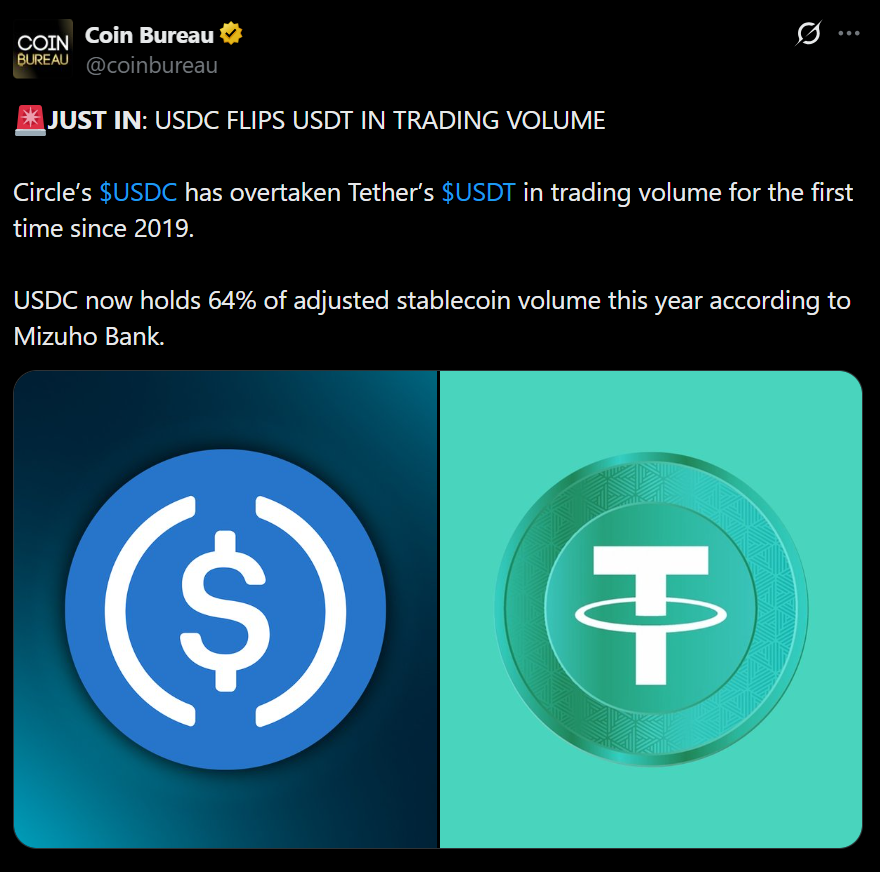
But new data suggests the balance may be shifting. According to figures cited by Mizuho Bank, Circle’s USDC has overtaken USDT in trading volume for the first time since 2019. So far this year, USDC has accounted for roughly 64% of adjusted stablecoin trading volume, marking a major change in how capital is moving through the digital asset ecosystem.
Institutional Capital May Be Driving the Shift
One key factor behind the change appears to be the growing role of institutional investors in crypto markets. USDC is issued by Circle and backed primarily by reserves held in short-term U.S. Treasuries and regulated financial institutions.
For asset managers, hedge funds, and corporate treasuries, that structure often feels more aligned with traditional financial standards. As a result, many institutional participants tend to prefer USDC when operating within regulated trading environments.
The rise of spot Bitcoin ETFs, tokenized assets, and regulated crypto platforms has accelerated this trend. These developments are bringing more institutional capital into the market, and that capital often gravitates toward stablecoins with clearer compliance frameworks.
Tether Still Dominates Global Liquidity
Despite the recent volume shift, Tether remains the largest stablecoin by supply and still dominates many trading venues. USDT continues to serve as the primary liquidity engine on several global exchanges, particularly in derivatives markets.
It is also widely used in regions where direct access to U.S. dollar banking infrastructure is limited. In those markets, stablecoins often function as a substitute for traditional financial rails, making USDT an essential component of global crypto trading.
This means the competition between USDT and USDC is less about replacement and more about evolving market dynamics.

The Stablecoin Market Is Becoming More Competitive
The shift in trading volume highlights a broader transformation taking place in the stablecoin sector. Instead of a single dominant player, the market is gradually becoming more competitive as new participants and financial structures enter the ecosystem.
USDT represents the infrastructure that supported crypto’s early growth, enabling trading and liquidity during a time when traditional financial institutions were largely absent. USDC, on the other hand, reflects the increasing overlap between crypto markets and regulated financial systems.
Both models serve important roles within the ecosystem, but their user bases are beginning to look different.
Crypto Liquidity Is Entering a New Phase
USDC surpassing USDT in trading volume is more than a temporary milestone. It signals that crypto markets are evolving as new forms of capital flow into the system.
As institutional investors continue entering the space through ETFs, tokenized assets, and regulated exchanges, stablecoins that align closely with traditional financial frameworks may see growing demand.
Tether may have built the rails that powered early crypto trading, but the next phase of the market could involve multiple stablecoins competing for dominance as digital finance continues expanding.