

- Senate passes bill blocking a US digital dollar until at least 2030
- The restriction is tied to a broader housing legislation package
- Lawmakers argue private crypto innovation should lead instead
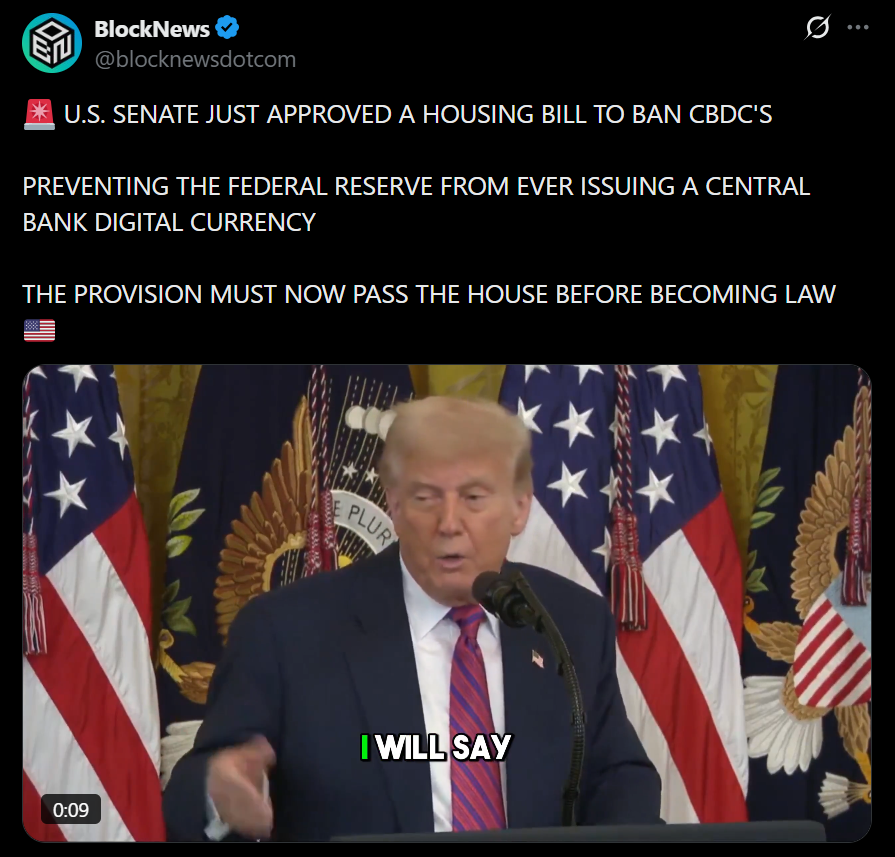
The U.S. Senate has approved a measure that would block the Federal Reserve from issuing a central bank digital currency until at least the end of 2030. The provision passed with strong bipartisan support in an 89–10 vote, though it was not introduced as a standalone crypto bill. Instead, the restriction was attached to a broader housing reform package, the 21st Century ROAD to Housing Act, creating uncertainty about how the legislation will move forward.
For now, the measure represents one of the most direct attempts by lawmakers to halt the development of a government-run digital dollar. While the Federal Reserve has explored CBDC research in recent years, the U.S. has never moved beyond early-stage studies. The Senate’s action signals that many policymakers want to slow or completely block that path, at least for the rest of the decade.
The Bill Explicitly Blocks a Federal Reserve Digital Dollar
Buried near the end of the 302-page housing bill is a section that clearly prohibits the Federal Reserve from issuing a CBDC. The language states that the Fed may not create or distribute a central bank digital currency directly or indirectly through financial institutions or intermediaries.
The restriction is sweeping in scope. It covers not only a direct digital dollar issued by the central bank but also any asset that functions in a substantially similar way. In effect, the measure would prevent the Fed from launching a retail digital currency competing with privately issued stablecoins.
Lawmakers Say Financial Privacy Is a Key Concern
Supporters of the provision argue that blocking a CBDC protects financial privacy and prevents excessive government control over digital payments. Cody Carbone, CEO of the Digital Chamber, said the Senate’s move reinforces the idea that digital innovation in the United States should remain driven by private companies rather than government systems.
The concern has been particularly strong among Republican lawmakers, who have frequently warned that a government-controlled digital currency could enable surveillance of financial activity. Even so, the Senate vote showed unusually broad bipartisan support for limiting a CBDC rollout.
The Bill Faces Political Uncertainty in the House
Despite the strong Senate vote, the legislation’s future remains unclear. The bill must still move through the House of Representatives, where some lawmakers have already indicated they may push for changes. One controversial section of the housing legislation would restrict how many homes large investors, including private equity firms, can own.
That provision could complicate the bill’s path forward, even though it has drawn interest from both parties. The debate around housing policy could end up overshadowing the crypto-related language attached to the package.
Trump’s Position Adds Another Layer of Uncertainty
The political outlook is further complicated by President Donald Trump’s recent comments about pending legislation. Trump has suggested he may refuse to sign new bills unless Congress first passes a voter-identification law requiring proof of citizenship before ballots are cast in upcoming congressional elections.
Because of that position, the fate of the housing bill — and the CBDC ban attached to it — remains uncertain. If the legislation stalls, lawmakers could potentially reintroduce the digital currency restriction in a separate bill.
For now, though, the Senate vote marks one of the strongest signals yet that U.S. policymakers are hesitant to move forward with a government-issued digital dollar. And if the measure eventually becomes law, it could leave stablecoins and private crypto projects as the primary digital dollar infrastructure for years to come.