

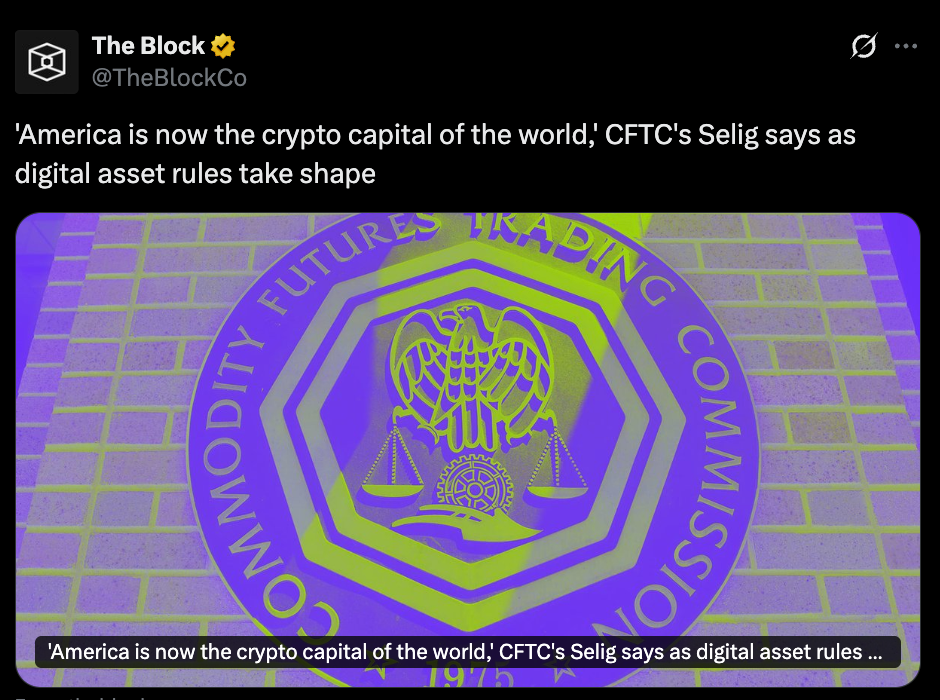
- CFTC Chair Michael Selig said the United States is now the “crypto capital of the world”
- Regulators are building a formal crypto asset taxonomy to clarify oversight
- A joint SEC–CFTC effort called Project Crypto aims to end regulatory conflicts
The United States is making a bold claim about its role in the digital asset industry. Speaking at the FIA industry conference in Boca Raton, CFTC Chair Michael Selig declared that America is now the “crypto capital of the world,” signaling what appears to be a shift in how regulators are approaching the sector.
For years, the regulatory environment surrounding cryptocurrencies in the U.S. felt uncertain and fragmented. Different agencies competed for oversight, enforcement actions often arrived without clear rules, and many crypto startups quietly moved their operations offshore to avoid regulatory ambiguity. Now, at least in tone, regulators seem to be acknowledging that the industry needs something different.
Regulators Want to Define Crypto More Clearly
One of the central ideas behind the new regulatory direction is the creation of a formal taxonomy for digital assets. In simple terms, regulators want to classify different types of crypto assets and determine which authority governs each category.
That means identifying which tokens fall under the Securities and Exchange Commission, which should be overseen by the Commodity Futures Trading Commission, and which may exist outside either framework. For the crypto industry, this kind of classification has been one of the most requested reforms for years.
Without clear definitions, entrepreneurs have often launched products without knowing which regulator might later claim jurisdiction. That uncertainty has slowed innovation and discouraged some companies from building in the United States.
Guidance for DeFi and Wallet Developers
Another important part of the regulatory discussion involves decentralized finance developers and non-custodial software providers. Selig indicated that regulators are preparing guidance that could clarify how wallet software and DeFi protocols fit into existing financial regulations.
This issue has been particularly controversial. Some policymakers have suggested that developers of decentralized software should register as financial intermediaries, a proposal that raised major concerns across the crypto community.
Providing clearer guidance could help developers understand whether their tools fall under financial regulations or remain classified as software infrastructure.
Project Crypto Aims to End Agency Conflicts
The regulatory shift also includes a joint initiative between the CFTC and the SEC known as “Project Crypto.” The goal is to reduce the long-running jurisdiction disputes between agencies that have complicated oversight of digital assets.
By coordinating regulatory frameworks, the agencies hope to establish clearer rules for crypto trading platforms, derivatives products, and emerging blockchain-based markets.
Among the areas under review are leveraged retail crypto trading and so-called “crypto perpetuals,” financial instruments that resemble futures contracts but often operate outside traditional derivatives regulations.
New Markets Are Emerging Faster Than Regulation
Regulators are also paying closer attention to prediction markets built on blockchain technology. Selig suggested that decentralized event markets could potentially help aggregate public expectations about real-world events.
While that idea may sound unconventional, it reflects a broader shift in how policymakers are beginning to view blockchain-based systems. Instead of focusing only on enforcement, regulators are increasingly exploring how these markets could function within existing financial frameworks.
The Real Test Is Still Ahead
Declaring the United States the global crypto capital may capture headlines, but the real challenge lies in translating that rhetoric into practical rules. Clear classifications for digital assets, workable guidelines for developers, and coordinated oversight between agencies could help restore confidence in the U.S. crypto market.
If regulators deliver on those promises, the United States could regain ground lost to jurisdictions that moved faster to adopt crypto-friendly policies. If progress stalls, however, the industry may continue building elsewhere where legal frameworks are clearer.