- Nasdaq and Kraken are exploring tokenized stocks that trade 24/7
- Token holders would receive dividends and shareholder voting rights
- The move could reshape how global equity markets operate
For more than a century, stock markets have followed a strict schedule. Trading opens in the morning, runs for a set number of hours, and then closes until the next business day. That system once made sense when financial markets depended on physical trading floors and human intermediaries. But in a world where transactions are already digital, the old structure is beginning to look outdated.
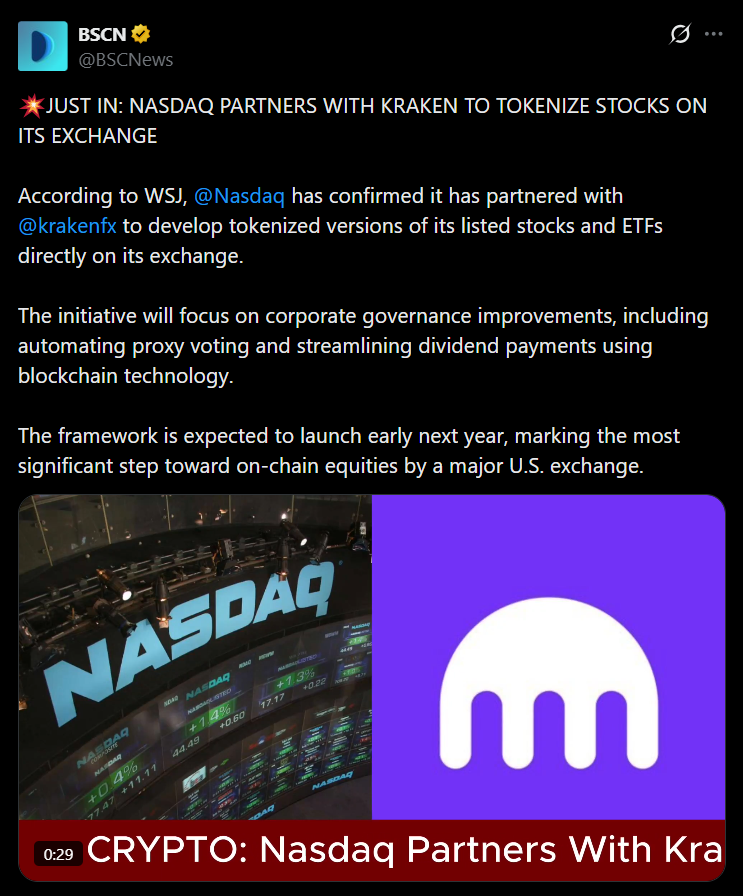
Nasdaq’s collaboration with crypto exchange Kraken signals that change may be coming sooner than many expected. The two companies are developing a framework that would allow tokenized versions of public stocks and exchange-traded products to trade around the clock. If regulators approve the concept, the system could launch sometime around 2027.
Tokenization Could Transform How Stocks Trade
At its core, the idea behind tokenized stocks is relatively straightforward. A blockchain-based token would represent ownership of a real share of a publicly traded company. Instead of relying solely on traditional market infrastructure, the token could move across blockchain networks, allowing transactions to settle more quickly.
Because blockchain systems operate continuously, tokenized assets could theoretically trade 24 hours a day, including weekends and holidays. That would be a dramatic shift from the traditional stock market model, where trading windows remain tightly controlled.
Shareholder Rights Would Remain Intact
One major concern around earlier experiments with tokenized equities was whether investors actually owned the underlying shares. In many cases, previous tokenized products functioned more like derivatives than direct equity ownership.
Nasdaq’s proposal aims to address that issue. According to early details, token holders would receive the same rights as traditional shareholders. That includes access to dividend payments and the ability to participate in shareholder voting through proxy systems.
Crypto Infrastructure Influences Traditional Finance
The partnership between Nasdaq and Kraken highlights a broader shift happening in financial markets. Crypto exchanges have already experimented with 24/7 trading models and blockchain-based settlement systems. These features allow assets to move faster and operate without the rigid trading windows used in traditional finance.
Now established financial institutions appear to be adopting similar infrastructure. Rather than resisting blockchain technology, some legacy players are beginning to integrate it into their own systems.
A Possible Shift in Market Structure
If tokenized stocks eventually gain regulatory approval, the impact on global markets could be significant. Continuous trading would allow investors across different time zones to participate without waiting for exchanges to open. It could also reduce delays tied to clearing and settlement systems.
The move would not eliminate traditional markets overnight. However, the concept of tokenized equities trading on blockchain rails suggests that the structure of financial markets may gradually evolve.