
- The SEC is preparing a “token taxonomy” to classify crypto assets
- The framework could move forward even if the CLARITY Act fails
- Combined SEC and CFTC actions may bring crypto regulatory clarity
For years, the crypto industry has been waiting on Washington to pass a comprehensive market structure bill. The CLARITY Act was expected to be that turning point, a moment when lawmakers would finally define how digital assets should be regulated in the United States. Instead, the bill has stalled in political gridlock, tangled in disagreements over stablecoin yields and how much control traditional banks should have in the system.
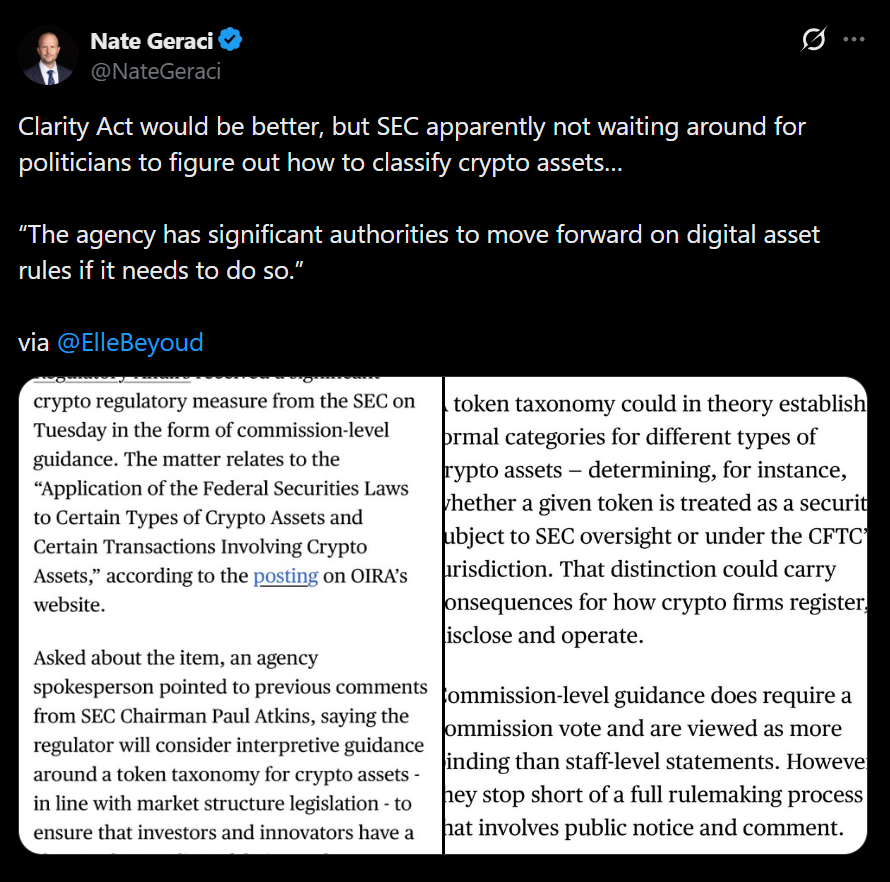
Now regulators appear ready to move ahead without waiting for Congress. Reports suggest the U.S. Securities and Exchange Commission is preparing interpretive guidance that would introduce what insiders are calling a token taxonomy. In simple terms, the agency wants a clearer method for classifying digital assets under existing securities laws, something the crypto market has lacked for more than a decade.
SEC Token Taxonomy Could Define Crypto Asset Categories
If implemented, the proposed token taxonomy could provide a structured way to determine whether certain crypto assets fall under securities regulations. That distinction has been at the center of many regulatory battles between the SEC and the digital asset industry. A standardized classification system could finally clarify how different tokens should be treated under federal law.
For exchanges, token issuers, and investors, this kind of framework could function as the rulebook the market has been missing. Instead of navigating vague enforcement actions and uncertain interpretations, companies would have clearer guidelines on where regulatory boundaries actually sit. It may not resolve every dispute overnight, but it would reduce the confusion that has defined the sector for years.
Regulators May Act Without Waiting for Congress
The bigger signal here may be how regulators are approaching the issue. Rather than waiting indefinitely for lawmakers to finalize new crypto legislation, the SEC appears willing to use its existing authority to establish guardrails. That move could allow regulators to bring structure to the market even if political negotiations continue to stall.
While comprehensive legislation would likely provide the strongest long-term framework, incremental clarity could still make a meaningful difference. Markets tend to function best when rules are predictable, even if they are not perfect. A regulatory framework built through guidance and interpretation may be enough to stabilize large parts of the industry.
CFTC Rules Could Expand Crypto Market Oversight
At the same time, the Commodity Futures Trading Commission is reportedly preparing its own proposals tied to digital assets. These rules may focus on prediction markets and crypto derivatives, particularly perpetual futures contracts that have become extremely popular across global trading platforms. The agency’s involvement would extend regulatory oversight beyond just spot markets.

If both the SEC and CFTC move forward with new frameworks, the combined effect could create a functional regulatory structure across major segments of the crypto industry. Even without the CLARITY Act, these coordinated efforts could begin shaping how digital assets are traded, issued, and regulated in the United States.
Crypto May Finally Exit Regulatory Limbo
For years, the crypto sector has operated in a strange regulatory gray zone where agencies enforced rules that were never clearly defined. Companies faced lawsuits and enforcement actions without always knowing exactly which standards they were expected to follow. That uncertainty has slowed innovation and pushed some projects outside the United States.
A token taxonomy would not solve every regulatory challenge overnight. But it could finally give the market a clearer framework to operate within. Ironically, the industry’s next phase of regulatory clarity may not come from sweeping legislation at all, but from regulators deciding they can no longer wait for Washington to act.