

- “How to buy Bitcoin” searches are nearing 2017 bull run levels
- Rising retail curiosity could shift market momentum dynamics
- Analysts caution that search data alone doesn’t confirm buying
Online searches for the phrase “How to buy Bitcoin” are rising quickly, approaching levels last seen during the historic 2017 crypto bull run. The trend, initially highlighted by Crypto Rover and later reviewed by other market observers, has begun circulating widely across trading communities. That alone says something. When search data starts trending, narratives follow.
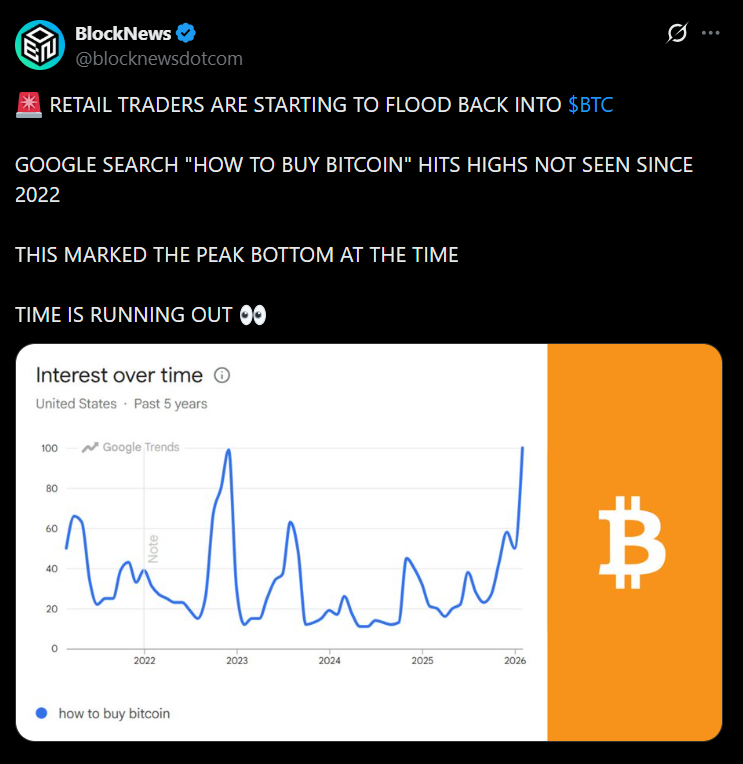
Search engine activity has long served as a rough proxy for retail sentiment. During both the 2017 rally and the 2020–2021 cycle, spikes in beginner-focused Bitcoin queries closely tracked surges in new exchange registrations. Retail investors tend to leave digital footprints before they deploy capital, and those footprints are becoming more visible again.
Retail Curiosity Versus Institutional Momentum
Recent Bitcoin rallies have largely been driven by institutional flows, ETF demand, and macro positioning. Those flows often move quietly through structured products or over-the-counter desks, leaving little public trace. Retail participation, on the other hand, shows up loudly in Google Trends and social media chatter.
If this renewed search activity sustains, it could signal a transition from institution-led accumulation toward broader public engagement. Historically, retail waves tend to amplify price momentum late in bull cycles. They add liquidity, energy, and sometimes volatility, especially when enthusiasm outpaces experience.
Search Data Is a Signal, Not Confirmation
Market analysts caution that search spikes do not automatically translate into buying pressure. Curiosity can rise due to media coverage or viral posts without converting into meaningful capital inflows. To confirm real participation, observers look at exchange net inflows, wallet creation rates, small-transaction volume, and stablecoin purchase data.
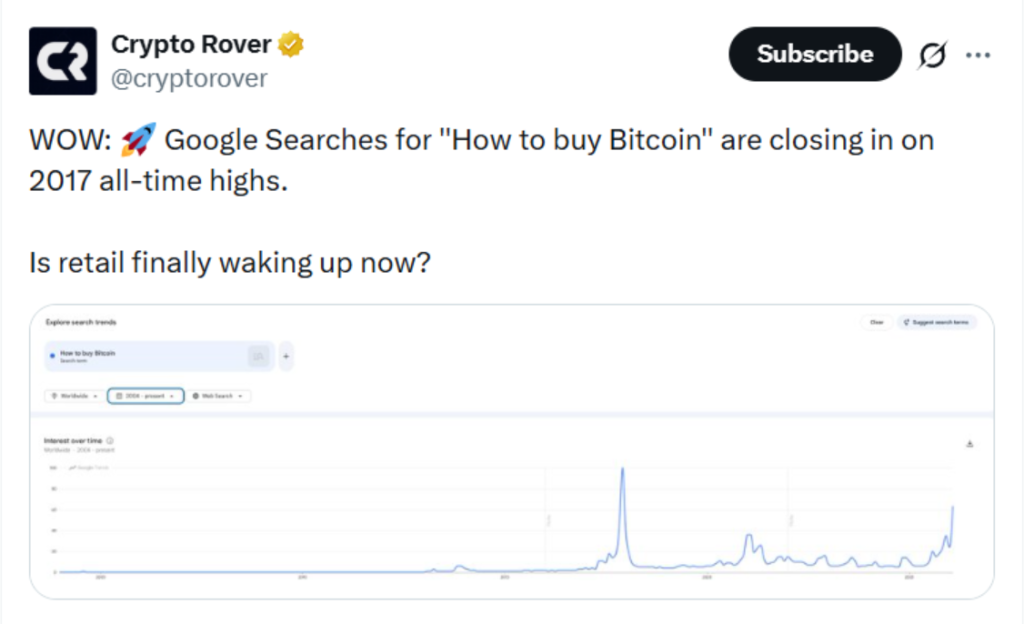
Without that transactional confirmation, search trends remain an early-stage sentiment indicator. In previous cycles, retail enthusiasm often peaked near local tops, not bottoms. That nuance matters. Rising search interest can reflect excitement, but it can also reflect late-cycle FOMO.
Macro Backdrop Adds Another Layer
The renewed curiosity arrives amid shifting macroeconomic conditions. Interest rate expectations, inflation signals, and global liquidity trends continue to influence digital asset markets. Bitcoin’s narrative as both a speculative asset and a hedge against currency instability has resurfaced in certain circles.
If macro uncertainty persists, retail investors may view Bitcoin as both opportunity and protection. Access is also easier than it was in 2017. Today, mainstream financial apps and brokerages allow near-instant crypto purchases, potentially shortening the gap between search intent and execution.
Retail Could Redefine the Next Phase
If retail participation accelerates meaningfully, markets could see increased spot volume, sharper volatility, and intensified media coverage. Psychological price milestones often attract new participants, and rising attention can become self-reinforcing. Momentum feeds coverage, coverage feeds curiosity, and curiosity can feed price.
Still, caution remains warranted. Search data alone doesn’t confirm sustained adoption or speculative mania. It does, however, suggest that Bitcoin is re-entering mainstream conversation at scale. Whether this marks the early stages of a new retail-driven rally or simply another temporary spike in attention will become clearer in the weeks ahead.