
- ADA continues to hold the $0.33–$0.35 support zone despite weak sentiment
- Whale accumulation and crowded short positioning suggest downside pressure may be fading
- Institutional access and protocol development are improving even as price stays muted
Cardano has worn an unflattering label for a long time now. Slow. Boring. Left behind. For a lot of traders, ADA became the kind of chart you stopped opening because nothing ever seemed to happen.
Lately though, the data has started telling a quieter, different story. Not one driven by hype or flashy headlines, but by positioning. And if that positioning holds, ADA may already be sitting closer to a real bottom than most people realize.
Why ADA Keeps Defending the Same Support Zone
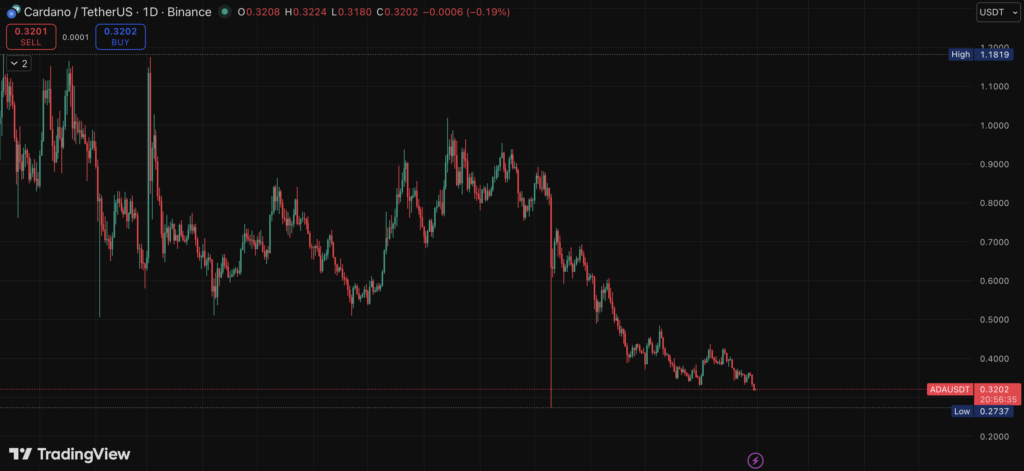
For weeks, ADA has been pinned in the same $0.33 to $0.35 range. On the surface, that looks like dead money. Price goes nowhere, volume fades, attention drifts. Underneath, however, something else appears to be unfolding.
Large wallets have been steadily adding ADA while smaller holders continue to sell into weakness. Each revisit to the lows comes with thinner volume, a sign that selling pressure is slowly drying up. That’s often what markets look like when sellers are getting tired, even if price hasn’t reacted yet.
There’s also been a consistent buy wall sitting just below current levels, quietly absorbing supply. The argument from positioning-focused traders is simple. This doesn’t look like panic. It looks like a grind designed to shake out impatient hands before the next move, however long that takes.
The Chart Isn’t as Broken as It Feels
Technically, ADA hasn’t collapsed the way many assume. On the daily timeframe, price has stopped making lower lows, and momentum indicators show more sideways drift than outright weakness. Short-term moving averages are beginning to curl upward, subtle, but noticeable if you’re watching closely.
The levels are clean. $0.33 is the floor. As long as price holds above it, the broader structure remains intact. A move through $0.38 starts to change sentiment, with $0.41 and $0.42 acting as the next real friction points. Clear those, and resistance thins out quickly, leaving room toward the $0.60 area that hasn’t been tested in a while.
This isn’t a breakout yet. But it’s no longer the kind of chart that screams collapse either.
Shorts Are Crowded While Institutions Stay Quiet
One of the more interesting dynamics around ADA isn’t obvious on the spot chart. Short positions remain heavily stacked, with shorts significantly outweighing longs across major venues. Funding rates are still negative, meaning traders are paying to stay bearish.
That matters. If ADA starts pushing higher, especially into the low $0.40s, those shorts may be forced to unwind fast. When that happens, liquidations often turn into aggressive market buys, and price can move faster than anyone expects. It doesn’t take much fuel when positioning is already leaning too far one way.
Away from short-term trading, Cardano is also checking boxes institutions tend to care about, quietly. ADA has been included in a major crypto ETF filing, giving it a defined role alongside other large-cap assets. Regulated Cardano futures are also scheduled to launch on CME in early 2026, opening the door to hedging and structured exposure.
Meanwhile, protocol upgrades focused on governance and scalability continue to move forward, supported by a sizable on-chain treasury. These aren’t features built for fast cycles. They’re built with longevity in mind.
The Level That Decides Everything
There’s still a clear line in the sand. If ADA loses $0.33 on a weekly close, this entire setup breaks down. That would reopen the door to deeper downside and force a full reset of expectations.
For now, though, the structure is holding. Large holders are accumulating, shorts are crowded, and institutional access is expanding. If those conditions remain in place, the market may soon have to stop pricing Cardano’s past and start paying attention to what’s quietly being built underneath.