

- Crypto treasuries on Sui are shifting from passive holders to active protocol participants
- Controlled token unlocks and stable circulation support long-term ecosystem growth
- Rising stablecoin liquidity and yields are reinforcing Sui’s role as a yield-focused DeFi network
Crypto treasuries are quietly changing roles, shifting from passive balance sheets into active protocol participants, and Sui is a clean example of how fast that transition is happening. In earlier cycles, firms like Strategy, formerly MicroStrategy, or Metaplanet treated crypto assets as static reserves meant to sit untouched. Today, simply holding isn’t enough, deployment and participation actually matter now.
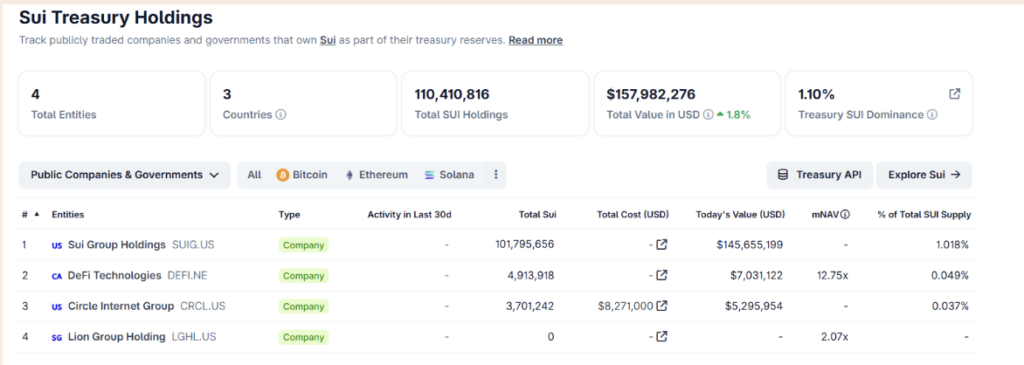
On Sui, foundation-controlled wallets remain the largest holders, but on-chain data shows treasury wallets tracked via Explorer holding a concentrated 108 million SUI, roughly 3% of circulating supply. At the same time, analytics point to growing holder concentration among top wallets, which hints at coordinated, long-term positioning rather than scattered speculation. This setup isn’t just about price support or liquidity anymore, it increasingly touches governance participation and yield generation, meaning treasuries are starting to run protocols instead of merely storing tokens.
Sui token circulation stays steady despite unlocks
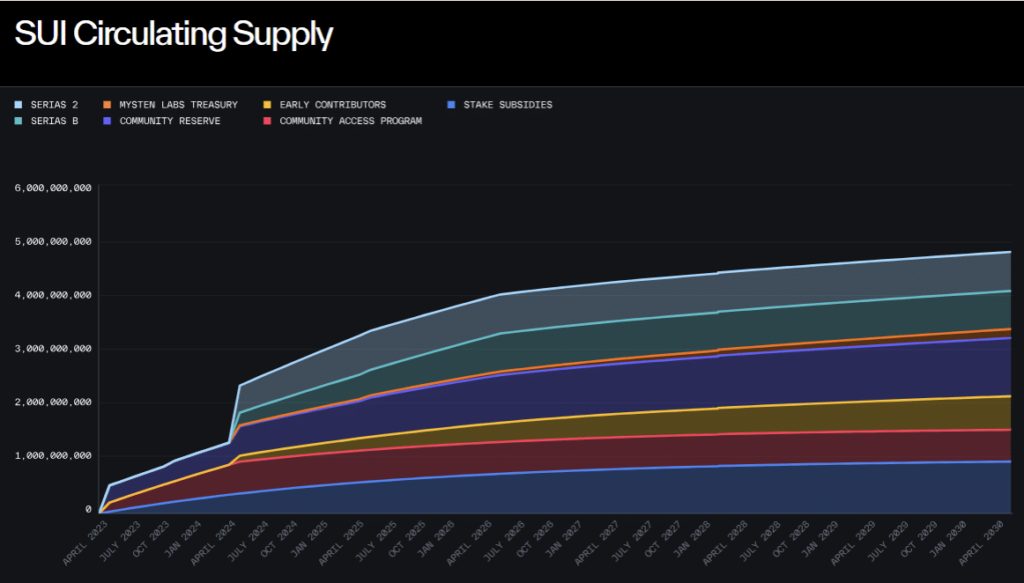
Sui’s circulating supply continues to expand in a controlled, predictable way rather than through sudden shock-driven releases. As of late January 2026, circulating supply sits near 3.79 billion SUI, or about 38% of the 10 billion maximum supply. Unlocks are following a predefined vesting curve, with no unusual spike events disrupting the market.
Because of this structure, supply growth has largely been absorbed where holdings matter most. Data from token schedules shows that the Sui Foundation and Mysten Labs still control sizable allocations, but much of that supply remains locked for long-term development, staking incentives, and ecosystem funding. In practice, this looks less like Bitcoin-style scarcity and more like Solana-style ecosystem bootstrapping, where retention supports growth over time. CoinGecko data also shows institutional holdings exceeding 110 million SUI, reinforcing a strategy focused on yield-enabled usage rather than short-term turnover.
Stablecoin growth reflects active treasury behavior
Stablecoin expansion on Sui closely mirrors the rise of active crypto treasuries, and the two trends feed into each other. By late January 2026, Sui’s stablecoin market cap reached roughly $500 million, with USDC accounting for over 70% of that total. This liquidity increasingly fuels lending, trading, and yield strategies across DeFi protocols on the network.
At the same time, treasury-linked entities have moved beyond simply holding SUI. By deploying capital through stablecoins instead, they deepen liquidity pools, generate fees, and influence protocol usage without adding spot sell pressure. Treasuries are no longer sitting on the sidelines, they’re operating inside the Sui economy itself. This convergence points to a broader shift from asset custody toward execution and control at the protocol level.
Yield dynamics explain why this matters
Yield conditions across Sui DeFi have strengthened steadily, reflecting deeper liquidity and improving capital efficiency. In late January 2026, lower-risk strategies offered yields in the 3% to 10% range, while incentive-heavy pools pushed past 50%, supported by over $500 million in stablecoin liquidity and rising TVL. These aren’t static numbers either, they move with usage.
Lending platforms like NAVI Protocol and Suilend have delivered roughly 5% to 7% APY on USDC, while DEXs such as Cetus have driven yields above 70% through trading fees and incentives. Yield growth pulls in capital, improves liquidity depth, and reinforces Sui’s identity as an active, yield-driven DeFi ecosystem rather than a passive Layer 1.