

- Vitalik Buterin rejected calls to abandon Ethereum in favor of a brand-new chain built from scratch.
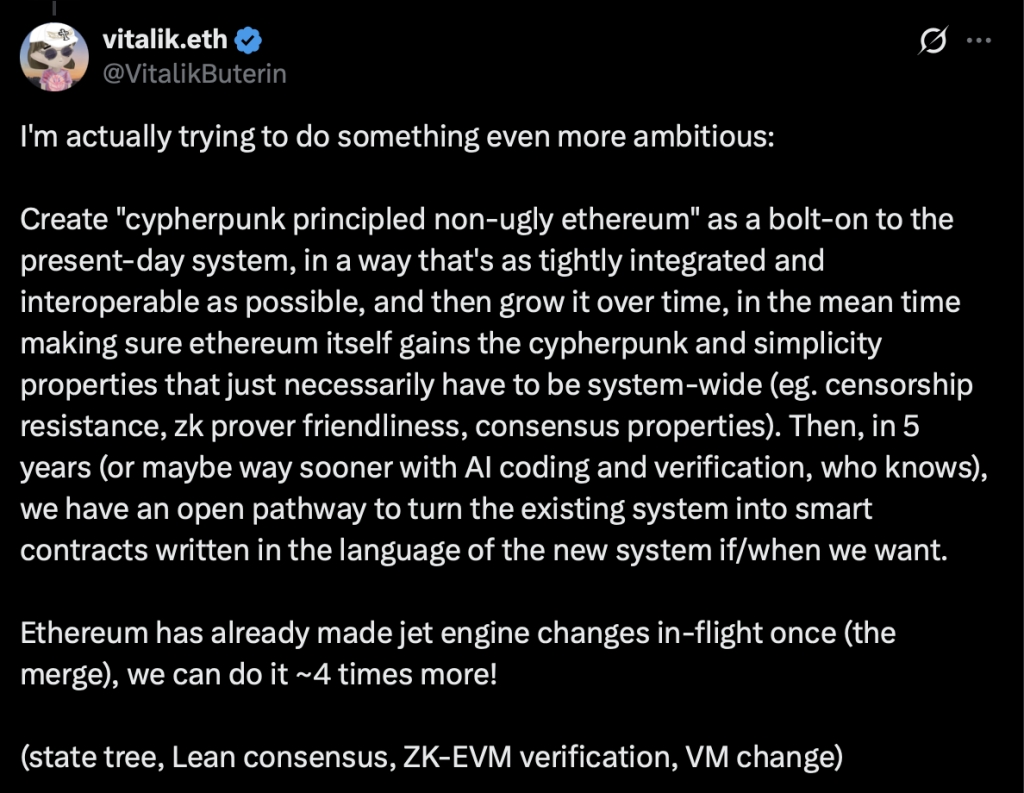
- He proposed a “bolt-on” upgrade strategy that rebuilds Ethereum internally while keeping the current network operational.
- AI-assisted coding and verification could significantly accelerate this transformation over the next five years.
Ethereum co-founder Vitalik Buterin has made it clear: the original Ethereum chain is not being abandoned. Not now, not quietly, and definitely not in favor of some shiny replacement built from scratch. While some critics have suggested the network should be allowed to slowly fragment under the weight of layer-2 rollups and app chains, Buterin instead proposed something far more ambitious — rebuild Ethereum from the inside, without ever turning it off.
The Push to Start Over — And Buterin’s Rejection
The debate reignited after an X user argued that Ethereum should be left to “die a slow and painful death by fragmentation,” replaced by a fresh, purely cypherpunk chain designed from first principles. The suggestion even floated rebuilding on RISC-V architecture, essentially resetting the ecosystem to prove technical dominance. It was bold. Dramatic, even.
But Buterin didn’t entertain the idea for long.
Rather than scrapping the existing system, he outlined a plan to evolve it aggressively. No scorched earth reset. No symbolic restart. Instead, a layered transformation that upgrades Ethereum while it continues running — like swapping components on a jet engine mid-flight, which, to be fair, Ethereum has already done once.
The “Bolt-On” Evolution Strategy
Buterin described his vision as building a “cypherpunk principled non-ugly Ethereum” directly alongside the current infrastructure. The idea isn’t to fork off into isolation or fracture the ecosystem further. It’s to bolt on new architecture, tightly integrated with what already exists, and gradually inject stronger cypherpunk principles back into the base layer.
This approach is surgical rather than revolutionary.
The new infrastructure would grow in parallel, coexisting with today’s Ethereum while quietly reshaping it. Over time, core components could transition into a cleaner, more principled framework — without forcing developers, users, or institutions to abandon the chain they’re already on. It’s evolution, not extinction.
Ethereum as a Plane Mid-Flight
To explain the magnitude of the task, Buterin compared Ethereum’s roadmap to replacing parts of an airplane while it’s still flying. That metaphor isn’t new, but it hits. Ethereum has already executed major in-flight transformations, including its shift to proof-of-stake, and survived.
According to Buterin, it can do it again. Maybe four more times, he suggested — casually, almost offhand.
The timeline for this broader transformation? Roughly five years. Though he added an interesting caveat: AI could dramatically accelerate that schedule. With AI-assisted coding and verification, the pathway to rewriting core components and migrating smart contracts into a new system language might open much faster than anyone expects.
AI as the Wildcard
That’s where things get intriguing.
Buterin hinted that AI tools could compress development cycles significantly, allowing Ethereum to transition existing smart contracts into a new framework more seamlessly. In theory, if AI verification becomes reliable enough, entire sections of infrastructure could be rewritten, audited, and deployed at speeds that were unthinkable just a few years ago.
And that changes the calculus.
Instead of a long, grinding rebuild, Ethereum could gradually morph into a cleaner, more cohesive system — without ever shutting down. The network doesn’t need to “die” to evolve. It just needs iteration. Careful, layered iteration.
In the end, Buterin’s message was straightforward: Ethereum isn’t being replaced. It’s being rebuilt, piece by piece, while the engine keeps running. Messy? Probably. Ambitious? Definitely. But in crypto, survival often belongs to the systems that adapt — not the ones that reset.