

- Chainlink’s fundamentals look strong, but LINK is still trading under pressure around the key $8.40 support level.
- Momentum indicators (MACD + RSI) are attempting a weak recovery, though neither has confirmed a bullish shift yet.
- If LINK loses $8.30, $7.50 becomes the next support, while reclaiming $9.50 would be the first real stabilization signal.
Chainlink’s position as the leading oracle network in crypto has only grown stronger over time, yet LINK’s price is telling a more cautious story right now. The token is hovering around a critical support zone, and pressure is starting to build. At the time of writing, LINK is trading near $8.46, down roughly 3.16% in the past 24 hours, which reflects the broader hesitation across the market.
Institutional Expansion Gains Visibility
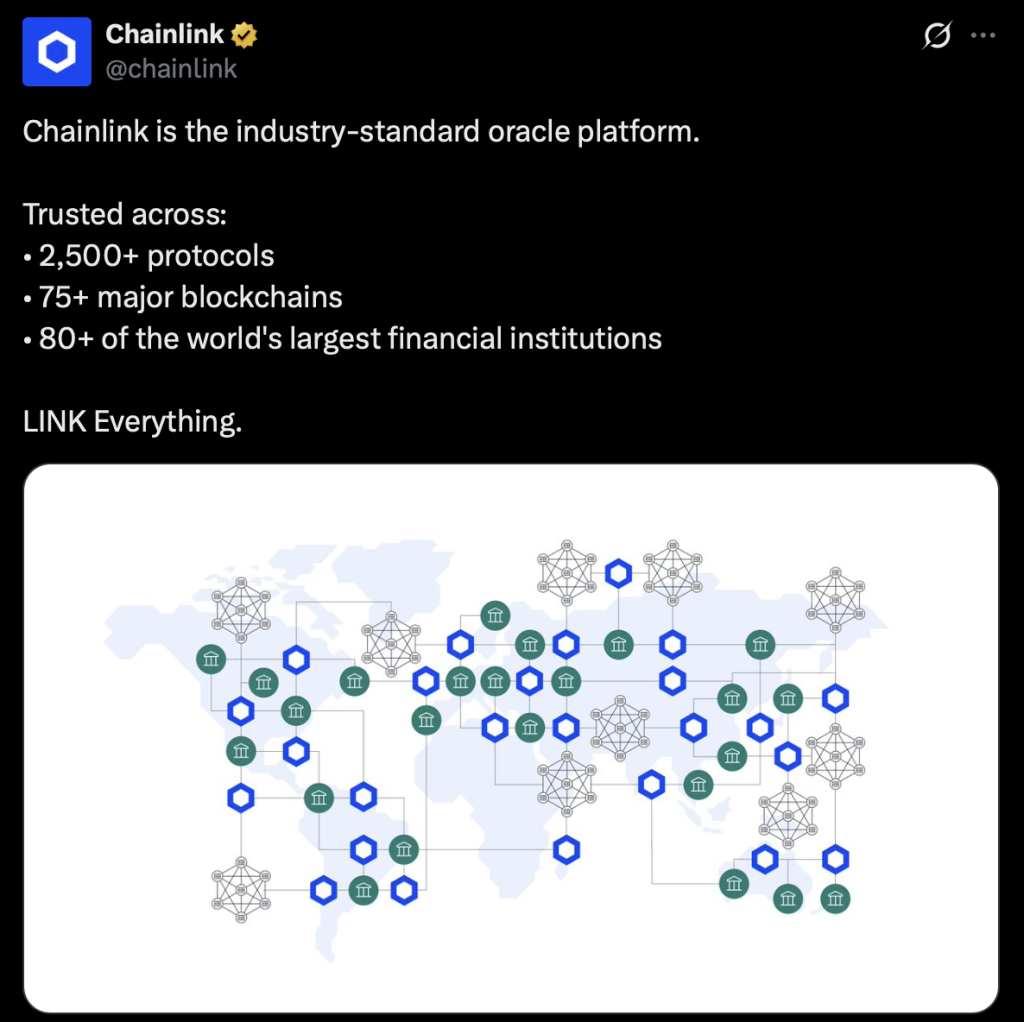
LINK remains central to the Chainlink ecosystem, acting as the payment layer for oracle services and the staking asset that helps secure the network. It essentially powers the data pipelines that connect decentralized applications across blockchains to real-world assets and financial systems, which is not a small job. In a recent update shared on X, Chainlink highlighted its globally distributed network, spanning thousands of dApp projects and dozens of major blockchain protocols, reinforcing its claim as industry-standard middleware.
The shared network map posted by the team paints a clear picture: Chainlink is deeply embedded across ecosystems. It has become that quiet infrastructure layer most users don’t see, but many rely on. And while the fundamentals appear strong, price action isn’t exactly celebrating just yet.
LINK Price Tests Structural Support
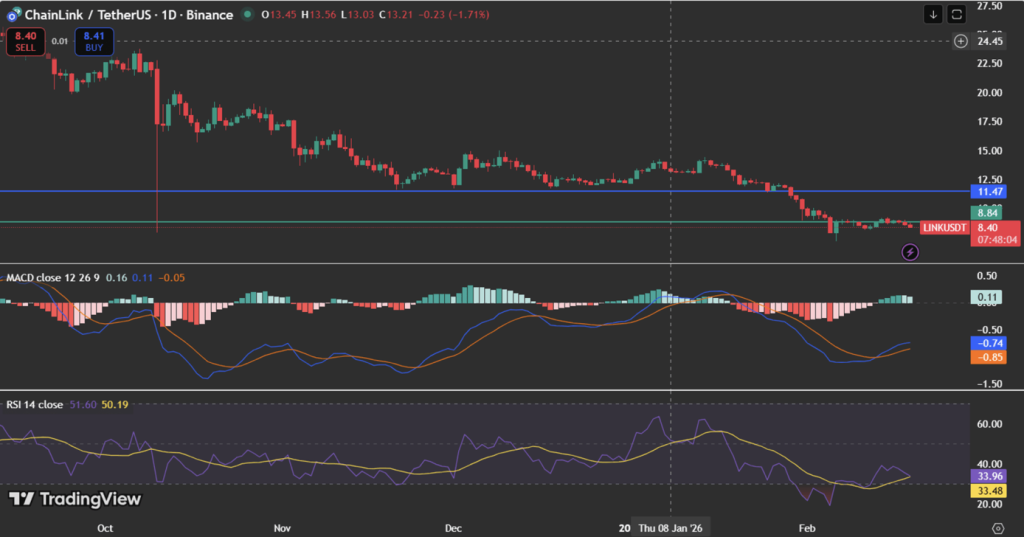
On the daily chart via TradingView, LINK is sitting near the $8.40 level, a horizontal support area that previously acted as a structural floor. This zone has held before, but it’s now being tested again, and repeated tests can sometimes weaken support over time. If sellers continue pressing, a breakdown below $8.30 could expose the next downside target around $7.50.
Zooming out, the broader trend still leans bearish. Since its rejection near the $11.47 level, LINK has formed a pattern of lower highs, signaling that upward momentum has struggled to sustain itself. Each rally attempt has faded a bit quicker than the last, which isn’t exactly what bulls want to see.
Momentum Signals Early, Weak Recovery
Momentum indicators are hinting at a potential shift, but it’s far from convincing. The MACD is still below the zero line, though it has started to curl upward, suggesting early recovery — very early. Meanwhile, the RSI is hovering near oversold territory but remains below the neutral 50 level, meaning buyers haven’t fully stepped in with conviction.
Technically speaking, LINK needs to reclaim the $9.50 area to signal meaningful stabilization. A move above that level would interrupt the pattern of lower highs and potentially attract fresh interest. Until then, any bounce may simply be a short-term relief rally, not a confirmed trend reversal.
Fundamentals Strong, Chart Still Fragile
Chainlink continues to provide secure off-chain data to decentralized applications through its network of nodes, and its role in bridging traditional finance with blockchain systems keeps expanding. Institutional coordination and infrastructure development appear to be accelerating in the background, which strengthens the long-term thesis. But markets, as usual, move on liquidity and sentiment in the short term, not just fundamentals.
For now, $8.40 stands as the battleground. If it turns into an accumulation base, LINK could quietly build momentum for a recovery. If not, the downside scenario toward $7.50 becomes more realistic, and things could get a little uncomfortable before they improve.