

- Cardano is rolling out major upgrades, including LayerZero integration, USDCx, and a Midnight mainnet launch by late March.
- Bitcoin’s breakdown into the mid-$60Ks keeps the broader market fragile, and a deeper 30% drop is still possible.
- If BTC falls again, ADA could revisit $0.226 quickly, with $0.20 and $0.15–$0.17 as deeper downside zones.
Cardano (ADA) keeps shipping upgrades even while the market is tense and prices look ugly. This week, the network approved a major LayerZero integration, linking Cardano to more than 160 blockchains. A new privacy-focused stablecoin called USDCx is also expected to launch at the end of February, adding another utility layer to the ecosystem.
And that’s not all. Cardano’s Midnight partner chain has now confirmed a mainnet rollout before the end of March. So from a fundamentals standpoint, things are moving. The problem is, price doesn’t really care right now. ADA is still chained to Bitcoin’s next move, and Bitcoin… looks weak.
Bitcoin’s Chart Still Looks Fragile
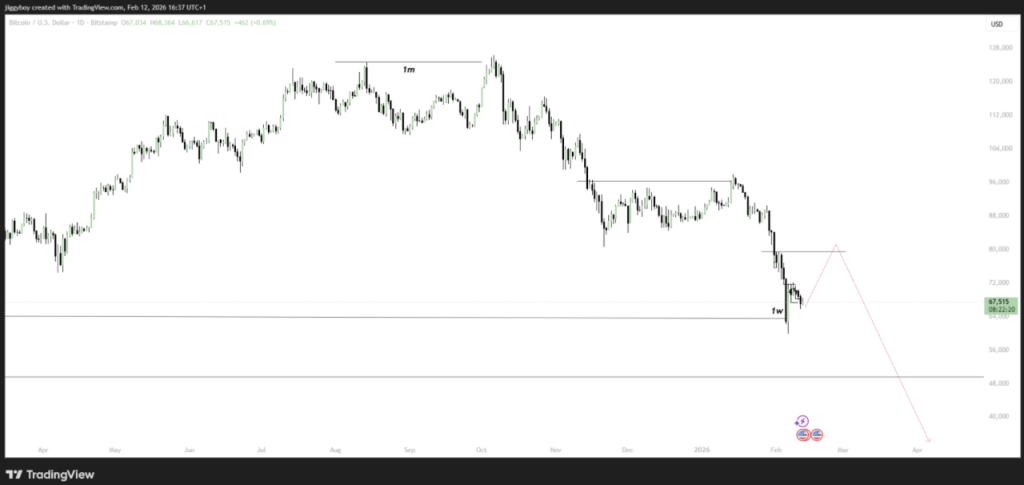
BTC has been sliding for months, and the real damage came after the early February breakdown. Bitcoin lost a major support zone and dropped sharply into the mid-$60,000s, with only a small bounce showing up so far. It’s not the kind of dip that screams “healthy pullback.” It looks more like a structural reset.
And moves like this rarely happen in isolation. When Bitcoin breaks down aggressively, it usually leads to one of two outcomes. Either a relief rally back into resistance, or another leg lower once the bounce runs out of fuel. The BTC chart even hints at a possible rebound toward $80,000, but at this point that level looks more like a ceiling than a launchpad.
Could Bitcoin Still Drop Another 30%?
A 30% drop from current levels would drag Bitcoin into the $47,000 to $50,000 range. That sounds extreme, but it’s not impossible if you look at the structure. There’s a lot of open space below the current zone, and the next major support level sits much lower than where BTC is trading today.
If fear stays elevated and macro pressure continues, Bitcoin could pull the entire market down with it. And Cardano, like most large-cap altcoins, tends to follow Bitcoin closely during heavy selloffs. Even if ADA has its own catalysts, it usually doesn’t get to ignore BTC when the market is in panic mode.
Why ADA Could Still Stay Under Pressure
Bitcoin is the main driver, but it’s not the only reason ADA could remain weak. Market sentiment is still extremely fragile, and in fear-heavy environments even strong development progress can get ignored. That’s just how crypto works sometimes, fundamentals matter, but not when liquidity is running away.
ADA also remains highly correlated with the broader risk-off environment. So even if Cardano keeps delivering upgrades, price can still drift lower if the market stays stressed. There’s also regulatory uncertainty hanging over the space. Grayscale has filed for a spot ADA ETF, but approval is far from guaranteed, and without a clear institutional catalyst soon, buyers may stay cautious.
Whale accumulation and oversold signals help, sure. But they don’t automatically create a reversal if the wider market remains under pressure. You can be oversold for longer than anyone expects, and crypto has proven that over and over.
What This Could Mean for Cardano’s Price Next
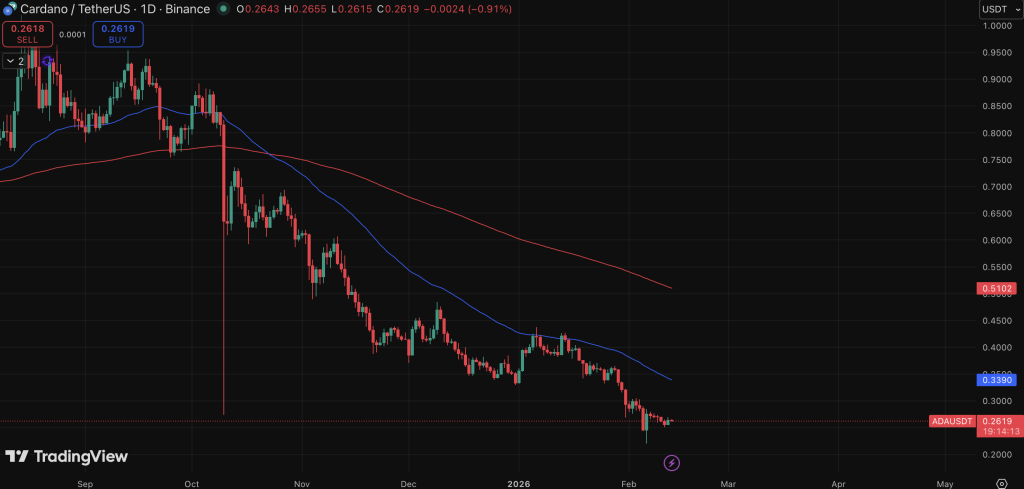
When you put everything together, ADA still looks vulnerable if Bitcoin breaks down again. The first downside level remains the recent low near $0.226. If fear spikes, the $0.20 zone becomes the next major line to watch, because that’s where the market could try to stabilize.
In a deeper washout scenario, ADA could even slide toward the $0.15 to $0.17 range before a true bottom forms. That’s not a prediction, it’s just the kind of downside space that opens up when Bitcoin loses control and altcoins get dragged into forced selling.
Cardano Still Has Real Catalysts, Even if Price Ignores Them
The frustrating part is that Cardano actually has meaningful catalysts lined up. Midnight is expected to launch before the end of March, LayerZero interoperability is now approved, and USDCx is on the way. Those upgrades could strengthen the ecosystem heading into Q2, and they matter for long-term positioning.
But until broader sentiment improves, downside targets remain firmly in play. Cardano’s fundamentals are improving, but price is still trapped in a market ruled by Bitcoin and fear.
For bulls, the first real recovery signal would be reclaiming $0.326 and holding above it. Until that happens, ADA remains in the zone where macro pressure and market fear can keep dragging it lower, even with major upgrades sitting right around the corner.