

- Bitcoin has broken out above $95,000 after nearly two months of tight consolidation
- A wave of short liquidations, nearing $250 million, fueled the breakout through key resistance
- Holding above $93,000 could shift the market toward a renewed push for six-figure prices
Bitcoin has finally broken free. After weeks of grinding sideways, BTC surged past the $95,000 mark, hitting its highest level in nearly two months and snapping a consolidation range that had capped price for what felt like forever.
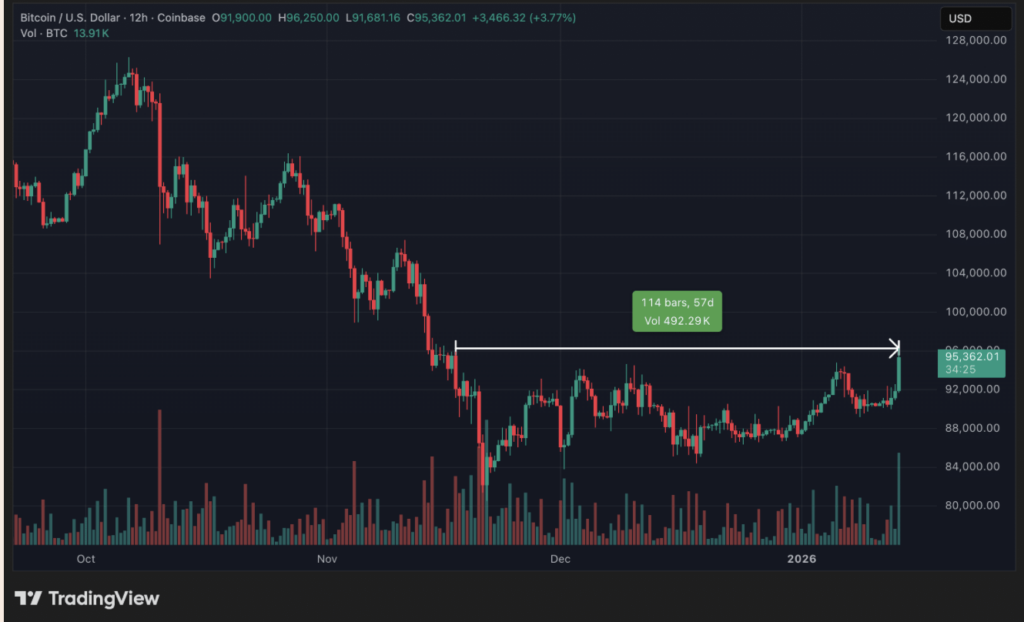
On the 12-hour TradingView chart, Bitcoin ran up to roughly $96,250 before cooling off slightly. At the time of writing, price was hovering near $95,360. That pullback looks more like a pause than a reversal, especially considering what just got cleared.
The key zone sat between $93,000 and $94,000. Bitcoin had been stuck below that range for about 57 days, or 114 twelve-hour candles, which makes this breakout structurally meaningful. This wasn’t a quick wick or a weekend fakeout. It was pressure building, then releasing.
Why This Breakout Had So Much Force
Long consolidation phases tend to act like pressure chambers. Positions stack up. Stops get layered. Leverage creeps in quietly. Both bulls and bears grow confident that the range will hold, until it doesn’t.
When price finally escapes, the move is rarely subtle.
That dynamic showed up clearly in Bitcoin’s latest surge. As BTC pushed above $93,000, the market didn’t just drift higher, it accelerated.
Short Liquidations Lit the Fuse
Data from Coinglass shows that a wave of forced short liquidations hit right as Bitcoin broke through resistance. In the 12-hour window surrounding the move, short liquidations surged to nearly $250 million. Long liquidations, by comparison, were minimal.
That imbalance tells a clear story. Bearish traders had piled in after weeks of sideways action, betting that the $93,000–$94,000 zone would keep holding. When Bitcoin pushed through it, stop-losses and margin calls kicked in almost instantly.
Short sellers were forced to buy back BTC at market price, which pushed price higher, triggering even more liquidations. That feedback loop, shorts buying into strength, is the textbook definition of a short squeeze. And it’s what helped propel Bitcoin toward, and through, $95,000.
The broader structure supports this view. After bottoming near $84,000 in late November, Bitcoin quietly began printing higher lows through December and early January. Even though price couldn’t break higher at first, selling pressure kept weakening. The range tightened until bulls finally overwhelmed the sell side.
Why $95,000 Is a Big Deal
Reclaiming $95,000 isn’t just a psychological milestone. It reshapes the technical map. The former ceiling around $93,000 now flips into first-line support, at least in theory.
Above current levels, the next meaningful resistance sits between $96,000 and $98,000. That area previously acted as a distribution zone before the November sell-off, so it’s likely to attract attention again.
If Bitcoin can hold above its breakout level, traders are more likely to treat this move as a genuine trend transition, not just a liquidation-driven spike. With a large portion of short exposure already flushed out and liquidity reset, follow-through buying becomes more likely.
If that happens, a retest of six-figure prices may not be far off.