
- XRP remains under pressure after a 45% drawdown, but institutional ETF inflows continue to build quietly.
- Whale behavior shows fading confidence short term, even as regulated products attract steady capital.
- A Japanese analyst believes regulatory clarity in 2026 could push XRP toward the 1,000-yen ($6.41) level.
XRP has spent months under pressure as crypto markets grind through a difficult phase. Price action has been uninspiring, confidence has thinned, and many traders have grown impatient. Still, not everyone believes this weakness tells the full story.
A well-followed Japanese financial commentator known as Angorou has put forward a longer-term view that cuts against the current mood. In his latest outlook, he argues that XRP could eventually climb to 1,000 yen, roughly $6.41 at today’s exchange rates, once broader structural changes fall into place.
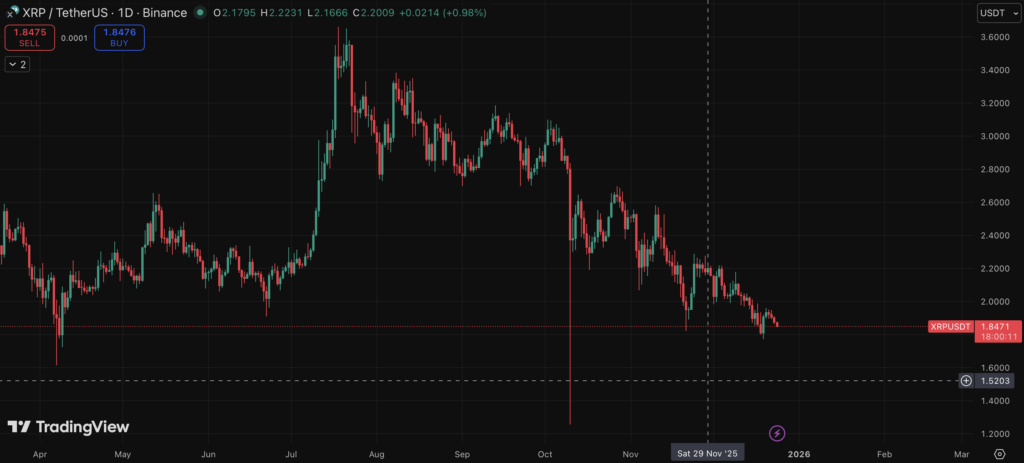
At the time of his analysis, XRP was trading near $1.99, or about 300 yen. Not impressive on the surface, sure. But Angorou believes the groundwork being laid now could matter far more heading into 2026.
How XRP Ended Up Here After the 2024–2025 Rollercoaster
Angorou starts by retracing XRP’s path since late 2024. Back in early November of that year, XRP traded around 75 yen.z
Things shifted quickly after Donald Trump’s U.S. election victory, which sparked expectations of regulatory change and possible leadership turnover at the SEC.
Those expectations mattered. Investors began pricing in a potential resolution to Ripple’s long-running legal issues, and XRP responded fast. By January 2025, the token had surged past 500 yen.
The rally didn’t last, though. A broader market correction, combined with tax-related selling, dragged XRP back into the 200-yen range. Later, momentum returned and pushed the token to a new high of 542 yen in July 2025.
That peak marked another turning point. From there, XRP slid steadily lower, falling to roughly 303 yen by the time Angorou published his commentary. That’s a drawdown of about 45% from the highs, leaving XRP looking weaker than many of its large-cap peers.
Whale Behavior Signals a Shift in Conviction
On-chain data plays a big role in Angorou’s thesis. He focused on wallets holding at least 1 million XRP, worth more than 300 million yen at current prices.
On November 6, 2024, there were 2,111 such addresses. As XRP rallied after the U.S. election, whale accumulation accelerated. Even after the July 2025 peak, large holders kept adding, pushing the number of whale wallets to a record 2,758 by October.
That trend didn’t hold. As prices fell sharply, whale participation reversed just as quickly. The count dropped to around 2,011 addresses, pointing to a clear shift in confidence. At the same time, Angorou noted signs that retail participation had also faded, adding more pressure during the decline.
Institutional Demand Refuses to Disappear
Despite weak price action and cooling on-chain signals, institutional interest tells a different story. In November, Canary Capital launched the first U.S.-listed spot XRP ETF. Since then, four more XRP-focused ETFs have entered the market.
What stands out is their consistency. These products haven’t seen a single day of net outflows since launch. From mid-November onward, they recorded 25 straight trading days of inflows, pushing total assets to roughly $1.07 billion, or about 169 billion yen.
That streak is longer than what was seen during the early phases of Bitcoin, Ethereum, or Solana ETF launches. To Angorou, that suggests institutions are positioning quietly, even while price remains under pressure.
Regulatory Clarity Could Be the Real Catalyst in 2026
Angorou ultimately believes regulation will decide XRP’s next major chapter. He pointed to proposed U.S. legislation aimed at clearly separating securities from commodities. Assets deemed commodities would fall under the CFTC, a regulator generally seen as less restrictive than the SEC.
Bitcoin already enjoys commodity status, and Ethereum appears to be moving in that direction as well. If XRP were to receive similar treatment, Angorou argues U.S. banks could adopt Ripple’s payment infrastructure without legal hesitation.
He also highlighted Ripple’s conditional approval to operate as a trust bank, which could expand its footprint inside regulated financial services.
To frame potential upside, Angorou looked at XRP’s historical valuation relative to Bitcoin. During periods of strong confidence, XRP’s ratio to BTC averaged around 0.169, with peaks reaching as high as 0.48. Throughout the SEC lawsuit, that ratio stayed deeply suppressed.
If regulatory clarity restores confidence and narrows that gap, Angorou estimates XRP could reach roughly 780 yen even if Bitcoin prices remain stable. And if legal reform aligns with Bitcoin climbing above 20 million yen, he believes XRP breaking the 1,000-yen mark in 2026 becomes a realistic scenario.
For now, XRP remains stuck in a frustrating phase. But in Angorou’s view, the pieces for a much larger shift are slowly, quietly lining up.